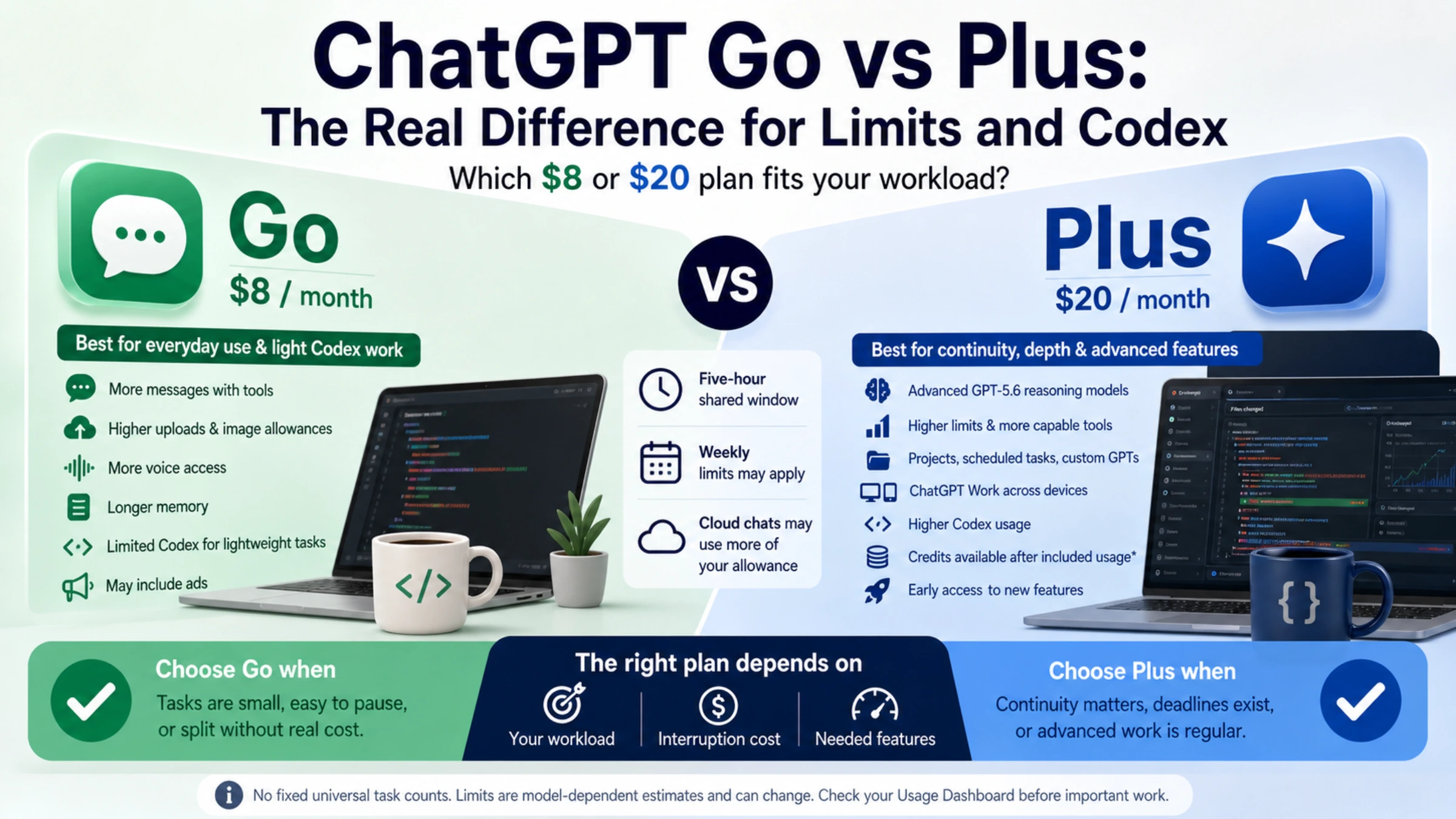
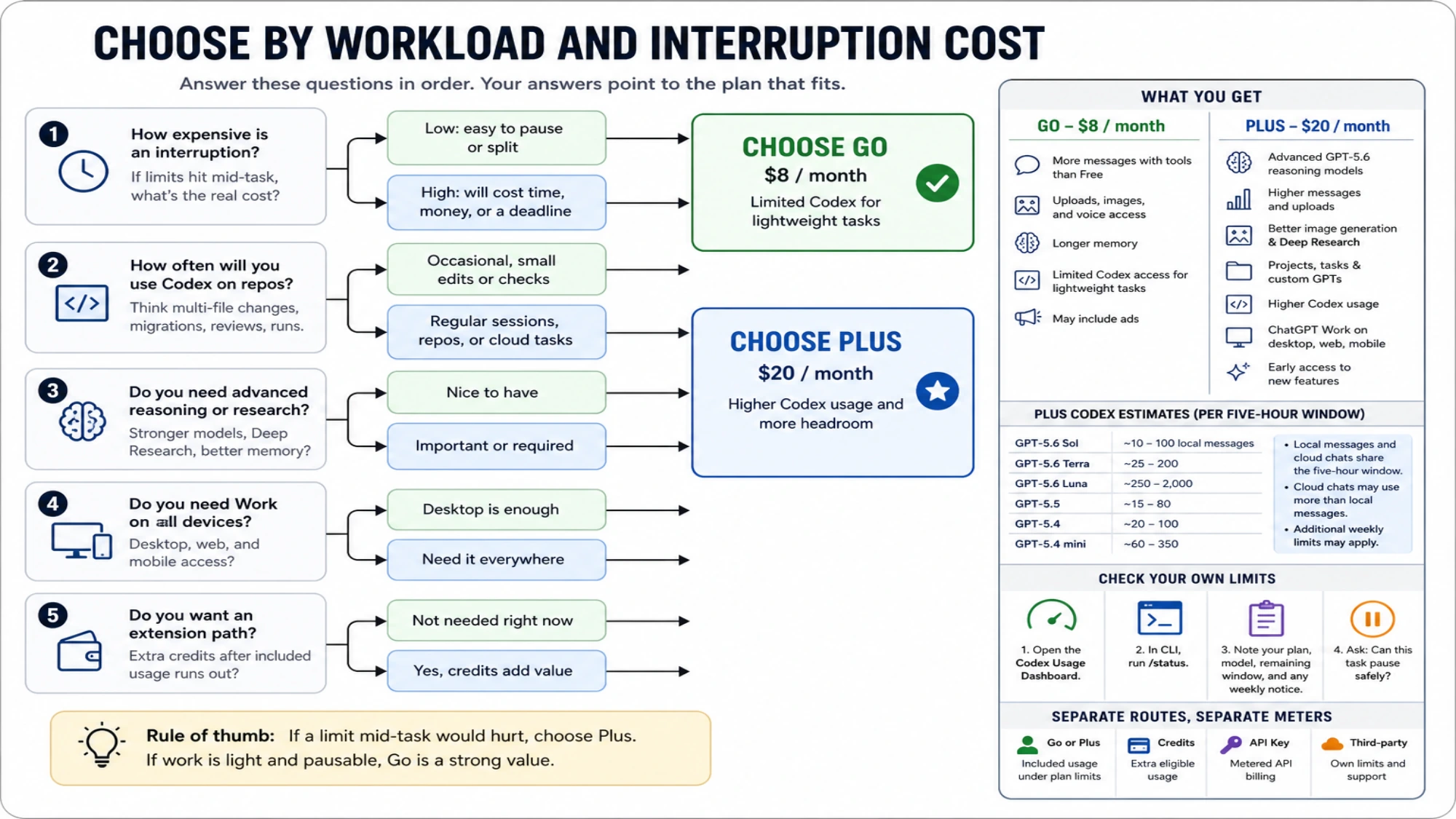
Go costs $8 per month and expands everyday use; Plus costs $20 per month and is the safer choice when advanced reasoning, regular Codex work, or an expensive interruption matters. Those are US list prices on OpenAI's Codex pricing page as of September 12, 2026; tax, currency, store billing, and availability can change what your checkout shows.
There is no honest universal answer such as “Go gets exactly X Codex tasks.” OpenAI currently labels Go's Codex access as limited but does not publish a stable Go-specific message table. Plus has published model-dependent estimates, yet those are ranges—not a promise that a repository migration will last a certain number of hours.
What the extra $12 buys
Go is a meaningful step above Free. The current ChatGPT plan comparison says Go adds more messages with tools, higher upload and image allowances, more voice access, and longer memory. It may include ads. For someone who mostly chats, studies, drafts, analyzes occasional files, or uses Codex for small checks, that can be the right stopping point.
Plus includes everything in Go and changes the ceiling as well as the feature set. OpenAI currently lists these material additions:
- advanced reasoning with GPT-6 Astra and the GPT-5.6 family;
- higher message and upload limits;
- more capable image generation;
- enhanced Deep Research;
- stronger memory and context support;
- scheduled tasks and custom GPTs;
- higher Codex usage;
- ChatGPT Work on desktop, web, and mobile instead of limited desktop access;
- early access to new features.
Projects are also listed on Free, so access to projects alone is not a reason to buy Plus. Compare the specific feature and allowance you need.
That list creates two different buying tests. If you only need more of the everyday ChatGPT experience, Go may be enough. If a missing capability—or a mid-task limit—would stop paid work, the additional Plus headroom matters more than the price difference.
“Limited Codex” is a workload warning, not a task count
Both plans include a route into Codex, but the official positioning is different: Go is for lightweight coding tasks, while Plus is meant for a few focused coding sessions each week. The current public documentation does not turn “lightweight” into a durable Go quota.
That omission matters because Codex messages do not cost the same amount of included usage. A short request against one file can consume far less than a cloud task that reads a repository, holds a large context, calls tools, searches documentation, edits multiple files, and runs tests. Model choice, reasoning, context, retrieval, caching, and task complexity all affect consumption.
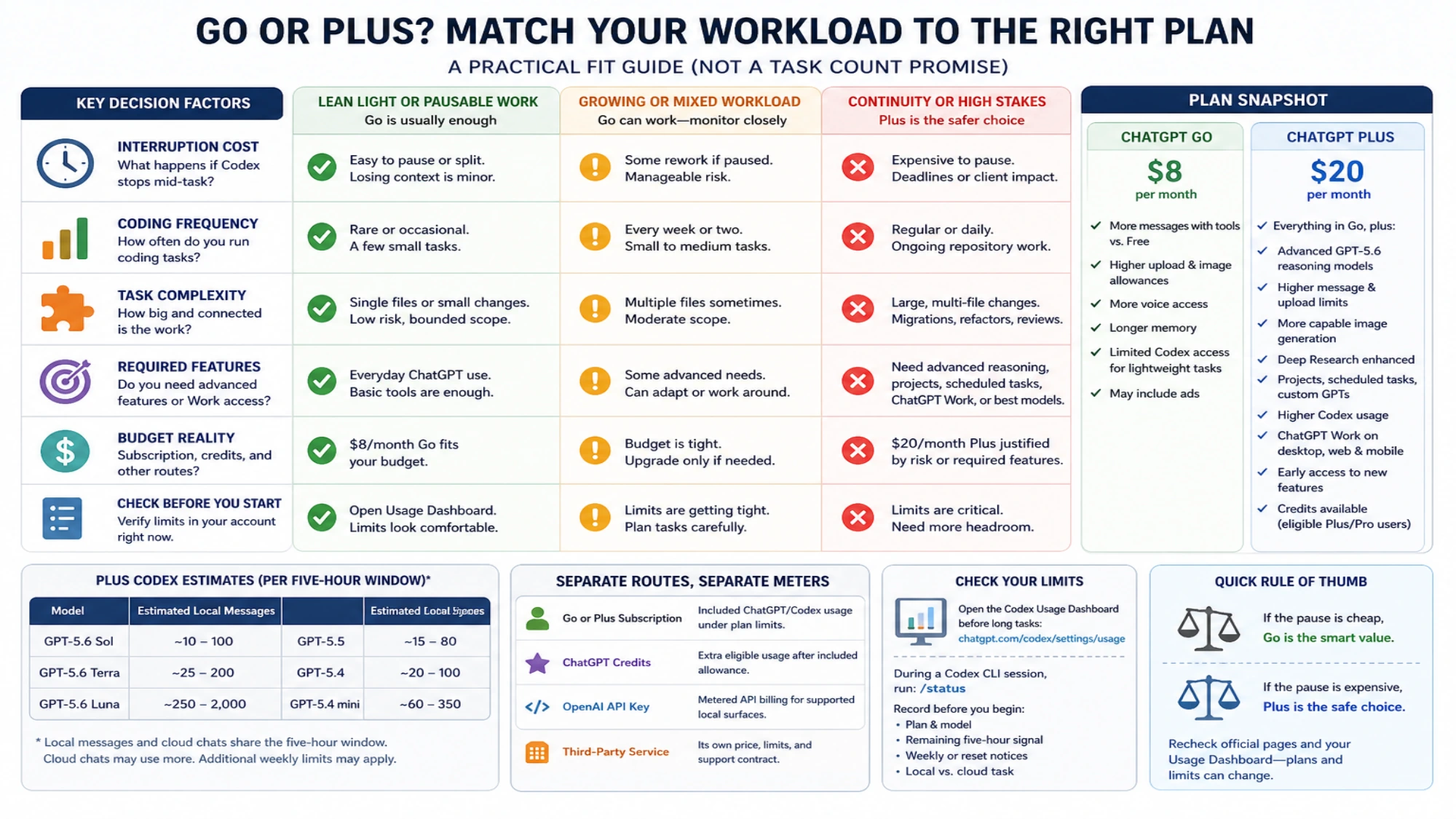
Treat Go as suitable when the work is easy to pause or split:
- explaining a diff or error;
- checking a small file;
- proposing a bounded refactor;
- learning a codebase feature;
- making occasional low-risk edits.
Treat Plus as the safer starting point when continuity has value:
- regular repository work;
- multi-file changes and migrations;
- repeated code review;
- cloud tasks and connected workflows;
- work tied to a deadline;
- any task where rebuilding context after a limit would cost more than the subscription difference.
This is a risk rule, not a hidden benchmark. Reducing unnecessary context and choosing a suitable model can make Plus last longer, and a single unusually large task can consume more than many small tasks.
The current Plus estimates, with the qualifiers attached
OpenAI publishes estimated local messages per five-hour window for Plus. As of September 12, 2026, the official usage-limit table shows:
- GPT-6 Astra: about 5–45;
- GPT-5.6 Sol: about 10–100;
- GPT-5.6 Terra: about 25–200;
- GPT-5.6 Luna: about 250–2,000;
- GPT-5.5: about 15–80;
- GPT-5.4: about 20–100;
- GPT-5.4 mini: about 60–350.
These estimates suggest how much model choice can affect usage. Astra and Sol are candidates for demanding work, Terra for everyday production tasks, and Luna for lighter, higher-volume work. Each still consumes the shared allowance. Switching models can be a sensible way to save the strongest model for the few turns that genuinely need it.
Three qualifiers prevent the table from becoming misleading:
- Local messages and cloud chats share the five-hour window on ChatGPT plans.
- Cloud chats may use more of the allowance than local messages.
- Additional weekly limits may apply. ChatGPT Work also shares Codex usage, so work in that product can affect the same allowance.
The range therefore cannot tell you how many pull requests, files, or coding hours you will get. It can tell you that model choice and task shape materially change how quickly the plan is consumed.
OpenAI does not publish an equivalent stable Go table on the checked pricing page. A fixed Go-to-Plus percentage from a forum post or screenshot may describe one account at one moment, but it is not a plan-wide promise.
Check the meter before the work becomes expensive
The most reliable limit is the one attached to your account now. Open the Codex Usage Dashboard before a long task. During an active Codex CLI session, /status shows remaining limits.
Record four things before committing Codex to important work:
- the plan and model;
- the remaining five-hour allowance;
- any weekly or reset notice;
- whether the task will run locally or in the cloud.
Then ask: Can this task pause safely? Go can be an efficient choice for light, occasional work that can wait. For time-sensitive work, Plus offers more headroom and eligible paid continuation, but it can still reach a limit. Keep a recovery plan on either subscription.
Saving task context outside a single session also helps on either plan. Keep the intended outcome, current state, changed files, test command, and unresolved issues in the repository or task notes. That does not increase the quota, but it reduces the cost of a pause.
Credits and API keys are separate routes
Plus has another advantage after included usage runs out: OpenAI says eligible Plus and Pro users can purchase additional ChatGPT credits to continue. This is an extension path, not proof that Plus is unlimited or that every account sees the same purchase options.
An OpenAI API key connects Codex to separate API billing. It can fund local Codex work in the CLI, SDK, or IDE extension at API token rates. It does not refill the Go or Plus meter, and the API-key route does not include plan-owned cloud features such as GitHub code review or Slack integration.
Keep the routes separate when estimating cost:
- Go or Plus subscription: included ChatGPT/Codex usage under plan limits;
- ChatGPT credits: extra eligible usage after the included allowance;
- API key: metered API billing for supported local clients;
- third-party service: its own prices, limits, and support terms.
Paying for one route does not silently grant capacity in another.
Choose Go when the pause is cheap; choose Plus when it is not
Go is the stronger value when your main goal is more everyday ChatGPT use, you can accept limited Codex access, and coding tasks are small enough to stop or split. It is also a reasonable first paid plan if you do not yet know whether Codex will become a regular tool.
Plus is the better fit when you need advanced reasoning or enhanced research, need scheduled work, rely on ChatGPT Work across devices, or expect Codex to operate on repositories repeatedly. Its published ranges and credit extension path provide more planning headroom, even though they do not remove all limits.
If you are still unsure, start with the failure mode rather than an imagined daily message total. A temporary pause during a hobby task is inconvenient. A pause in the middle of a client migration, release review, or deadline-driven fix is a real cost. That difference usually identifies the right plan faster than a stale quota chart.
Recheck the official pricing page and your Usage Dashboard at purchase time. Plan features and limit ranges can change; your workload and tolerance for interruption are the stable parts of the decision.