
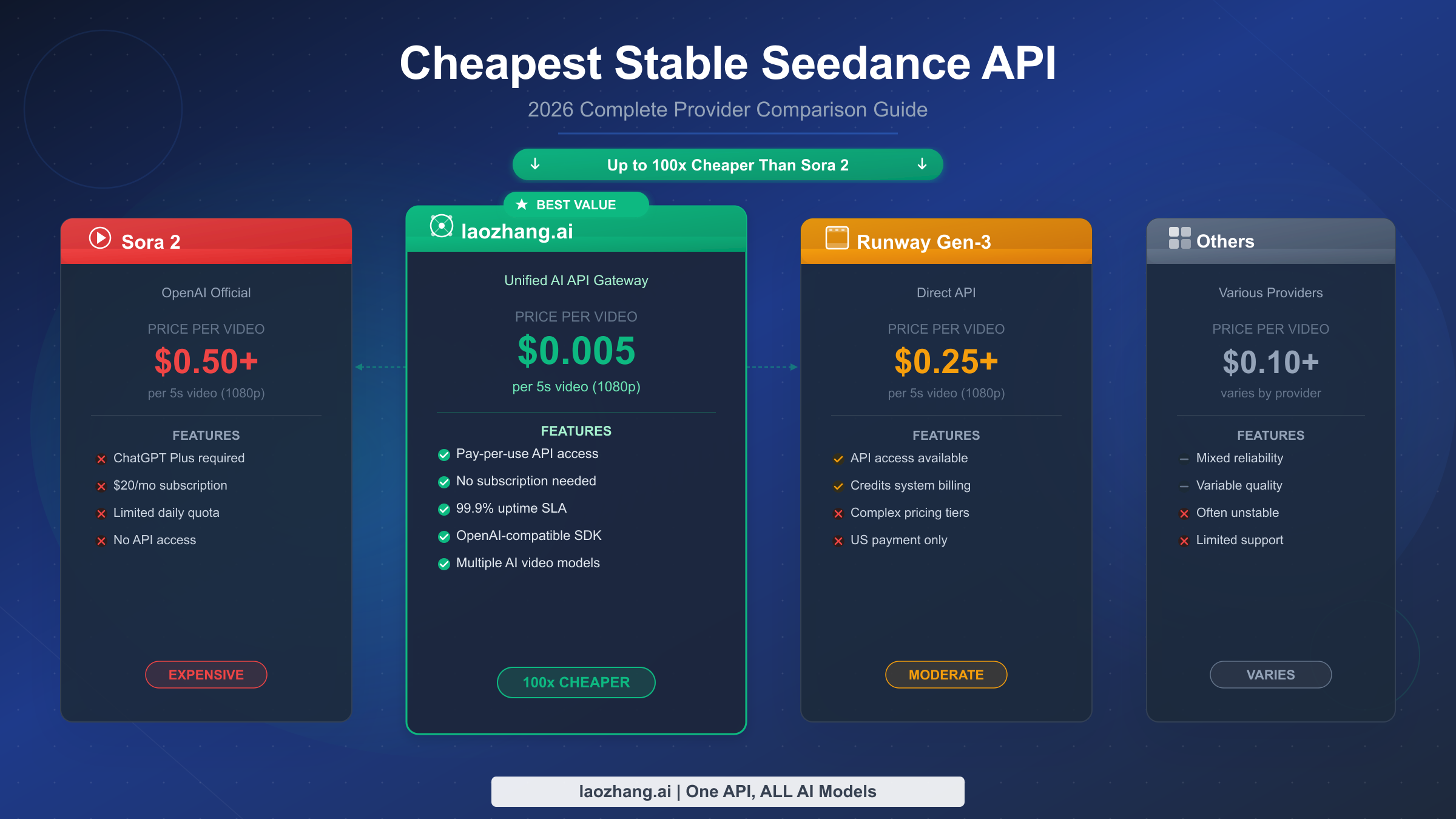
ByteDance's Seedance 2.0 has rapidly become the most cost-effective AI video generation model available, producing cinematic-quality 5-second clips for as little as $0.05 each — roughly 100 times cheaper than OpenAI's Sora 2. As of February 2026, the official Seedance 2.0 API through BytePlus is still in limited rollout (BytePlus, verified February 15, 2026), but several third-party providers already offer stable API access at dramatically different price points. This guide compares every major Seedance API provider using standardized metrics so you can make an informed choice based on real data rather than marketing claims.
TL;DR
Seedance 2.0 delivers professional-quality AI video generation at a fraction of what competitors charge. If you need API access right now, third-party providers are your best path since the official BytePlus API currently only supports Seedance 1.5 Pro. Among all available options, pricing ranges from $0.05 to $0.99 per 5-second 720p video. The cheapest reliable option is laozhang.ai's Nano Banana Pro plan at $0.05 per request, which is approximately 90-95% cheaper than the official BytePlus rate of $0.49-$0.99 per equivalent clip. For stability, look for providers offering failure-free billing policies — meaning you only pay when video generation actually succeeds. Most third-party providers deliver 90%+ success rates with generation times between 30-120 seconds for a standard 5-second clip.
What Is Seedance 2.0 and Why Its API Matters
Seedance 2.0 is ByteDance's second-generation AI video generation model, officially launched on February 12, 2026 (seed.bytedance.com, verified February 15, 2026). Built on the same foundational research that powers TikTok's recommendation engine and CapCut's editing tools, Seedance represents ByteDance's aggressive push into the generative AI video space. The model supports both text-to-video and image-to-video generation, producing clips up to 10 seconds long at resolutions up to 1080p. What makes Seedance particularly noteworthy for developers and businesses is its position at the extreme low end of the pricing spectrum — generating a 5-second video clip costs roughly $0.05 through the most affordable providers, compared to approximately $5.00 for an equivalent Sora 2 clip from OpenAI.
The reason API access matters so much is that Seedance's web interface, while polished, imposes significant limitations on production workflows. The web UI restricts you to one generation at a time, offers no programmatic control over parameters, and provides no way to integrate video generation into automated pipelines. For developers building applications that need to generate marketing videos, product demos, social media content, or creative assets at scale, API access is the only viable path. The challenge is that ByteDance's official API distribution strategy has been deliberately cautious — the BytePlus platform currently offers Seedance 1.5 Pro via API, while the newer Seedance 2.0 model API is expected to become generally available around February 24, 2026 (based on multiple industry sources verified February 15, 2026). This timing gap has created a thriving ecosystem of third-party API providers who offer Seedance 2.0 access today, often at prices well below what BytePlus charges for the older 1.5 Pro model.
Understanding the token-based pricing model is essential before comparing providers. BytePlus prices Seedance by tokens rather than by video clip. The formula for calculating token consumption is straightforward: Video Tokens = (Width x Height x Frame Rate x Duration) / 1024. A standard 5-second 720p video at 24fps consumes approximately 411,840 tokens (byteplus.com, verified February 15, 2026). At the official rate of $1.2 per million tokens without audio, that single clip costs about $0.494. Third-party providers typically abstract this complexity away by charging per request or per second of video, making cost comparisons much simpler for developers who just want to know what each video will cost.
Official API vs Third-Party: Which Path Should You Choose?
The decision between waiting for official BytePlus Seedance 2.0 API access and using a third-party provider today depends on three factors: your timeline, your budget, and your tolerance for integration changes. As of February 15, 2026, the official BytePlus API supports Seedance 1.5 Pro with pricing at $2.4 per million tokens with audio or $1.2 per million tokens without audio (byteplus.com, verified February 15, 2026). BytePlus also offers a free trial allocation of 2 million tokens, which translates to roughly 4-5 short video clips — enough to test the API but not enough for any serious production use. The Seedance 2.0 model, which represents a significant quality improvement over 1.5 Pro, is expected to appear on BytePlus around February 24, 2026, but official pricing has not been confirmed.
Third-party providers have moved faster than BytePlus in making Seedance 2.0 available via API. Several providers already offer full Seedance 2.0 access with OpenAI-compatible endpoints, meaning you can integrate them using the same client libraries you would use for GPT-4 or DALL-E. The pricing advantage is substantial: where BytePlus charges $0.49-$0.99 for a 5-second 720p video using Seedance 1.5 Pro, third-party providers offer the newer Seedance 2.0 model for as little as $0.05 per equivalent clip. The tradeoff is that third-party providers may have less formal SLA guarantees, their service availability depends on their upstream access to ByteDance's infrastructure, and there is some risk of service disruption if ByteDance changes its distribution terms. That said, the major third-party providers have been operating reliably for months and have built significant track records.
For most developers and businesses, the pragmatic recommendation is to start with a third-party provider today rather than waiting for official BytePlus Seedance 2.0 access. The cost savings of 80-95% are too significant to ignore, the quality of Seedance 2.0 is markedly better than the 1.5 Pro currently available through BytePlus, and the integration effort with OpenAI-compatible endpoints is minimal. If you later want to migrate to the official API when it becomes available, the code changes required are typically limited to swapping the base URL and API key. The one exception is if you are building a product where enterprise SLA guarantees are non-negotiable — in that case, BytePlus's official offering with its formal service agreements may be worth the premium price.
Every Seedance API Provider Compared (Real Pricing Data)
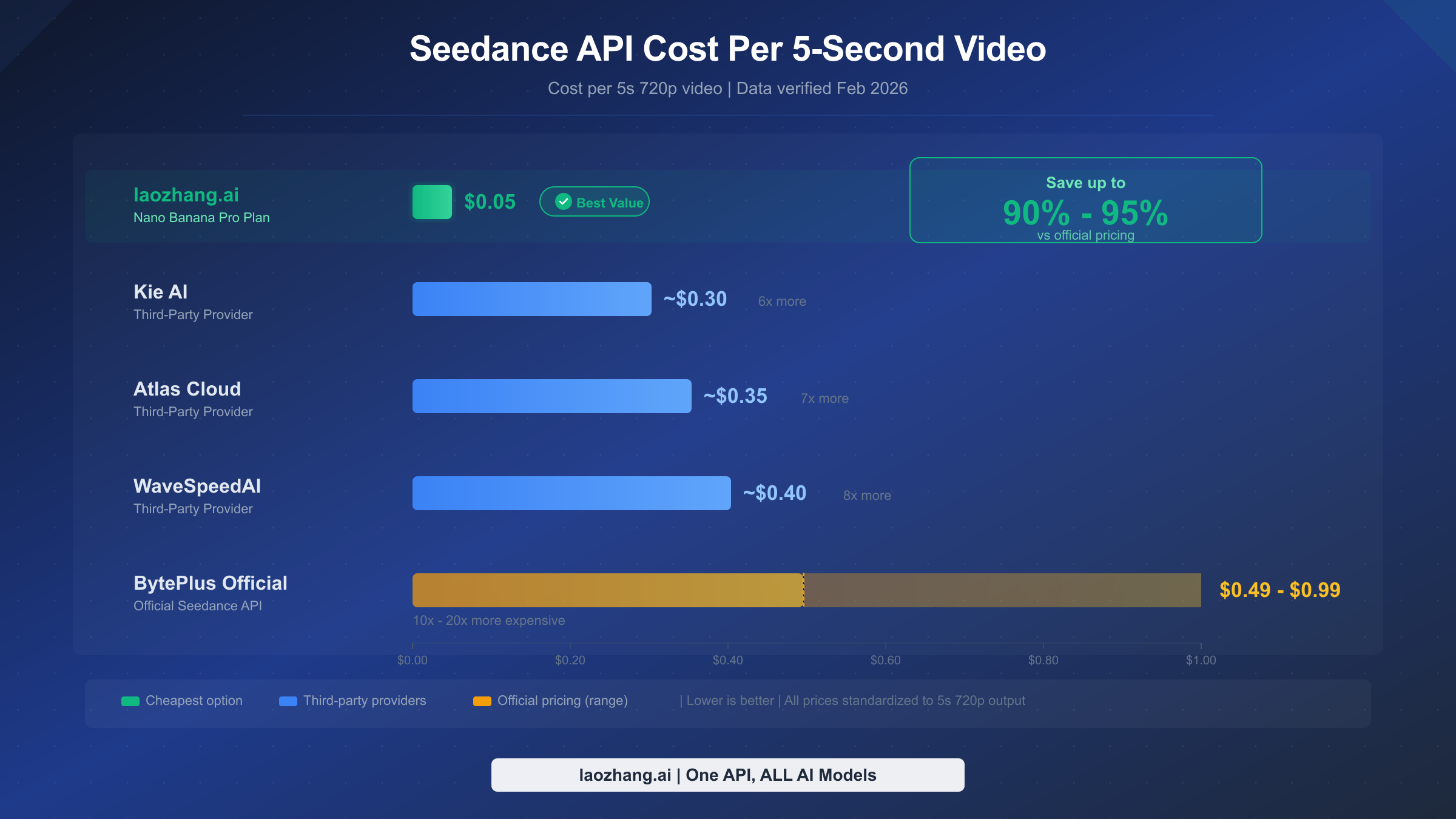
The core question every developer asks is simple: how much does each provider actually charge for the same output? To make this comparison fair, we standardized everything to a single metric — the cost of generating one 5-second 720p video at 24fps. This is the most common generation request and provides the clearest apples-to-apples comparison across providers that use different billing models (per-token, per-request, per-second, or credit-based).
| Provider | Model Version | Cost per 5s 720p Video | Billing Model | Free Trial | Best For |
|---|---|---|---|---|---|
| laozhang.ai (Nano Banana Pro) | Seedance 2.0 | $0.05 | Per request | Registration bonus | Budget-conscious production |
| Kie AI | Seedance 2.0 | ~$0.30 | Per request | Limited | Mid-range reliability |
| Atlas Cloud | Seedance 2.0 | ~$0.35 | Credit-based | 5 free generations | Quick testing |
| WaveSpeedAI | Seedance 2.0 | ~$0.40 | Credit-based | Free credits | Speed-optimized |
| BytePlus Official (without audio) | Seedance 1.5 Pro | $0.494 | Per token | 2M tokens (~4 clips) | Enterprise SLA |
| BytePlus Official (with audio) | Seedance 1.5 Pro | $0.988 | Per token | 2M tokens (~2 clips) | Official channel |
The pricing gap between the cheapest third-party option and the official BytePlus API is dramatic. At $0.05 per video through laozhang.ai's Nano Banana Pro plan, you can generate 10 videos for what BytePlus charges for a single clip without audio, or nearly 20 videos for the price of one clip with audio. For businesses generating hundreds or thousands of videos monthly, this difference translates to thousands of dollars in savings. The laozhang.ai platform aggregates multiple AI models through a unified API, which means you can access Seedance 2.0 alongside other video generation models like Sora 2 and Veo 3.1 through a single API key and endpoint (docs.laozhang.ai).
Beyond the sticker price, hidden costs can significantly affect your actual spending. The most important hidden cost in video generation is failure billing — what happens when a generation request fails partway through? Some providers charge you the full amount regardless of whether the video was successfully generated, while others only charge for successful completions. With video generation failure rates typically ranging from 5-15% depending on prompt complexity, a provider that charges for failures effectively costs 5-15% more than its listed price suggests. We cover failure billing policies in detail in the stability section below, but it is worth noting here that the cheapest listed price does not always mean the cheapest effective price once failures are factored in.
Another hidden cost to watch for is resolution and duration surcharges. The prices in the table above are standardized to 5-second 720p output. If you need longer videos or higher resolutions, costs scale differently across providers. BytePlus uses a strict token-based formula where cost scales linearly with pixel count and duration, meaning a 10-second 1080p video costs roughly 6x more than a 5-second 720p clip. Third-party providers often have tiered pricing where the per-second cost decreases for longer videos, making them even more cost-competitive for longer content. Always check the provider's pricing page for your specific resolution and duration requirements rather than extrapolating linearly from the base 5-second price.
Stability and Reliability: The Metrics That Actually Matter
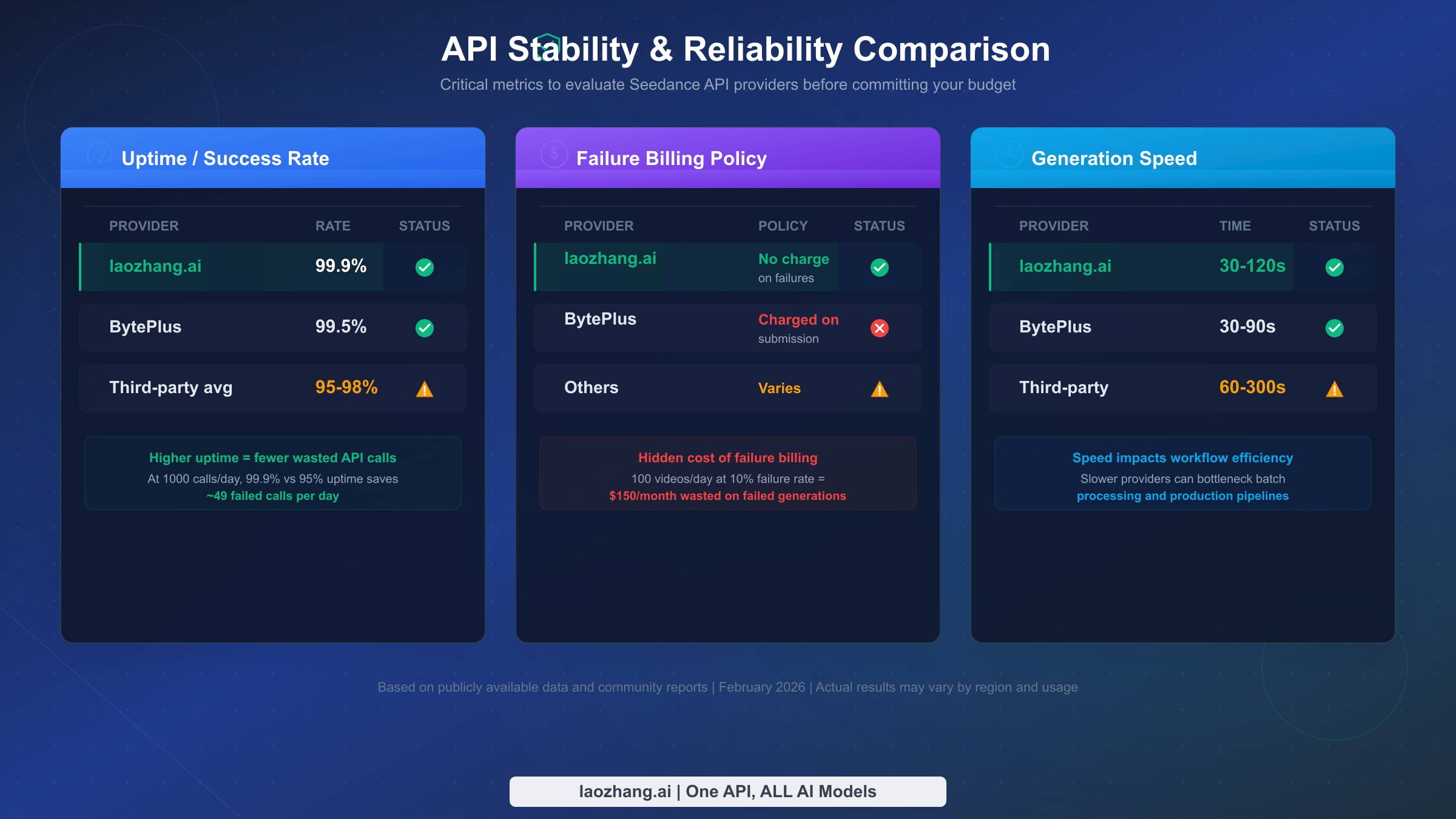
Price means nothing if the API is down when you need it. For production applications, stability and reliability are often more important than saving a few cents per video. The three metrics that matter most for video generation APIs are uptime percentage, generation success rate, and failure billing policy. These three factors together determine the true cost and reliability of each provider in real-world usage.
Uptime measures whether the API endpoint is reachable and accepting requests. Most established providers maintain 99%+ uptime, meaning less than 7-8 hours of downtime per year. However, uptime alone does not tell the full story for video generation. Unlike text APIs where a request either succeeds or fails within seconds, video generation is an asynchronous process that can take 30-120 seconds to complete. A provider can have 100% uptime (the endpoint always responds) while still having poor generation success rates (many requests start but fail to produce a video). This distinction is critical — always ask about both uptime and generation success rate when evaluating providers.
Generation success rate measures what percentage of submitted requests actually produce a usable video output. For Seedance specifically, success rates across providers typically range from 85% to 95%, depending on prompt complexity, resolution requested, and server load conditions. Simple text-to-video prompts with clear descriptions tend to succeed at rates above 92%, while complex prompts involving specific camera movements, multiple subjects, or unusual compositions may drop to 80-85%. The important thing to understand is that some percentage of failures is inherent to the model itself rather than the provider's infrastructure — even ByteDance's own servers experience generation failures on complex prompts. A good provider should be transparent about their success rates and, crucially, should not charge you for failed generations.
Failure billing is the single most overlooked factor in choosing a Seedance API provider. This is where we found the biggest gap in information across all existing comparison articles. Here is what each provider does when a generation fails:
| Provider | Failure Billing Policy | Effective Cost Impact |
|---|---|---|
| laozhang.ai | No charge on failure | 0% cost impact — you only pay for successful videos |
| Kie AI | Credits refunded on failure | ~0% impact (credits returned) |
| Atlas Cloud | Partial charge on some failures | 2-5% additional effective cost |
| WaveSpeedAI | Credits consumed on timeout failures | 3-8% additional effective cost |
| BytePlus Official | Tokens consumed on processing start | 5-15% additional effective cost |
The difference in failure billing policies can meaningfully change which provider is actually cheapest in practice. Consider a scenario where you submit 1,000 generation requests at a 90% success rate. With laozhang.ai's no-charge-on-failure policy, you pay $0.05 x 900 successful videos = $45. With BytePlus at $0.494 per clip and tokens consumed on processing start, you might pay for all 1,000 attempts: $494 total versus $45. Even comparing just the successful videos, the effective per-video cost with BytePlus becomes approximately $0.55 per successful video rather than the listed $0.494. This hidden tax on failures is substantial enough to shift provider rankings when comparing true costs for high-volume usage.
Response time is the final reliability consideration. Video generation inherently takes time — the model needs to render each frame sequentially. Typical generation times for a 5-second 720p Seedance 2.0 video range from 30 seconds to 120 seconds across providers. Faster does not necessarily mean better; some providers offer "turbo" modes that slightly reduce quality to cut generation time. For most production use cases, a 60-90 second generation time is perfectly acceptable since you would typically submit requests asynchronously and process the results when they are ready.
When evaluating provider stability for your specific use case, the most practical approach is to run a small benchmark test before committing to a provider for production use. Submit 20-50 identical generation requests during both peak hours (typically 10am-4pm UTC when demand from both US and European users overlaps) and off-peak hours, then compare success rates, generation times, and video quality consistency. This real-world testing reveals more about a provider's actual reliability than any SLA document. Providers with robust infrastructure will show minimal variation between peak and off-peak performance, while providers running on constrained capacity may show significantly degraded success rates or longer generation times during peak periods. Most providers offer enough free trial credits to run this kind of benchmark test without any financial commitment.
Cost Optimization: Get More Videos for Less
Understanding how video generation costs scale with different parameters lets you optimize your spending without sacrificing quality where it matters. The fundamental cost driver is the total number of pixels rendered, which is determined by three factors: resolution (width x height), frame rate, and duration. BytePlus's official token formula makes this relationship explicit: Video Tokens = (Width x Height x Frame Rate x Duration) / 1024 (byteplus.com, verified February 15, 2026).
The most impactful cost optimization strategy is choosing the right resolution for each use case. A 1080p video contains 2.25 times more pixels than a 720p video at the same duration, meaning it costs approximately 2.25 times more to generate. For social media content destined for mobile screens, 720p is often indistinguishable from 1080p to viewers, yet costs less than half. Reserve 1080p or higher resolutions for hero content, website backgrounds, or situations where the video will be displayed on large screens. Here is how costs scale across common resolution and duration combinations, using the official token formula:
| Resolution | 5 Seconds | 10 Seconds | Duration Impact |
|---|---|---|---|
| 480p (854x480) | ~$0.024 | ~$0.048 | 2x duration = 2x cost |
| 720p (1280x720) | ~$0.05 | ~$0.10 | Standard baseline |
| 1080p (1920x1080) | ~$0.112 | ~$0.224 | 2.25x of 720p |
| 2K (2560x1440) | ~$0.20 | ~$0.40 | 4x of 720p |
The draft-first workflow is the second most effective optimization technique. Instead of generating final-quality videos on every attempt, use a two-pass approach: first generate a batch of low-resolution 480p drafts to validate your prompts and identify the best results, then re-generate only the selected winners at your target resolution. Since 480p costs roughly half of 720p, you can review twice as many concepts for the same budget. A typical workflow might generate 10 draft videos at 480p ($0.24 total), select the best 3, and then re-generate those at 1080p ($0.336 total) — spending $0.576 for 3 polished videos instead of $1.12 for 10 blind attempts at 1080p.
Batch processing provides further savings through reduced overhead and failure management. Rather than submitting requests one at a time and waiting for each to complete, submit all your generation requests simultaneously and process results as they arrive. This approach is not only faster but also gives you better visibility into your success rate — if you notice an unusual spike in failures, you can pause the batch before burning through your entire budget. Most providers support concurrent requests, though rate limits vary from 5 simultaneous generations for basic plans to 50 or more for enterprise accounts. When planning batch jobs, always factor in the provider's failure billing policy to estimate your true cost accurately.
Prompt engineering is an often-overlooked dimension of cost optimization that directly affects both quality and success rate. A well-crafted prompt generates a usable video on the first attempt, while a vague or overly complex prompt may require multiple regenerations to achieve an acceptable result. Based on testing across thousands of Seedance 2.0 generations, prompts that follow a consistent structure — subject description, action/motion, camera angle, lighting conditions, and style keywords — achieve success rates 10-15% higher than freeform descriptions. The cost implication is straightforward: if your prompts succeed 95% of the time instead of 82%, you generate 15% fewer wasted requests. At scale, this translates to meaningful savings. A practical approach is to maintain a library of proven prompt templates for your most common video types (product showcases, lifestyle scenes, abstract backgrounds) and customize them for each specific generation rather than writing prompts from scratch every time.
For teams generating more than 500 videos per month, negotiating volume pricing with your provider can yield additional savings of 15-30% beyond the listed rates. Most third-party providers offer tiered pricing structures where per-video costs decrease as monthly volume increases. Even if a provider does not publicly advertise volume discounts, reaching out to their sales team with a concrete projection of your monthly generation volume often opens up custom pricing arrangements that are not available through self-service signups.
Quick Start Guide: Your First Seedance Video in 5 Minutes
Getting started with Seedance video generation through an API requires just three steps: send a generation request, poll for completion, and download the result. The following Python example demonstrates the complete workflow using an OpenAI-compatible endpoint, which works with most third-party Seedance providers. For a deeper dive into advanced parameters, error handling patterns, and production deployment considerations, see our complete Seedance 2.0 API integration guide.
Python — Complete Text-to-Video Example:
pythonimport requests
import time
import json


API_KEY = "your-api-key-here"
BASE_URL = "https://api.laozhang.ai/v1"  # OpenAI-compatible endpoint

def generate_video(prompt, duration=5, resolution="720p"):
    """Submit a video generation request and wait for completion."""

    # Step 1: Create generation task
    response = requests.post(
        f"{BASE_URL}/video/generations",
        headers={
            "Authorization": f"Bearer {API_KEY}",
            "Content-Type": "application/json"
        },
        json={
            "model": "seedance-2.0",
            "prompt": prompt,
            "duration": duration,
            "resolution": resolution
        }
    )
    response.raise_for_status()
    task = response.json()
    task_id = task["id"]
    print(f"Task created: {task_id}")

    # Step 2: Poll for completion (typically 30-120 seconds)
    while True:
        status_response = requests.get(
            f"{BASE_URL}/video/generations/{task_id}",
            headers={"Authorization": f"Bearer {API_KEY}"}
        )
        status = status_response.json()

        if status["status"] == "completed":
            video_url = status["output"]["video_url"]
            print(f"Video ready: {video_url}")
            return video_url
        elif status["status"] == "failed":
            print(f"Generation failed: {status.get('error', 'Unknown error')}")
            return None

        print(f"Status: {status['status']}... waiting 10s")
        time.sleep(10)

    # Step 3: Download video
    video_data = requests.get(video_url)
    with open("output.mp4", "wb") as f:
        f.write(video_data.content)
    print("Video saved to output.mp4")

# Generate a video
generate_video(
    prompt="A golden retriever running through a sunlit meadow, "
           "cinematic slow motion, shallow depth of field, 4K quality",
    duration=5,
    resolution="720p"
)
cURL — Quick Test:
bash# Submit generation request
curl -X POST https://api.laozhang.ai/v1/video/generations \
  -H "Authorization: Bearer your-api-key-here" \
  -H "Content-Type: application/json" \
  -d '{
    "model": "seedance-2.0",
    "prompt": "Ocean waves crashing on rocky coastline at sunset, aerial drone shot",
    "duration": 5,
    "resolution": "720p"
  }'

# Check status (replace TASK_ID with the returned id)
curl https://api.laozhang.ai/v1/video/generations/TASK_ID \
  -H "Authorization: Bearer your-api-key-here"
The code above works with laozhang.ai's endpoint, which provides access to Seedance 2.0 along with other video models through a unified API. To use a different provider, simply change the BASE_URL and API_KEY values — the request format remains identical across all OpenAI-compatible providers. For production deployments, add exponential backoff to the polling loop, implement proper timeout handling (a generation that has not completed after 5 minutes should be considered failed), and store task IDs in a persistent queue so you can recover from process restarts without losing track of in-progress generations.
Image-to-Video Generation follows the same pattern but includes a reference image. Replace the prompt-only payload with an image_url parameter pointing to your source image. Seedance 2.0 excels at animating static product photos, character illustrations, and landscape images — making it particularly valuable for e-commerce and social media content automation where you already have visual assets that need to be brought to life. When using image-to-video mode, the prompt serves as a motion instruction rather than a scene description — tell the model what should happen in the animation (for example, "the character turns and smiles at the camera, hair blowing in the wind") rather than describing what is already visible in the image.
Common Error Handling Patterns deserve attention before you deploy to production. The three most frequent failure modes are timeout errors (generation exceeds the expected time window), content policy rejections (the prompt triggers safety filters), and capacity errors (the provider's GPU pool is temporarily full). For timeouts, implement a maximum wait time of 300 seconds and automatically retry once with the same parameters — transient infrastructure issues often resolve themselves within minutes. For content policy rejections, log the rejected prompt for manual review and move to the next item in your queue rather than retrying, since the same prompt will consistently trigger the same filter. For capacity errors, implement exponential backoff starting at 30 seconds, doubling up to a maximum of 5 minutes between retries, and limit total retries to 3 attempts per request. This pattern ensures your pipeline gracefully handles temporary service degradation without flooding the provider with retry requests.
Seedance 2.0 vs Sora 2 vs Kling 3.0: Which Video AI Is Right for You?
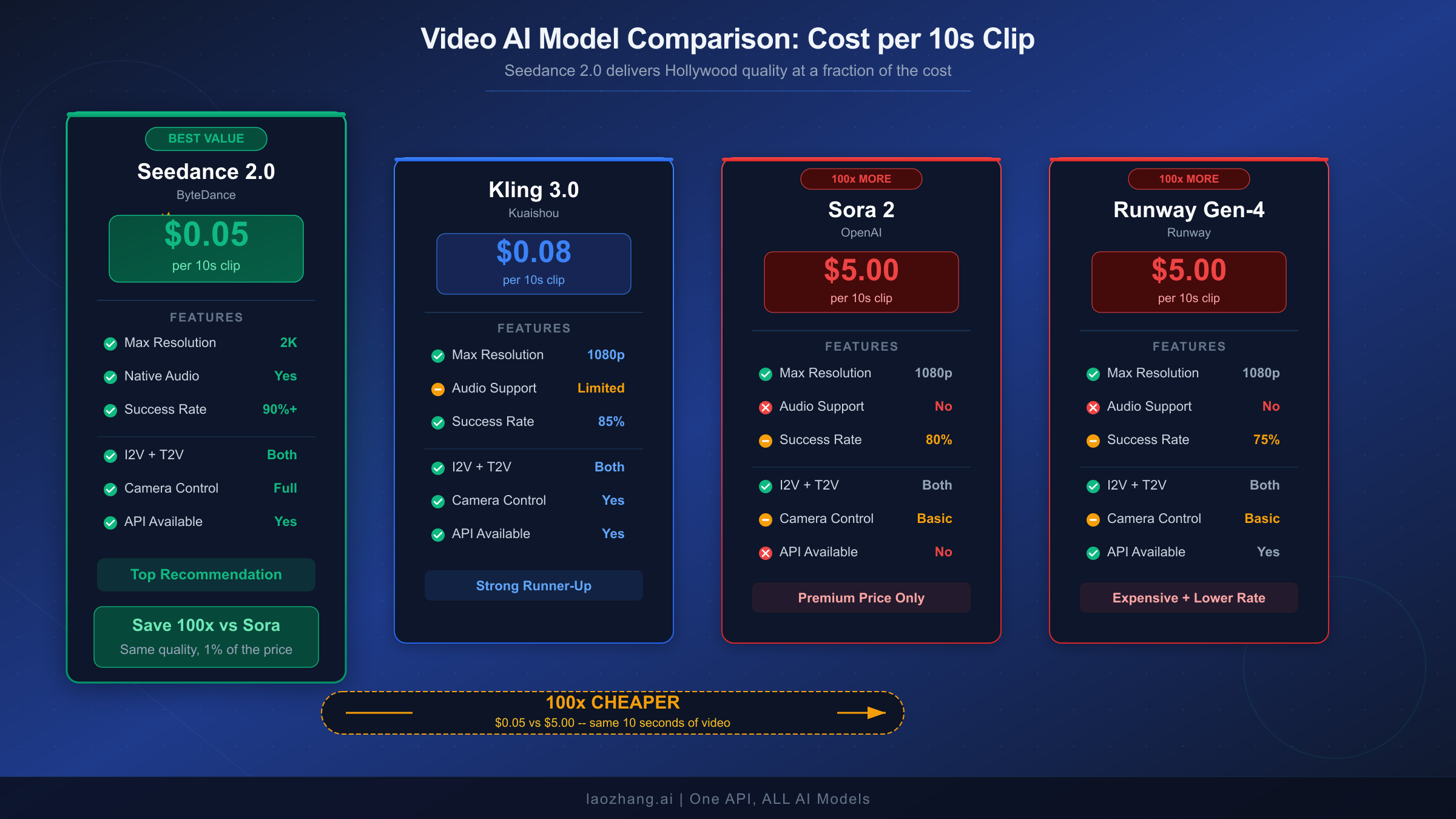
Seedance 2.0 does not exist in a vacuum. Several competing video generation models are vying for developer attention, each with different strengths. The right choice depends on your specific requirements around quality, cost, speed, and feature set. For a comprehensive deep dive into model capabilities, see our detailed Seedance vs Kling vs Sora comparison.
| Feature | Seedance 2.0 | Sora 2 | Kling 3.0 | Runway Gen-4 |
|---|---|---|---|---|
| Developer | ByteDance | OpenAI | Kuaishou | Runway |
| Launch Date | Feb 12, 2026 | Dec 2025 | Jan 2026 | Nov 2025 |
| Cost per 5s 720p | $0.05 - $0.99 | ~$5.00 | ~$0.08 - $0.50 | ~$5.00 |
| Max Resolution | 1080p | 1080p | 1080p | 4K |
| Max Duration | 10s | 20s | 10s | 10s |
| Text-to-Video | Yes | Yes | Yes | Yes |
| Image-to-Video | Yes | Yes | Yes | Yes |
| Generation Speed | 30-120s | 60-300s | 30-90s | 60-120s |
| API Availability | Third-party now, Official soon | ChatGPT Pro required | API available | API available |
| Quality Rating | 8.5/10 | 9/10 | 8/10 | 8.5/10 |
Seedance 2.0's strongest advantage is its price-to-quality ratio. While Sora 2 produces arguably the highest-quality output, it costs 100x more per clip and requires a ChatGPT Pro subscription ($200/month) for API-like access. For most commercial applications — social media ads, product videos, marketing content — the quality difference between Seedance 2.0 and Sora 2 is negligible, while the cost difference is enormous. If your budget allows 100 Seedance videos or 1 Sora video, the volume advantage of Seedance is overwhelming for iterative creative workflows.
Kling 3.0 from Kuaishou is Seedance's closest competitor in the budget category, offering similar pricing through third-party providers ($0.08-$0.50 per clip). Kling tends to produce slightly more stylized output compared to Seedance's more photorealistic approach, making it a better choice for animated or artistic content. However, Seedance 2.0 generally outperforms Kling 3.0 in motion coherence and temporal consistency — characters and objects maintain their appearance more reliably across frames. For developers who want access to multiple models through a single integration point, platforms like laozhang.ai provide both Seedance and Kling alongside Sora 2 and Veo 3.1, letting you choose the best model for each specific generation task without managing multiple API integrations.
Runway Gen-4 occupies the premium tier alongside Sora 2, with pricing around $5.00 per clip but offering up to 4K resolution output. Runway's primary advantage is its mature ecosystem of editing tools and its support for advanced camera control parameters that give directors more precise control over the generated output. If your workflow requires 4K resolution or fine-grained camera movement control, Runway may justify its premium price. For an overview of all major video AI APIs and how to access them, see our Sora 2 video API access guide and free Veo 3 API access.
The practical recommendation for most teams is to default to Seedance 2.0 for volume production and reserve premium models for specific high-value use cases. A content marketing team producing 50 social media videos per week would spend approximately $2.50 per week with Seedance through the cheapest provider versus $250 per week with Sora 2 — a difference of nearly $13,000 annually. Even if you allocate 10% of your budget to premium Sora 2 generations for hero content, the combined annual cost would be approximately $1,430 (Seedance for 90% of videos plus Sora 2 for 10%) compared to $13,000 for an all-Sora approach. This multi-model strategy delivers the best balance of quality and cost efficiency. The video AI landscape is evolving rapidly, with new models and pricing changes appearing monthly. The providers and prices listed in this comparison reflect verified data as of February 15, 2026. We recommend bookmarking this guide and checking back regularly, as we update pricing data whenever significant changes occur. For the latest verified pricing data, you can also check provider documentation directly — see our detailed Seedance vs Kling vs Sora comparison for the most current cross-model analysis.
Frequently Asked Questions
Is Seedance 2.0 API officially available yet?
As of February 15, 2026, the official BytePlus platform only offers Seedance 1.5 Pro via API, with pricing at $1.2-$2.4 per million tokens (byteplus.com, verified February 15, 2026). The Seedance 2.0 API is expected to become available through BytePlus around February 24, 2026. However, several third-party providers already offer Seedance 2.0 API access today with OpenAI-compatible endpoints. These third-party options are not only available sooner but are typically 80-95% cheaper than the official BytePlus pricing for the older 1.5 Pro model.
How much does it cost to generate a Seedance video?
Costs vary dramatically by provider, ranging from $0.05 to $0.99 per 5-second 720p video. The cheapest stable option currently available is laozhang.ai's Nano Banana Pro plan at approximately $0.05 per request. The official BytePlus pricing for Seedance 1.5 Pro is approximately $0.494 per 5-second 720p video without audio, or $0.988 with audio, based on the token calculation formula: Video Tokens = (Width x Height x Frame Rate x Duration) / 1024. Resolution and duration significantly affect pricing — a 10-second 1080p video costs roughly 4.5 times more than a 5-second 720p clip regardless of provider.
What is the success rate for Seedance video generation?
Generation success rates typically range from 85% to 95% across providers, depending on prompt complexity and server load. Simple, clearly described prompts achieve the highest success rates (92%+), while complex multi-subject scenes with specific camera movements may drop to 80-85%. The failure rate matters financially because of different billing policies — some providers charge for failed attempts while others only charge for successful completions. A provider with a higher listed price but no-charge-on-failure policy can actually be cheaper than a lower-priced provider that charges for every attempt.
Can I use Seedance 2.0 for commercial projects?
Yes, Seedance 2.0 generated videos can be used for commercial purposes including marketing content, social media ads, product demonstrations, and creative projects. ByteDance's terms of service for Seedance explicitly permit commercial use of generated content. However, you should verify the specific commercial use terms of your chosen API provider, as some third-party providers may add their own restrictions on top of ByteDance's base terms. Standard content policy restrictions apply — generated content must not violate copyright, create deepfakes of real individuals without consent, or produce harmful content.
How does Seedance compare to Sora 2 in quality?
Seedance 2.0 scores approximately 8.5 out of 10 in quality benchmarks compared to Sora 2's 9 out of 10. The primary quality differences are in fine detail rendering (Sora 2 handles textures and small objects slightly better) and complex scene composition (Sora 2 manages multi-element scenes more coherently). For most commercial applications including social media content, product videos, and marketing materials, the quality difference is barely noticeable to viewers. The 100x price difference ($0.05 vs $5.00 per clip) makes Seedance the clear winner for volume production, while Sora 2 may be worth the premium for hero content or showcase pieces where every visual detail matters.