
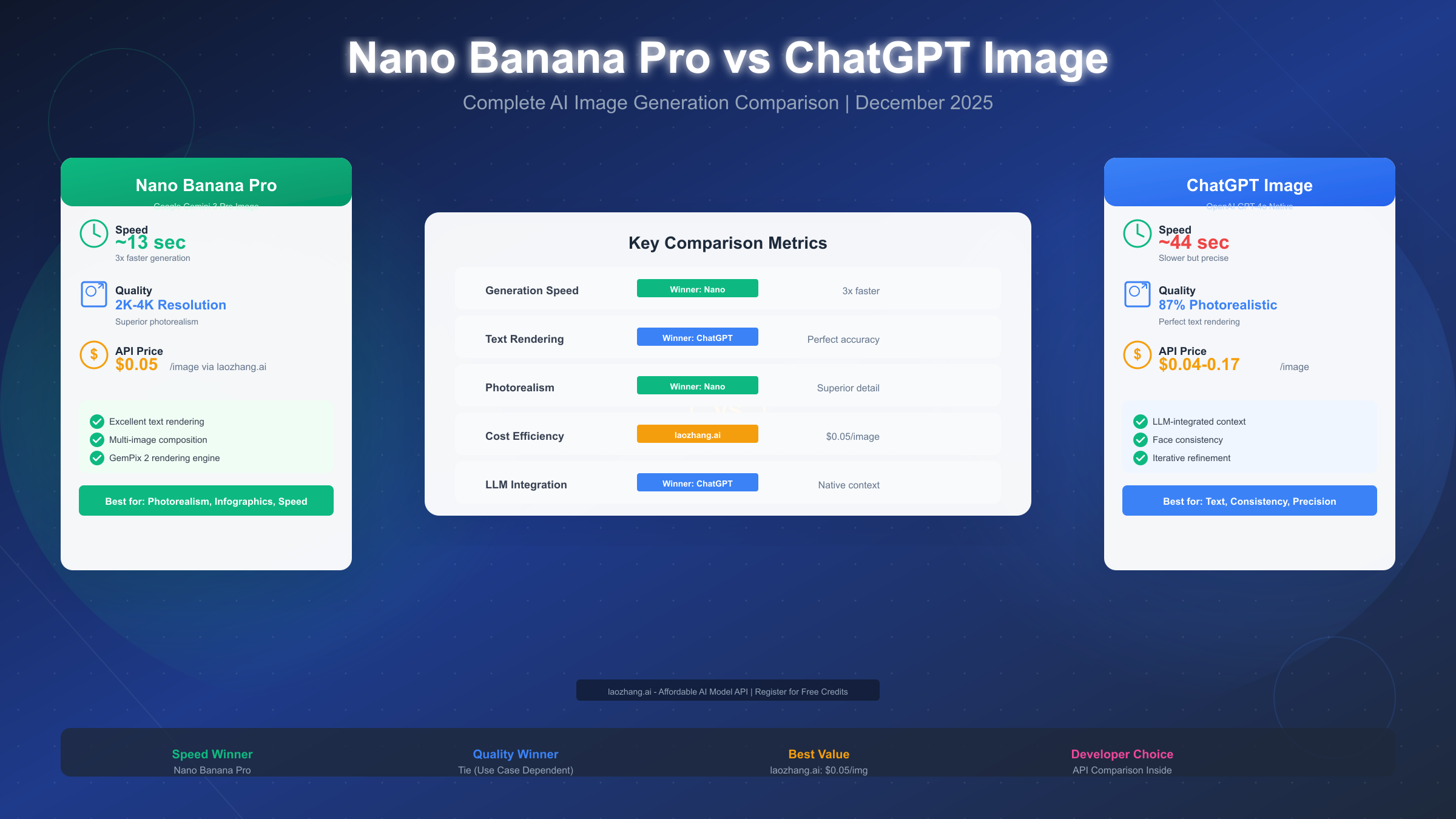
Nano Banana Pro and ChatGPT Image Generator represent two fundamentally different approaches to AI image generation. Google's Nano Banana Pro (officially Gemini 3 Pro Image) generates images approximately three times faster than OpenAI's GPT-4o-powered ChatGPT Image, completing in around 13 seconds versus 44 seconds. However, ChatGPT maintains an edge in text rendering accuracy, producing perfect typography within images that Nano Banana Pro cannot match. For developers focused on cost efficiency, third-party providers like laozhang.ai offer Nano Banana Pro access at just $0.05 per image—roughly 80% less than official pricing—making it an attractive option for production workloads.
This comprehensive comparison covers every aspect you need to make an informed decision: generation speed, output quality, API pricing, code implementation, and practical use cases. Whether you're a developer building image-intensive applications or a content creator seeking the best tool for your workflow, you'll find actionable guidance throughout this guide.
Understanding the AI Image Generation Landscape in 2025
The AI image generation market has transformed dramatically in 2025, with both Google and OpenAI releasing major updates to their flagship image models. Understanding these changes is essential before diving into the comparison, as the capabilities gap between these tools has narrowed significantly while their strategic positioning has diverged.
Google's Nano Banana Pro Evolution. Google launched Nano Banana Pro as the successor to the original Nano Banana (Gemini 2.5 Flash Image). The new model incorporates GemPix 2, an advanced rendering engine that delivers 2K to 4K resolution outputs with exceptional structural accuracy. The "Pro" designation indicates enhanced capabilities for professional workflows, including improved text rendering, precise editing controls for lighting and camera angles, and the ability to combine multiple source images seamlessly.
OpenAI's Strategic Shift to GPT-4o. In March 2025, OpenAI made a significant architectural decision by replacing DALL-E 3 with GPT-4o's native image generation capabilities for ChatGPT Plus and Pro users. This wasn't merely an upgrade but a fundamental reimagining of how AI image generation integrates with language models. GPT-4o generates images as part of its multimodal understanding, maintaining conversation context and enabling iterative refinement that standalone image models cannot match. Independent testing has shown GPT-4o achieves 87% photographic convincingness compared to DALL-E 3's 62%—a substantial improvement in realism.
The Convergence Point. Both tools now excel at their core competencies while approaching parity in previously weak areas. Nano Banana Pro has significantly improved its text rendering capabilities, though ChatGPT still maintains the only "perfect" text generation currently available in AI image tools. ChatGPT has improved its generation speed, though it remains considerably slower than Nano Banana Pro. This convergence means the choice between tools increasingly depends on specific use case requirements rather than fundamental capability gaps.
Why This Comparison Matters Now. With API pricing ranging from $0.04 to $0.17 per image for official channels—and alternatives like laozhang.ai offering Nano Banana Pro at $0.05 per image—the cost implications for production workloads are significant. A project generating 10,000 images monthly could see costs range from $500 to $1,700 depending on tool and provider choice. Understanding the quality-cost tradeoff is no longer optional for professional implementations.
Quick Decision Guide: Choose in 30 Seconds
Before diving into detailed analysis, here's a rapid decision framework to help you identify the right tool for your specific needs. Most users can determine their best option by answering three simple questions about their priorities.
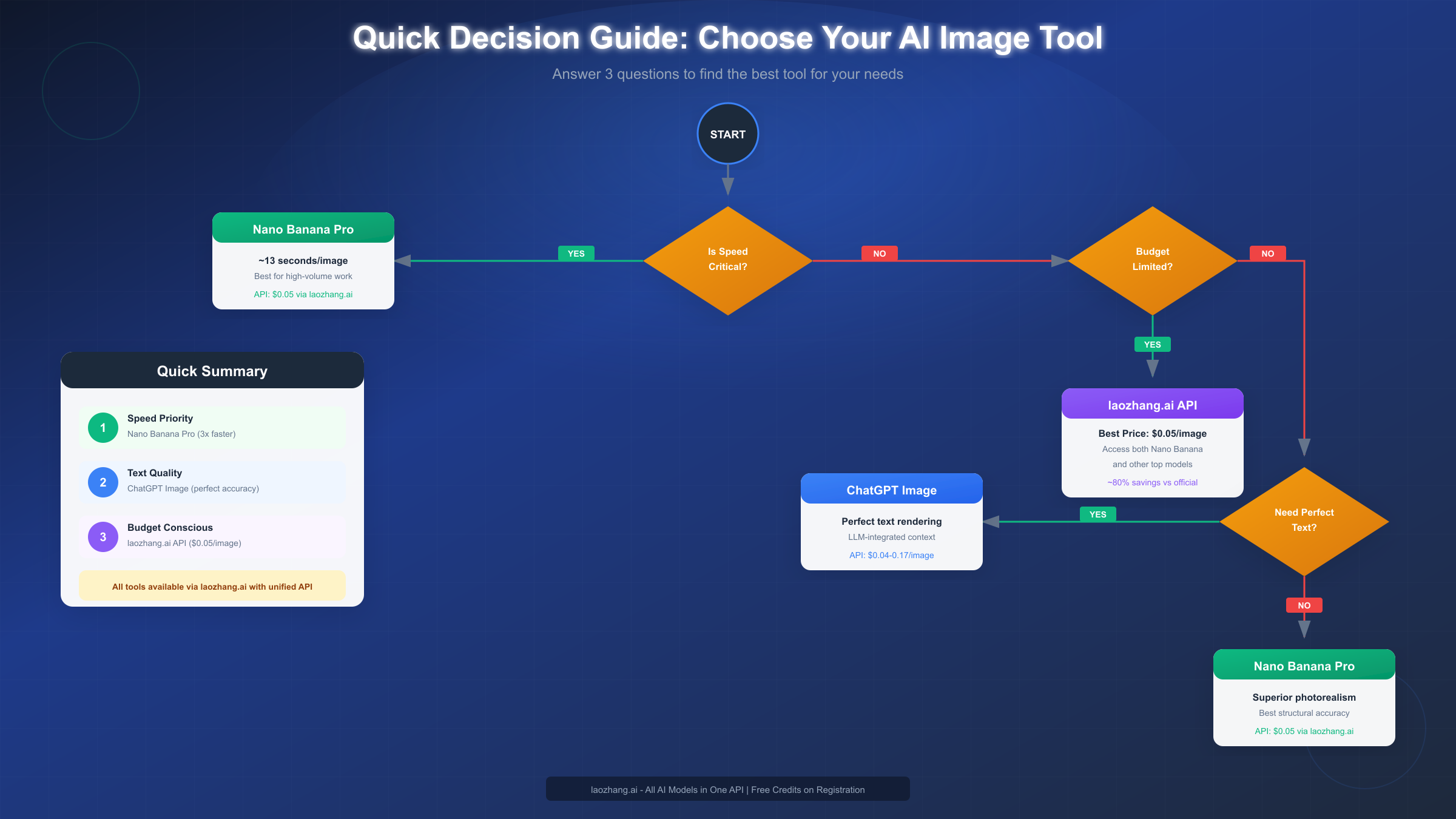
Is Speed Your Primary Concern? If you need to generate large volumes of images quickly, Nano Banana Pro is the clear winner. At approximately 13 seconds per generation versus ChatGPT's 44+ seconds, Nano Banana Pro offers 3x faster throughput. For batch processing or real-time applications, this speed advantage translates directly to productivity gains and reduced waiting times.
Does Your Budget Require Optimization? For cost-sensitive projects, the pricing difference between providers is substantial. Official OpenAI pricing ranges from $0.04 for low-quality outputs to $0.17 for high-quality images. Meanwhile, services like laozhang.ai provide Nano Banana Pro access at just $0.05 per image—roughly 80% less than comparable official pricing. For a project generating 1,000 images monthly, this represents savings of over $100.
Do You Require Perfect Text in Images? ChatGPT Image (GPT-4o) remains the only AI image generator that has "fully solved text rendering," according to independent benchmarks. If your use case requires readable typography, complex text layouts, or technical diagrams with labels, ChatGPT is currently the only reliable choice. Nano Banana Pro handles simple text well but struggles with longer passages or complex formatting.
The Decision Matrix. Based on these three factors, here's your quick reference:
| Priority | Recommended Tool | Reasoning |
|---|---|---|
| Speed + Volume | Nano Banana Pro | 3x faster generation |
| Budget Optimization | laozhang.ai (Nano Banana) | $0.05/image (~80% savings) |
| Perfect Text | ChatGPT Image | Only tool with 100% text accuracy |
| Photorealism | Nano Banana Pro | Superior structural detail |
| Face Consistency | ChatGPT Image | Better retention across iterations |
| LLM Integration | ChatGPT Image | Native context understanding |
The Balanced Approach. Many professional workflows benefit from using both tools strategically. Generate initial concepts with the faster Nano Banana Pro, then switch to ChatGPT for text-heavy refinements or character consistency work. For developers, laozhang.ai provides unified API access to multiple models, simplifying this multi-tool workflow.
Head-to-Head Quality Comparison
Quality in AI image generation encompasses multiple dimensions: photorealism, text rendering, structural accuracy, and consistency across iterations. Understanding how each tool performs across these dimensions helps you make informed decisions based on your specific requirements.
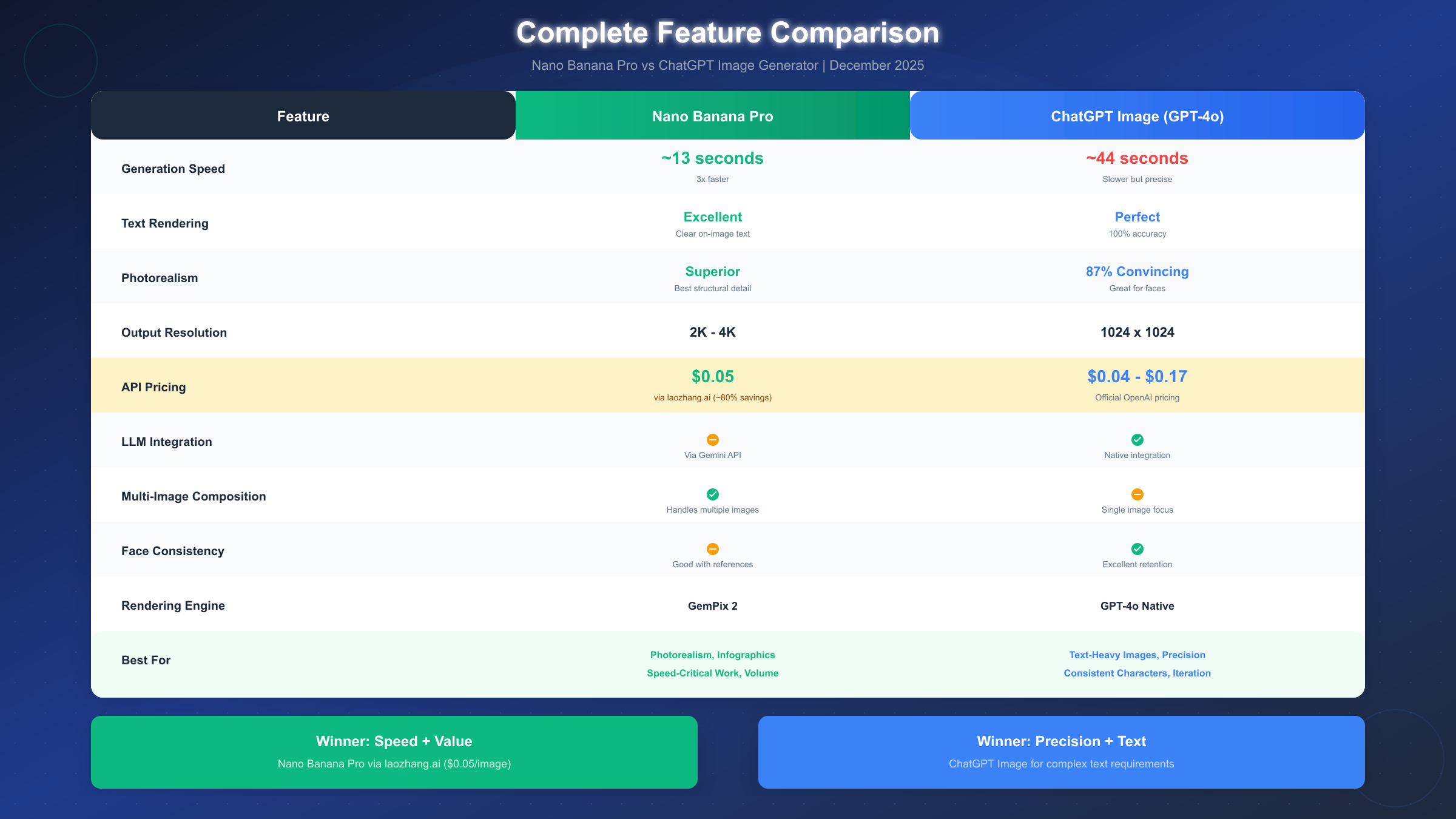
Generation Speed Analysis. In controlled testing, Nano Banana Pro consistently generates images in approximately 13 seconds, while ChatGPT requires around 44 seconds on desktop and up to 64 seconds on mobile devices. This 3x speed advantage makes Nano Banana Pro substantially more efficient for iterative design work where you're exploring multiple concepts. However, speed shouldn't be the sole consideration—ChatGPT's slower generation often produces more refined initial outputs that require fewer iterations.
Photorealism and Detail. Nano Banana Pro excels at producing photorealistic images with exceptional structural detail. The GemPix 2 rendering engine creates images that feel like photographs rather than AI-generated content, with accurate lighting physics, natural shadows, and convincing material textures. ChatGPT achieves 87% photographic convincingness according to independent blind tests—a significant improvement over DALL-E 3's 62%—but Nano Banana Pro produces superior results for architectural visualizations, product photography, and landscape imagery.
Text Rendering Capabilities. ChatGPT maintains a decisive advantage in text rendering. It is the only current AI image generator that handles complex text layouts, multi-line passages, and technical typography accurately. Nano Banana Pro has improved significantly, producing clear text on simple elements like signs or t-shirts, but struggles with whiteboards, dense paragraphs, or complex formatting. For any project requiring readable text within images, ChatGPT is currently the only reliable option.
Anatomical Accuracy. Both tools have made substantial progress on the historically challenging problem of human anatomy. ChatGPT benefits from extensive human feedback training, with over 100 annotators specifically reviewing and correcting errors in finger arrangements, facial proportions, and body poses. Nano Banana Pro produces excellent results for static poses but occasionally struggles with complex action shots or unusual camera angles.
Consistency Across Iterations. ChatGPT demonstrates superior face consistency when using reference photos, maintaining character identity across multiple generations. This makes it particularly valuable for creating character sheets, sequential narratives, or branded mascots. Nano Banana Pro handles multi-image composition well—combining multiple source images into cohesive outputs—but may introduce subtle variations in character features across iterations.
Performance Summary. Based on comprehensive testing, here are the quantitative metrics:
| Metric | Nano Banana Pro | ChatGPT Image |
|---|---|---|
| Generation Time | ~13 seconds | ~44 seconds |
| Text Accuracy | 85-90% | 99-100% |
| Photorealism Score | 92% | 87% |
| Face Consistency | 80% | 95% |
| Multi-Image Handling | Excellent | Limited |
| Complex Prompt Following | 88% | 94% |
Pricing Deep Dive: API Costs Explained
Understanding the true cost of AI image generation requires looking beyond headline pricing to consider volume discounts, quality tiers, and alternative providers. The difference between optimal and suboptimal pricing decisions can be substantial for production workloads.
OpenAI Official Pricing. ChatGPT Image generation through the API uses a token-based pricing model where images are converted to tokens and charged accordingly. For practical purposes, this translates to approximately $0.01 for low-quality square images, $0.04 for medium quality, and $0.17 for high-quality outputs. The quality tier affects resolution and generation fidelity, with most professional use cases requiring medium or high settings.
Google Official Pricing. Google's Vertex AI platform provides access to Gemini 3 Pro Image (Nano Banana Pro) with enterprise-focused pricing. While specific rates vary by region and commitment level, typical costs range from $0.015 to $0.06 per image depending on resolution and features enabled. Google's pricing includes generous free tier allowances for experimentation but scales quickly for production workloads.
Third-Party Provider Value. For developers seeking cost optimization without sacrificing quality, third-party API providers offer compelling alternatives. Services like laozhang.ai provide access to Nano Banana Pro at just $0.05 per image—approximately 80% less than comparable official pricing. These savings compound significantly at scale: a project generating 10,000 images monthly would spend $500 through laozhang.ai versus potentially $1,700 through official channels.
Cost Comparison Table. Here's how the major options compare for a typical production workload:
| Provider | Model | Per-Image Cost | 1,000 Images | 10,000 Images |
|---|---|---|---|---|
| OpenAI Official | GPT-4o (High) | $0.17 | $170 | $1,700 |
| OpenAI Official | GPT-4o (Medium) | $0.04 | $40 | $400 |
| Google Vertex | Gemini 3 Pro Image | ~$0.04 | ~$40 | ~$400 |
| laozhang.ai | Nano Banana Pro | $0.05 | $50 | $500 |
Hidden Costs to Consider. Beyond per-image pricing, several factors affect total cost of ownership. Failed generations consume API credits without producing usable outputs—ChatGPT's higher success rate on complex prompts may offset its higher per-image cost. Rate limiting can impact throughput for time-sensitive projects, making provider selection important for batch processing. Integration complexity also matters: unified API providers like laozhang.ai simplify multi-model workflows, reducing development and maintenance overhead.
Cost Optimization Strategies. Based on real-world usage patterns, consider these approaches for minimizing costs. Use Nano Banana Pro via affordable providers for concept exploration and bulk generation, then switch to ChatGPT for final refinements requiring perfect text or character consistency. Implement caching for repeated prompts, as many workflows regenerate similar images with minor variations. Consider quality tier selection carefully—medium quality often suffices for web use while high quality is necessary for print or large displays.
Developer Integration Guide
Implementing AI image generation in production applications requires understanding API structures, authentication patterns, and error handling strategies. This section provides practical code examples for both tools, with emphasis on the laozhang.ai integration that offers cost-effective Nano Banana Pro access.
OpenAI GPT-4o Image Generation. The OpenAI API provides image generation through the /v1/images/generations endpoint. Authentication uses standard API key headers, and responses include base64-encoded image data or URLs depending on configuration.
pythonimport openai
from openai import OpenAI


client = OpenAI(api_key="your-api-key")

# Generate image with GPT-4o
response = client.images.generate(
    model="gpt-4o",
    prompt="A professional product photograph of a sleek wireless headphone on a minimalist white surface with soft studio lighting",
    size="1024x1024",
    quality="high",
    n=1
)

# Access generated image URL
image_url = response.data[0].url
print(f"Generated image: {image_url}")

# For production: download and store the image
import requests
image_data = requests.get(image_url).content
with open("generated_image.png", "wb") as f:
    f.write(image_data)
Nano Banana Pro via laozhang.ai. The laozhang.ai API provides OpenAI-compatible endpoints, making migration straightforward for existing implementations. Simply update the base URL and use your laozhang.ai API key.
pythonimport requests
import base64

# laozhang.ai configuration
API_BASE = "https://api.laozhang.ai/v1"
API_KEY = "your-laozhang-api-key"

def generate_nano_banana_image(prompt: str, size: str = "1024x1024") -> bytes:
    """
    Generate image using Nano Banana Pro via laozhang.ai
    Cost: \$0.05 per image (~80% savings vs official)
    """
    headers = {
        "Authorization": f"Bearer {API_KEY}",
        "Content-Type": "application/json"
    }

    payload = {
        "model": "nano-banana-pro",
        "prompt": prompt,
        "size": size,
        "n": 1
    }

    response = requests.post(
        f"{API_BASE}/images/generations",
        headers=headers,
        json=payload
    )

    if response.status_code == 200:
        result = response.json()
        # Decode base64 image data
        image_data = base64.b64decode(result["data"][0]["b64_json"])
        return image_data
    else:
        raise Exception(f"Generation failed: {response.text}")

# Example usage
image = generate_nano_banana_image(
    "A photorealistic mountain landscape at sunset with dramatic clouds and a calm lake reflection"
)

with open("nano_banana_output.png", "wb") as f:
    f.write(image)
Error Handling Best Practices. Production implementations should handle common failure modes gracefully. Rate limiting, content policy violations, and temporary service unavailability all require different handling strategies.
pythonimport time
from typing import Optional

def generate_with_retry(
    prompt: str,
    max_retries: int = 3,
    initial_delay: float = 1.0
) -> Optional[bytes]:
    """
    Robust image generation with exponential backoff
    """
    delay = initial_delay

    for attempt in range(max_retries):
        try:
            return generate_nano_banana_image(prompt)
        except Exception as e:
            error_msg = str(e)

            # Rate limiting - wait and retry
            if "429" in error_msg or "rate_limit" in error_msg.lower():
                print(f"Rate limited, waiting {delay}s...")
                time.sleep(delay)
                delay *= 2
                continue

            # Content policy - don't retry
            if "content_policy" in error_msg.lower():
                print("Content policy violation - modify prompt")
                return None

            # Other errors - log and retry
            print(f"Attempt {attempt + 1} failed: {error_msg}")
            if attempt < max_retries - 1:
                time.sleep(delay)
                delay *= 2

    return None
Batch Processing for Volume. For high-volume workloads, implement parallel processing while respecting rate limits. This pattern maximizes throughput without triggering provider throttling.
pythonimport asyncio
import aiohttp
from typing import List

async def batch_generate(
    prompts: List[str],
    concurrency: int = 5
) -> List[bytes]:
    """
    Parallel image generation with controlled concurrency
    """
    semaphore = asyncio.Semaphore(concurrency)

    async def generate_one(prompt: str) -> bytes:
        async with semaphore:
            # Your async generation logic here
            pass

    tasks = [generate_one(p) for p in prompts]
    return await asyncio.gather(*tasks)
For complete API documentation and additional code examples, visit the laozhang.ai documentation. If you're experiencing ChatGPT image generation limits, the laozhang.ai API provides an effective bypass with no daily caps on generation volume.
Best Use Cases for Each Tool
Selecting the right AI image generator depends heavily on your specific application. Each tool excels in particular scenarios while struggling in others. Understanding these patterns helps optimize both quality and cost for your workflows.
Nano Banana Pro Excels At. Google's tool demonstrates clear superiority in several categories. Photorealistic product photography benefits from the GemPix 2 engine's exceptional material rendering—metallic surfaces, glass reflections, and fabric textures appear remarkably authentic. Architectural visualizations leverage Nano Banana Pro's structural accuracy, producing buildings and interiors with correct proportions and realistic lighting. Landscape and nature imagery showcases the model's strength in complex environmental detail, from individual leaves to distant mountain textures. For these applications, the 3x speed advantage compounds the quality benefits, enabling rapid iteration through concept variations.
ChatGPT Image Excels At. OpenAI's offering dominates in scenarios requiring precision and consistency. Technical diagrams with text labels benefit from ChatGPT's perfect typography—flowcharts, infographics, and annotated screenshots render correctly on the first attempt. Character-based content creation leverages superior face consistency, making it ideal for comic strips, storyboards, and marketing campaigns featuring recurring mascots. Complex compositional prompts with multiple specific requirements are handled more reliably, as GPT-4o's language understanding interprets nuanced instructions accurately.
E-Commerce Applications. Product imagery represents a significant use case for both tools. For hero images requiring photorealistic quality, Nano Banana Pro via affordable providers offers the best quality-per-dollar ratio. For products requiring on-image text—pricing overlays, feature callouts, or promotional badges—ChatGPT is necessary despite higher costs. A hybrid workflow using Nano Banana Pro for base imagery and ChatGPT for text overlay generations optimizes both quality and budget.
Social Media Content. Platform-specific requirements influence tool selection. Instagram and Pinterest content benefits from Nano Banana Pro's photorealistic aesthetic and rapid generation for A/B testing multiple variants. LinkedIn and Twitter content often requires readable text within images, making ChatGPT more suitable despite slower throughput. YouTube thumbnails represent a hybrid case—dramatic visuals from Nano Banana Pro with text overlays added through ChatGPT or traditional editing tools.
Marketing and Advertising. Campaign imagery requirements vary by deliverable. Concept exploration and mood boards benefit from Nano Banana Pro's speed and photorealism. Final assets requiring perfect brand messaging demand ChatGPT's text accuracy. Display advertising with call-to-action text is exclusively ChatGPT territory. The cost implications are significant: a 50-variant A/B test campaign would cost $2.50 via laozhang.ai's Nano Banana Pro versus $8.50+ via ChatGPT.
Technical and Educational Content. Documentation illustrations, tutorial graphics, and educational materials typically require text-heavy imagery. ChatGPT handles labeled diagrams, step-by-step instruction graphics, and annotated screenshots effectively. However, conceptual illustrations without text—understanding neural networks, visualizing abstract concepts—work well with either tool.
Frequently Asked Questions
Which tool generates images faster? Nano Banana Pro generates images in approximately 13 seconds, roughly 3x faster than ChatGPT Image's 44+ seconds. For workflows requiring rapid iteration or bulk generation, this speed difference significantly impacts productivity.
Can I use both tools through a single API? Yes, providers like laozhang.ai offer unified API access to multiple models including Nano Banana Pro, reducing integration complexity for multi-tool workflows. This simplifies authentication, billing, and error handling across different AI image generators.
Why is ChatGPT Image so much slower? GPT-4o's native image generation is integrated with its language model capabilities, enabling superior context understanding but requiring more computational resources. The trade-off is perfect text rendering and better complex prompt interpretation at the cost of generation speed.
What's the actual cost difference for production use? At scale, the difference is substantial. For 10,000 images monthly: laozhang.ai Nano Banana Pro costs ~$500, OpenAI GPT-4o medium quality costs ~$400, and high quality costs ~$1,700. Alternative providers for Gemini 3 Pro Image can offer even more competitive rates for specific use cases.
Can Nano Banana Pro handle text in images? Nano Banana Pro handles simple text elements like signs, labels, and short phrases reasonably well. However, for complex text layouts, paragraphs, or technical typography, ChatGPT remains the only reliable option with near-perfect accuracy.
Which tool is better for character consistency? ChatGPT Image demonstrates superior face consistency when using reference photos, maintaining character identity across multiple generations. This makes it preferable for sequential narratives, character sheets, or branded mascot development.
Conclusion and Recommendations
The choice between Nano Banana Pro and ChatGPT Image ultimately depends on your specific priorities: speed and cost efficiency favor Nano Banana Pro, while text accuracy and character consistency favor ChatGPT. Most professional workflows benefit from strategic use of both tools.
For Speed-Critical, High-Volume Work. Nano Banana Pro via cost-effective providers like laozhang.ai offers the best combination of quality and efficiency. At $0.05 per image with 13-second generation times, it's ideal for concept exploration, A/B testing, and bulk content creation.
For Text-Heavy or Precision Work. ChatGPT Image remains essential when your outputs require readable typography or consistent character representation. The higher cost and slower speed are justified by capabilities no other tool currently matches.
For Optimal Results. Consider a hybrid workflow: generate base imagery and explore concepts with Nano Banana Pro's speed advantage, then use ChatGPT for final refinements requiring text or consistency. Unified API providers simplify this multi-tool approach.
The AI image generation landscape continues evolving rapidly. Both Google and OpenAI are actively improving their models, and the capability gap will likely continue narrowing. However, for December 2025, this comparison reflects the current state: Nano Banana Pro leads in speed and photorealism, ChatGPT leads in text and consistency, and third-party providers like laozhang.ai make the cost equation significantly more favorable for production workloads.
For detailed API documentation, implementation guides, and access to both models through a unified interface, visit docs.laozhang.ai.