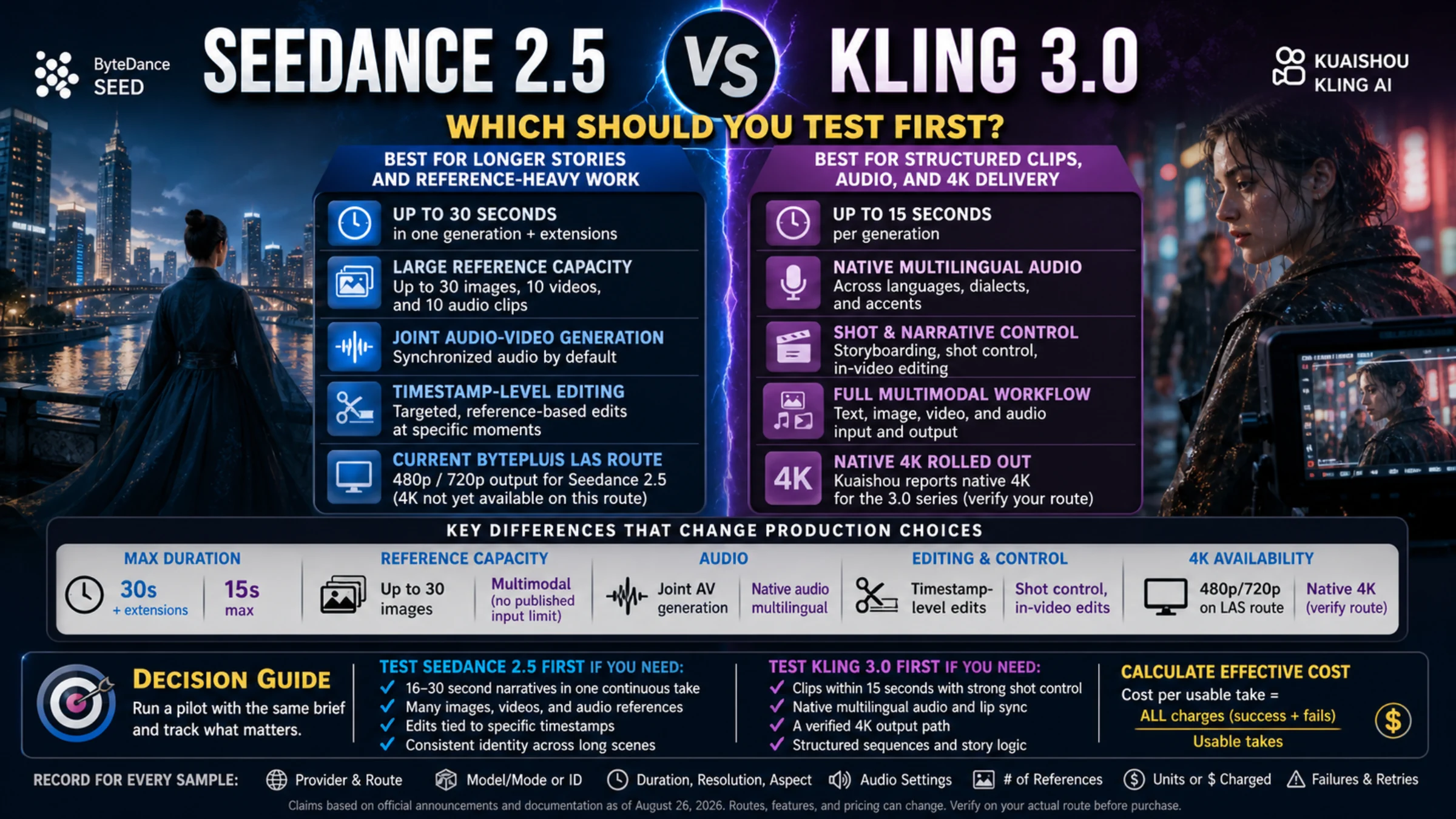
There is no route-independent winner. Seedance 2.5 is the more logical first test when a deliverable needs a continuous 16–30 second story, a large collection of character, product, motion, and sound references, or edits tied to specific moments. Kling 3.0 is the stronger first candidate when the job fits within 15 seconds and depends on structured shots, native multilingual audio, or a product path where native 4K is visibly available.
If your brief needs both long-form continuity and 4K delivery, keep both candidates. Record the exact product, model or mode, resolution, charged units, and failed attempts. “Seedance” and “Kling” are product families, not complete output contracts. A consumer app, an enterprise service, and a third-party gateway can expose different controls under a familiar model name.
The differences that can actually change a production choice
| Requirement | Seedance 2.5 | Kling 3.0 | What it changes |
|---|---|---|---|
| Maximum single generation | Up to 30 seconds, plus extensions | Up to 15 seconds | A complete 16–30 second beat points to Seedance first |
| Reference material | Up to 30 images, 10 videos, and 10 audio clips | Officially supports multimodal text, image, audio, and video workflows; the launch release does not publish an equivalent input-count limit | Reference-heavy work gives Seedance a clearer first-test case |
| Audio | Joint audio-video generation | Native audio across languages, dialects, and accents | Both belong in an audio test; “has audio” is not a tie-breaker |
| Narrative and editing | Longer storytelling, timestamp-level control, targeted and reference-based editing | Complex narrative logic, shot control, reference-to-video, and in-video editing | Choose by the correction workflow you will really use |
| 4K | BytePlus LAS currently lists Seedance 2.5 at 480p/720p | Kuaishou says native 4K rolled out for the Kling 3.0 series | A hard 4K requirement favors a verified Kling route |
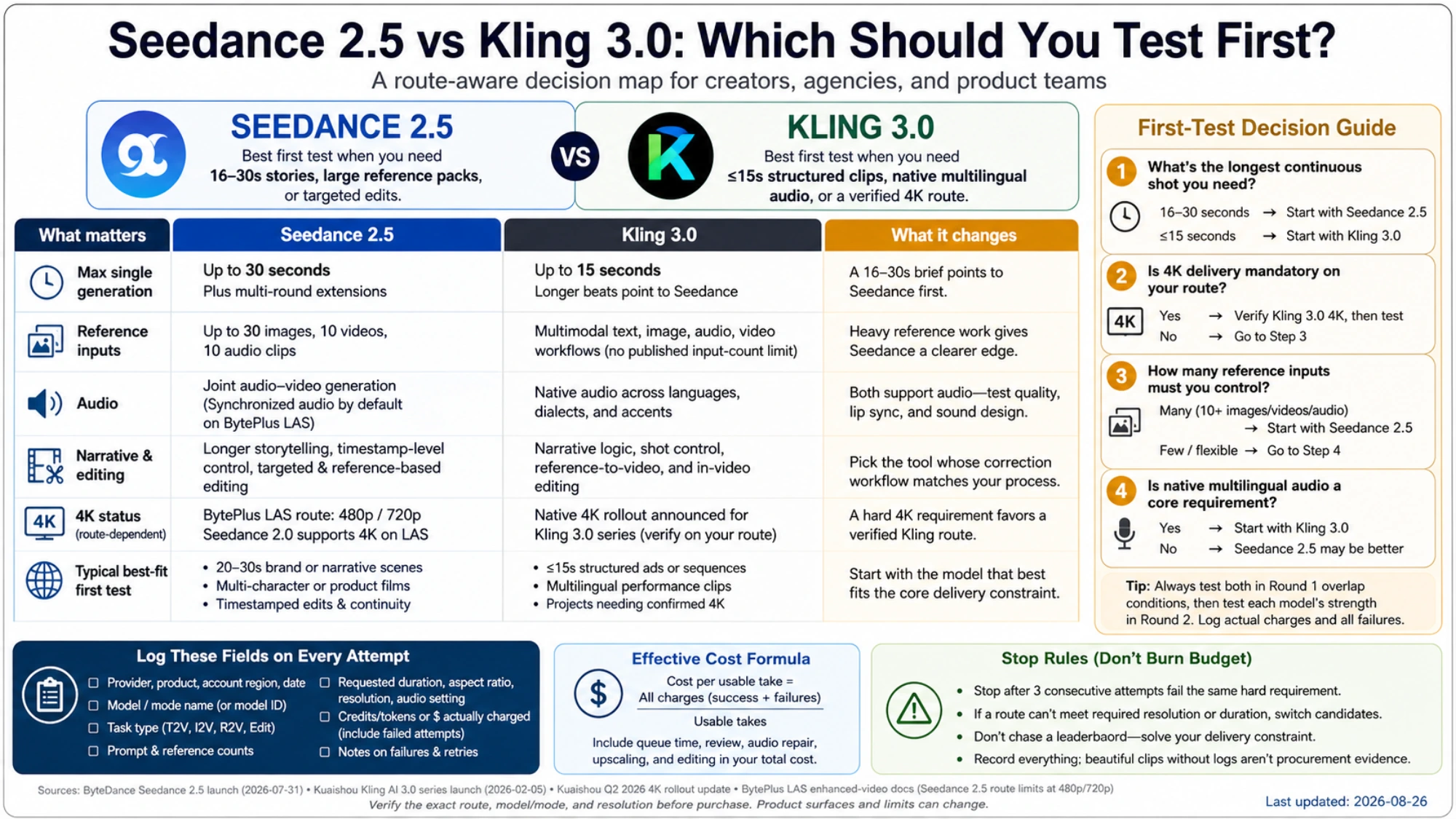
ByteDance's Seedance 2.5 launch announcement supports the 30-second, reference-count, and editing claims. It also says complex motion physics and multi-subject interactions still have room to improve. More inputs and a longer timeline do not guarantee that every action will survive a difficult scene.
Kuaishou's Kling AI 3.0 series announcement supports the 15-second limit, native multilingual audio, multimodal workflow, and shot-level control. Kuaishou later reported a native 4K rollout for the 3.0 series. “For the series” is not the same as “on every mode, account, region, plan, or API endpoint,” so check the actual 4K selector before you buy capacity.
A model name is not an output contract
Seedance 2.5's model page, its consumer access, and BytePlus documentation describe different surfaces. The high-level model materials describe 30-second storytelling and reference-aware editing. The current BytePlus LAS enhanced-video documentation lists dreamina-seedance-2-5-260628, synchronized audio by default, and 480p or 720p output for Seedance 2.5 on that route. The same page reserves 4K support for Seedance 2.0.
The precise question is therefore not “Does Seedance support 4K?” It is “Which model ID am I calling through which service, and what resolution can that request return today?” Ask the same question of Kling. Video 3.0, Video 3.0 Omni, Turbo, a consumer plan, and an API integration should not be assumed to share identical controls.
Keep these fields beside every sample:
- provider, product, account region, and date;
- full model or mode name, or the model ID for an API call;
- text-to-video, image-to-video, reference-to-video, or edit task;
- requested duration, aspect ratio, resolution, and audio setting;
- number and duration of image, video, and audio references;
- credits, tokens, or currency actually charged, including failed requests.
A beautiful clip without those fields is inspiration, not procurement evidence.
When Seedance 2.5 deserves the first run
Seedance's strongest reason to go first is the ability to keep a longer timeline and a larger reference pack inside one creation. A 30-second limit can hold setup, development, a turn, and a finish without forcing the team to rebuild identity and sound at every stitch. The 30-image, 10-video, and 10-audio allowances also matter when a brief specifies several characters, a product, locations, motion, and sonic cues.
Good tests include a 20–30 second brand scene with dialogue and ambience, a multi-character performance, a product film that must preserve exact appearance, or a clip that needs a change at a named timestamp. Evaluate identity across cuts, audiovisual continuity, and whether a targeted edit preserves the material before and after it. Do not judge the model from the most flattering still frame.
The tradeoff is route discipline. If your intended BytePlus LAS workflow tops out at 720p, a compelling 30-second result may still fail a 4K delivery requirement. That is a workflow mismatch, not proof that the model itself is low quality.
When Kling 3.0 deserves the first run
Kling 3.0 makes sense first for tightly structured work within 15 seconds where shots and sound are part of the output rather than later additions. Its official materials emphasize narrative logic, automatic storyboarding, precise shot control, and native audio across multiple languages, dialects, and accents.
Kling also has the clearer official signal for native 4K. Before treating that as a pass, verify that the target mode exposes 4K and download one result to inspect its actual pixel dimensions. A player badge, an upscaled export, or platform post-processing does not establish native model output.
This route is especially worth testing for a multilingual performance ad, a short sequence with several directed shots, or a delivery where a verified 4K option is non-negotiable. Evaluate whether shot transitions, speech, lip movement, sound effects, and the intended subject remain stable across repeated generations.
Use two rounds instead of one generic leaderboard
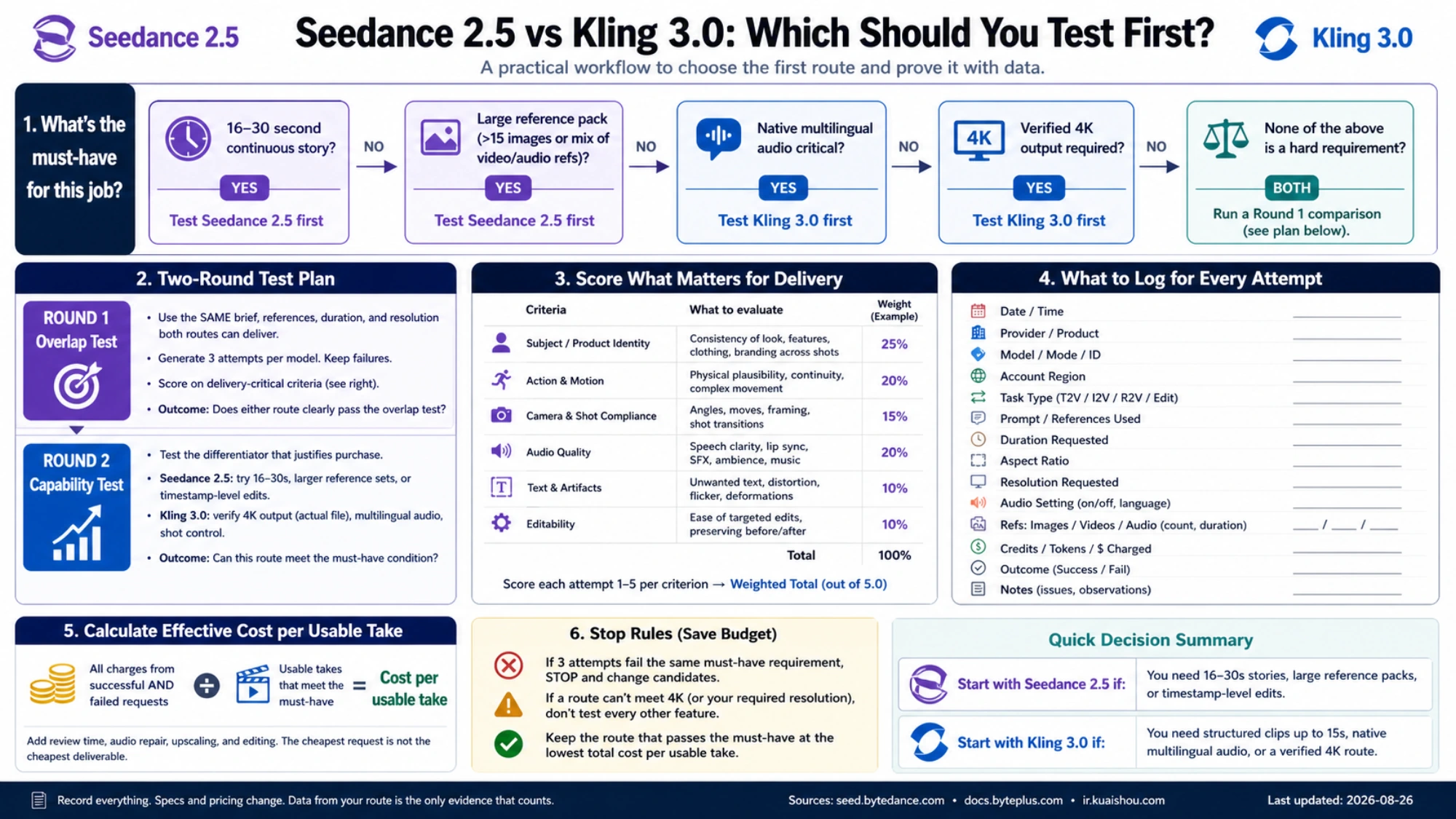
The first round should test the overlap. Limit both models to a duration and resolution both routes can deliver. Use the same prompt, the same first frame, or the nearest equivalent reference pack. Generate three attempts on each side and keep failures. Weight the criteria that determine delivery: subject or product identity, action, camera compliance, audio, unwanted text, and post-production effort.
The second round should test the capability that justifies the purchase. A long-form team can ask Seedance for one scene longer than 15 seconds. A 4K team can validate the actual file from its Kling route. A reference-heavy team can increase inputs methodically. A multilingual team can test pronunciation, lip sync, timing, and background sound.
Do not turn those different tasks into a fake universal score. They answer a narrower and more useful question: can this route satisfy the condition that would otherwise block delivery?
Calculate effective cost from the work you can use:
cost per usable take = all charges from successful and failed requests / usable takes
Add queue time, review time, audio repair, upscaling, and editing. A cheaper request that needs four retries and two repair tools can cost more than a higher-priced first pass. If three attempts fail the same hard requirement, stop and change candidates instead of hiding the mismatch with more sampling.
For the broader Seedance family and its route differences, see the 2026 Seedance model guide. If neither model passes the brief, widen the shortlist rather than treating these two names as the whole video market.
The decision to write on your test sheet
Before integration or subscription purchase, confirm the version, region, input mode, output resolution, audio control, duration, concurrency, and billing unit on the exact route you will use. Save the date because product surfaces change faster than model-family names.
Your final decision should fit in one sentence: on a named route and mode, which candidate produces a usable deliverable more consistently at the lower total cost? Start with Seedance 2.5 for long, reference-dense, edit-heavy work. Start with Kling 3.0 for structured clips up to 15 seconds, native multilingual sound, or a confirmed 4K path. When the brief crosses those boundaries, let matched inputs and actual charges decide.