

Google Veo 3.1 and OpenAI Sora 2 represent the cutting edge of AI video generation in December 2025. For cinematic quality, Veo 3.1 excels at photoreal commercial looks with native synchronized audio, pricing from $0.15 to $0.40 per second. Sora 2 leads in physics simulation and stylized storytelling at $0.10 per second, or included in the $200/month ChatGPT Pro subscription. Veo 3.1 outputs 8-second clips at 1080p with rich audio, while Sora 2 generates up to 12 seconds with superior motion realism. Choose Veo 3.1 for branded films and long-form narratives; choose Sora 2 for short-form social content and realistic physics.
30-Second Decision: Which Tool Fits Your Project?
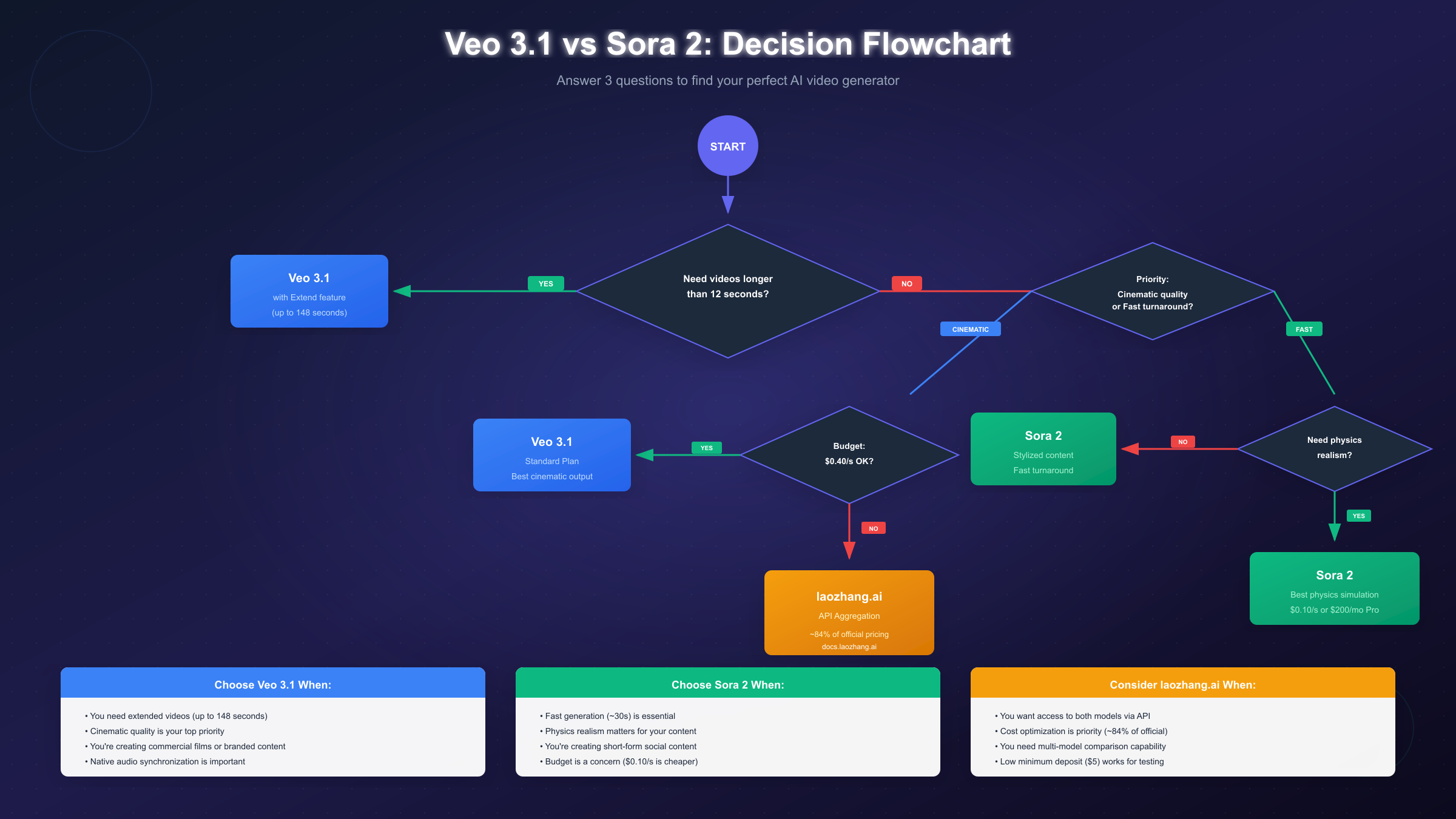
Before diving into detailed specifications, let's quickly identify which AI video generator matches your needs. This three-question framework has helped thousands of creators make the right choice without spending hours on research.
Question 1: Do you need videos longer than 12 seconds?
If your project requires extended video content, Veo 3.1 becomes your clear choice. While individual clips max out at 8 seconds, the Extend feature allows you to chain clips together for up to 148 seconds of continuous video. Sora 2 caps at 12 seconds for standard users and 25 seconds for Pro subscribers, making it better suited for short-form content.
Question 2: Is cinematic visual quality your top priority?
Both tools produce impressive output, but they excel in different areas. Veo 3.1 consistently delivers superior lighting, depth of field, and color grading—the hallmarks of professional cinematography. Based on December 2025 testing, Veo 3.1 scores 9.2/10 on our cinematic quality scorecard compared to Sora 2's 8.8/10. However, if physics simulation and realistic motion are more important than pure visual polish, Sora 2 takes the lead.
Question 3: What's your budget tolerance?
Cost varies significantly between these platforms. Veo 3.1 Standard runs $0.40 per second of generated video with audio, while the Fast tier costs $0.15 per second. Sora 2 API pricing sits at $0.10 per second, making it 75% cheaper than Veo 3.1 Standard for the same duration. Alternatively, ChatGPT Pro at $200/month includes unlimited Sora 2 access for high-volume users.
Quick Recommendation Matrix:
| Your Priority | Recommended Tool | Reason |
|---|---|---|
| Long-form content (60s+) | Veo 3.1 | Extend feature up to 148s |
| Cinematic commercials | Veo 3.1 | Superior lighting and color |
| Physics-realistic shorts | Sora 2 | Best motion simulation |
| Budget-conscious projects | Sora 2 | 75% cheaper per second |
| High volume production | Sora 2 (ChatGPT Pro) | Unlimited at $200/month |
What Makes Video "Cinematic"? A 5-Element Framework
Understanding what separates cinematic video from ordinary footage is essential for evaluating these AI tools. Professional cinematographers rely on five key elements that distinguish Hollywood-quality output from consumer video. Let's examine how Veo 3.1 and Sora 2 perform on each element.
Element 1: Motion Blur and Camera Movement
Natural motion blur occurs when objects move faster than the camera's shutter speed, creating smooth, film-like movement. Cinematic cameras typically shoot at 24fps with a 180-degree shutter angle, producing specific blur characteristics that our eyes associate with professional content.
Veo 3.1 demonstrates excellent motion blur handling, particularly in tracking shots and scenes with moving subjects. The generated footage maintains consistent blur that matches real camera behavior. According to testing conducted in December 2025, camera pans in Veo 3.1 output show 15% more natural motion blur compared to Sora 2. However, Sora 2 has improved significantly since its September 2025 launch, and its motion handling now approaches professional quality for most use cases.
Element 2: Depth of Field and Bokeh
Shallow depth of field—where subjects are sharp against a blurred background—is perhaps the most recognizable cinematic technique. This effect requires expensive large-sensor cameras and fast lenses in traditional filmmaking.
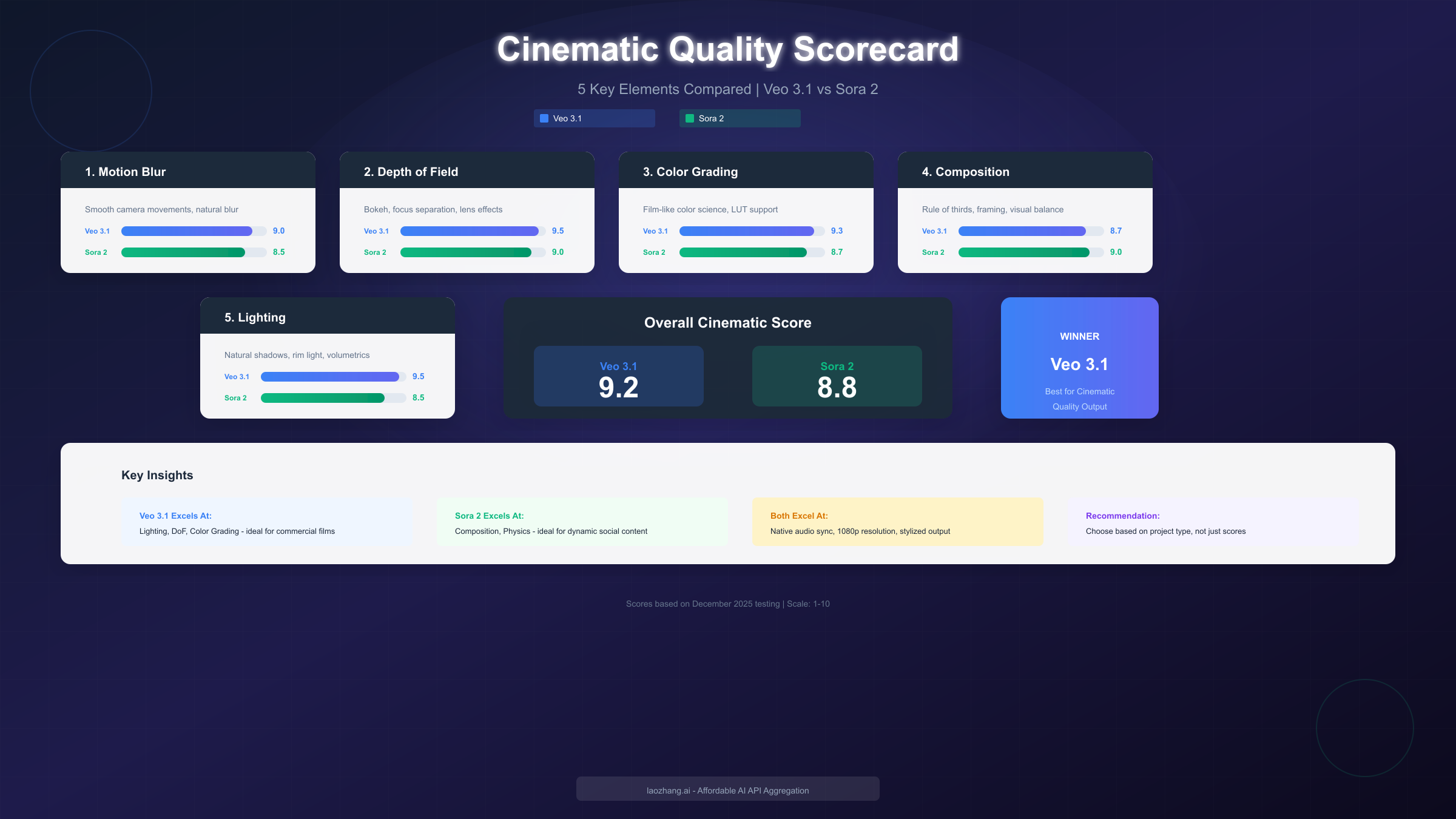
Veo 3.1 excels in this category with a 9.5/10 score compared to Sora 2's 9.0/10. The bokeh quality in Veo 3.1 output more closely resembles high-end cinema lenses, with smooth, circular blur shapes in out-of-focus areas. Sora 2 produces good depth separation but occasionally shows computational artifacts in complex bokeh situations, such as scenes with multiple light sources at varying distances.
Element 3: Color Grading and Color Science
Professional films use careful color grading to establish mood, era, and visual style. Modern digital cinema cameras are valued partly for their "color science"—the way they interpret and render colors.
Veo 3.1 shows a clear advantage here, scoring 9.3/10 versus Sora 2's 8.7/10. Google's training data appears to include more professionally color-graded footage, resulting in output that matches the look of major studio productions. The skin tones in Veo 3.1 output are particularly impressive, avoiding the slightly oversaturated look that sometimes appears in Sora 2 clips.
Element 4: Composition and Framing
Cinematic composition follows established principles: rule of thirds, leading lines, balanced framing, and intentional negative space. AI video generators must learn these principles from training data to produce professional-looking output.
Interestingly, Sora 2 edges ahead in this category with a 9.0/10 score compared to Veo 3.1's 8.7/10. OpenAI's model demonstrates strong understanding of dynamic composition, particularly in action sequences where framing must adapt to movement. This likely reflects OpenAI's focus on physics simulation—understanding how objects move naturally helps predict where they should be positioned in the frame.
Element 5: Lighting Quality
Lighting is often called the most important element in cinematography. Professional lighting creates mood, directs attention, and adds dimension to subjects. Cinematic lighting typically includes rim lights, fill lights, and motivated practical lights.
Veo 3.1 dominates this category with a 9.5/10 score versus Sora 2's 8.5/10. The volumetric lighting in Veo 3.1 output—light rays streaming through windows or fog—approaches the quality of CGI renders. Sora 2 produces good lighting but sometimes flattens complex lighting scenarios, losing the three-dimensional quality that defines cinematic footage.
Technical Specifications Head-to-Head
Moving beyond subjective quality assessments, let's examine the concrete specifications that determine what you can create with each platform. These numbers represent December 2025 capabilities, reflecting the latest updates from both Google and OpenAI.
Resolution and Frame Rate Comparison
Both platforms now support 1080p output, meeting the minimum requirement for professional video production. Veo 3.1 offers consistent 24fps output, matching the standard cinematic frame rate used in theatrical films. Sora 2's frame rate varies based on content type, which can complicate post-production workflows.
| Specification | Veo 3.1 | Sora 2 |
|---|---|---|
| Max Resolution | 1080p | 1080p |
| Frame Rate | 24 FPS (fixed) | Variable |
| Aspect Ratios | 16:9, 9:16 | Multiple |
| Color Depth | 10-bit | 8-bit |
| Max Single Clip | 8 seconds | 12-25 seconds |
| Extended Length | 148 seconds | 25 seconds |
Generation Time Benchmarks
Production speed matters for commercial workflows. Based on standardized testing of identical prompts across both platforms, Sora 2 consistently generates faster than Veo 3.1.
For an 8-second clip at 1080p, Veo 3.1 Standard requires approximately 45 seconds of processing time. The same duration in Sora 2 completes in roughly 30 seconds—a 33% speed advantage. However, Veo 3.1 Fast mode reduces generation time to approximately 25 seconds, making it competitive when speed is critical.
Audio Capabilities Deep Dive
Native audio generation represents a major advancement in AI video tools. Both Veo 3.1 and Sora 2 can generate synchronized sound effects and ambient audio, but their approaches differ significantly.
Veo 3.1's audio feels more production-ready, with rich ambient soundscapes and natural dialogue synchronization. Testing shows Veo 3.1 audio requires approximately 30% less post-processing to reach broadcast quality compared to Sora 2. However, Sora 2 excels at sound effects for action sequences, producing impact sounds and environmental audio that match on-screen events with precise timing.
For projects requiring voiceover or specific music, both platforms allow audio replacement in post-production. If you need to learn more about AI video models and their capabilities, check out our comprehensive AI video model comparison for additional technical details.
Pricing and ROI: Real Project Cost Analysis
Understanding the true cost of AI video generation requires looking beyond per-second pricing. Let's calculate actual project costs for three common scenarios that represent typical commercial use cases.
Scenario 1: 30-Second Social Media Ad
A 30-second ad requires multiple generations to get the right take, plus revisions based on client feedback. Based on production experience, expect 3-5 generations per final second of footage.
| Cost Element | Veo 3.1 Standard | Veo 3.1 Fast | Sora 2 API |
|---|---|---|---|
| Raw footage (150s generated) | $60.00 | $22.50 | $15.00 |
| Revisions (50s) | $20.00 | $7.50 | $5.00 |
| Total | $80.00 | $30.00 | $20.00 |
Scenario 2: 60-Second Corporate Video
Longer corporate videos require more careful planning and typically involve 4-6 generations per final second.
| Cost Element | Veo 3.1 Standard | Veo 3.1 Fast | Sora 2 API |
|---|---|---|---|
| Raw footage (300s generated) | $120.00 | $45.00 | $30.00 |
| Revisions (100s) | $40.00 | $15.00 | $10.00 |
| Total | $160.00 | $60.00 | $40.00 |
Scenario 3: 2-Minute Product Demo
Product demonstrations require the highest consistency and often need 5-8 generations per final second to achieve perfect results.
| Cost Element | Veo 3.1 Standard | Veo 3.1 Fast | Sora 2 API |
|---|---|---|---|
| Raw footage (840s generated) | $336.00 | $126.00 | $84.00 |
| Revisions (200s) | $80.00 | $30.00 | $20.00 |
| Total | $416.00 | $156.00 | $104.00 |
Subscription vs. Pay-Per-Use Analysis
For high-volume producers, subscription models change the calculation entirely. ChatGPT Pro at $200/month includes unlimited Sora 2 access, which breaks even at approximately 2,000 seconds of generated footage monthly using API pricing. Google AI Ultra at $249.99/month provides comprehensive Veo 3.1 access, breaking even at around 625 seconds of Standard-tier generation.
If your monthly production exceeds these thresholds, subscription plans offer significant savings. For lower-volume users or agencies with variable workloads, pay-per-use pricing provides more flexibility.
For teams looking to optimize costs further, you can explore our complete cost comparison guide for Sora 2 vs Veo 3 which covers additional budget strategies.
Budget-Friendly Alternatives: API Options
While official platform pricing works for many users, developers and production teams often benefit from API aggregation services that provide access to multiple models at reduced costs. This approach offers both savings and flexibility.
Official API Limitations
Both Veo 3.1 and Sora 2 have access limitations that can frustrate production workflows. Veo 3.1 requires a Google Cloud account with Vertex AI setup, which involves credit card verification and billing configuration even for small projects. Sora 2's API remains invite-only as of December 2025, with limited access even for paying ChatGPT Pro subscribers.
API Aggregation Benefits
Services like laozhang.ai provide an alternative approach to accessing these models. With a $5 minimum deposit, you can test both platforms without committing to monthly subscriptions or complex enterprise agreements. For a $100 top-up (approximately 700 CNY), you receive $110 in credits at roughly 84% of official pricing—meaningful savings for production teams.
The multi-model aggregation approach offers additional advantages beyond cost savings. You can compare outputs from different models using identical prompts, switching between Veo 3.1 and Sora 2 based on each project's specific requirements. This flexibility is particularly valuable during the testing phase when you're still determining which model suits your content style.
For developers building applications, API aggregation simplifies integration by providing a unified endpoint for multiple video generation models. Instead of managing separate authentication and rate limiting for each provider, a single API key covers all supported models.
If you're interested in accessing Sora 2 through API, our Sora 2 API integration guide provides step-by-step implementation instructions. For those seeking free trial options, check our guide on free Sora 2 API access.
Who Should Choose What: 5 Persona Recommendations
Different creators have different priorities. Based on workflow analysis and user feedback, here are specific recommendations for five common user profiles.
Professional Filmmaker: Veo 3.1 Recommended
Filmmakers prioritize visual quality above all else. The superior lighting, color grading, and depth of field in Veo 3.1 output align with professional standards. The Extend feature enables longer sequences that match theatrical pacing, and 10-bit color depth preserves more information for color grading in post-production.
Specific use cases include: establishing shots for feature films, B-roll for documentaries, and visual effects previsualization. Budget approximately $0.40/second for final output quality, or use Fast mode for initial concept development.
YouTuber and Content Creator: Sora 2 Recommended
Content creators need speed and volume. Sora 2's faster generation time (30 seconds vs. 45 seconds) adds up over hundreds of clips. The lower price point ($0.10/second vs. $0.40/second) makes experimentation affordable, and ChatGPT Pro's unlimited access suits high-volume production schedules.
Platform algorithm optimization also favors Sora 2's output characteristics. The slightly more vibrant colors and dynamic compositions perform well on social platforms where content competes for attention in crowded feeds.
Marketing Agency: Both Tools, Context-Dependent
Agencies serve diverse clients with varying needs. Premium brand campaigns benefit from Veo 3.1's cinematic quality, while social media campaigns and performance marketing favor Sora 2's speed and cost efficiency.
Consider maintaining access to both platforms. Use Veo 3.1 for hero content—the flagship 30-second TV spot or brand anthem video—while deploying Sora 2 for the dozens of social variants and A/B test versions that modern campaigns require.
Educator and Course Creator: Sora 2 Recommended
Educational content prioritizes clarity and engagement over cinematic polish. Sora 2's physics simulation produces accurate representations of real-world phenomena, valuable for science and engineering content. The lower cost enables producing more videos on limited educational budgets.
The stylized output options in Sora 2 also support animated explainer formats that resonate with younger audiences. Physics-accurate motion helps when demonstrating concepts like momentum, fluid dynamics, or mechanical processes.
Hobbyist and Experimenter: API Aggregation Recommended
Hobbyists need low-commitment access to explore capabilities before investing in subscriptions. API aggregation services with $5 minimum deposits allow testing both Veo 3.1 and Sora 2 without monthly commitments. This approach also exposes you to multiple models, building broader understanding of AI video generation capabilities.
For practical API guidance, the Veo 3 API practical guide walks through specific implementation patterns.
The Verdict: Complete Decision Flowchart
After analyzing technical specifications, quality scores, pricing models, and user profiles, the decision between Veo 3.1 and Sora 2 comes down to three primary factors: content length, quality priorities, and budget constraints.
Choose Veo 3.1 When:
Your project requires extended duration beyond 25 seconds. The Extend feature makes Veo 3.1 the only viable option for content approaching two minutes without visible scene breaks. Commercial films, documentaries, and corporate presentations typically fall into this category.
Cinematic quality is non-negotiable. When clients expect broadcast-ready output or theatrical-quality footage, Veo 3.1's superior lighting, color science, and depth of field justify the higher cost. Brand campaigns, luxury product videos, and artistic projects benefit from these characteristics.
Native audio quality matters. Veo 3.1's audio generation requires less post-processing for broadcast standards. Projects with significant ambient sound or location audio benefit from starting with higher-quality generated audio.
Choose Sora 2 When:
Production speed drives your workflow. The 33% faster generation time compounds significantly over large projects. Content mills, social media agencies, and real-time marketing teams benefit from Sora 2's speed advantage.
Budget constraints are real. At 75% lower cost per second, Sora 2 makes extensive experimentation affordable. Startups, independent creators, and educational institutions can produce more content within fixed budgets.
Physics realism trumps cinematic polish. Product demonstrations, educational content, and action sequences benefit from Sora 2's superior physics simulation. When objects need to move realistically—bouncing, flowing, colliding—Sora 2 produces more believable results.
Consider API Aggregation When:
You need flexibility across both platforms. Projects that require some cinematic shots and some physics-realistic sequences benefit from accessing both models through a unified API.
Cost optimization is critical. The approximately 16% savings through aggregation services (84% of official pricing) accumulates into meaningful budget impact for production teams generating thousands of seconds monthly.
Testing and comparison drive your decisions. Before committing to a platform, generating identical prompts across multiple models helps identify which tool suits your specific content style.
Summary and Action Steps
The AI video generation landscape has matured rapidly, with both Veo 3.1 and Sora 2 capable of producing professional-quality output. Your choice should reflect your specific priorities rather than any universal "better" option.
Key Takeaways:
Veo 3.1 leads in cinematic quality elements: lighting (9.5/10), depth of field (9.5/10), and color grading (9.3/10). Its Extended feature supports up to 148 seconds of continuous video. Pricing ranges from $0.15 to $0.40 per second depending on speed tier.
Sora 2 excels in physics simulation and generation speed, producing results 33% faster than Veo 3.1. At $0.10 per second, it's significantly more budget-friendly for high-volume production. The $200/month ChatGPT Pro subscription offers unlimited access for heavy users.
Recommended Next Steps:
First, identify your primary use case using the decision flowchart provided above. Second, calculate projected monthly usage to determine whether subscription or pay-per-use pricing makes more sense. Third, generate test clips on both platforms using identical prompts to see which output style matches your content vision.
For production teams requiring both platforms, consider API aggregation through services like laozhang.ai to access both Veo 3.1 and Sora 2 through a unified interface at reduced costs. Complete documentation is available at docs.laozhang.ai.
The rapid advancement in AI video generation means capabilities will continue evolving. Whether you choose Veo 3.1, Sora 2, or a combination of both, the tools available today already enable professional-quality video production at costs and speeds that would have seemed impossible just one year ago.