
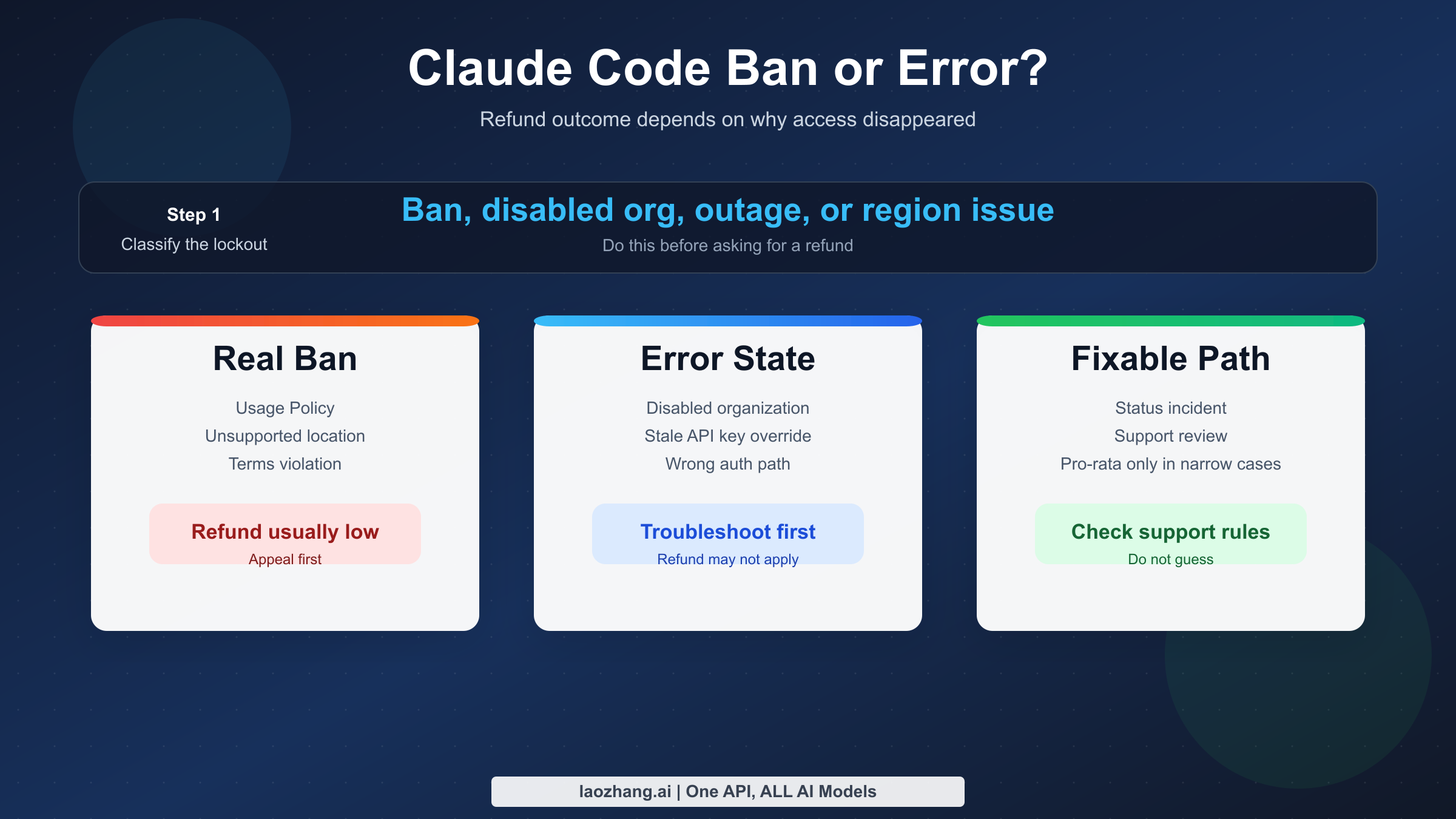
If you paid for Claude Pro or Claude Max and then lost access to Claude Code, the worst mistake is assuming every lockout means the same thing. A real safeguards suspension, an unsupported-location signup, a disabled Anthropic Console organization, a stale ANTHROPIC_API_KEY, and a temporary Claude login outage can all feel identical in the first ten minutes. They do not lead to the same refund outcome.
As of March 18, 2026, Anthropic's current support and legal pages point to a much narrower refund rule than most angry Reddit or GitHub threads suggest. The short version is simple: refunds are not automatic, and a policy-based termination usually means no refund. But there are still meaningful exceptions, and some of the most frightening Claude Code error messages are not bans at all. If you sort the failure mode first, you can avoid making the wrong support request, avoid unnecessary chargeback mistakes, and improve your odds of a useful answer from Anthropic.
TL;DR
- If Anthropic terminated your access because it believes you violated the Consumer Terms, the Consumer Terms say you are not entitled to a refund.
- If Anthropic terminates a website-purchased subscription for another reason, the same Terms say it will refund the unused remainder on a pro-rata basis.
- Anthropic's refund article says paid plan payments are non-refundable except where the Terms or local law say otherwise.
- Anthropic's safeguards article currently lists three headline suspension triggers: repeated Usage Policy violations, account creation from an unsupported location, and Terms of Service violations.
- Not every Claude Code lockout is a true ban. The error
This organization has been disabledcan come from a disabled Console organization or an oldANTHROPIC_API_KEY, even when your personal Pro or Max subscription still works. - Anthropic's status page recorded a March 11, 2026 incident that caused Claude.ai login issues for Claude Code users. Always check status before assuming enforcement.
- If you cannot log in, Anthropic support says it can still help with subscription support, including cancellation and refund-eligibility checks, through the Help Center messenger by choosing
I can't login. - Paid plan pricing, as checked on March 18, 2026: Pro is
\$20/monthin the US, Max 5x is\$100/month, and Max 20x is\$200/monthfor web subscriptions.
| What you see | What it usually means | What to do in the next 10 minutes |
|---|---|---|
| Account suspended or terminated | Real safeguards or Terms enforcement | Save the error, open the appeal form, and collect payment evidence |
This organization has been disabled | Often a Console org or API-key problem, not a consumer ban | Unset ANTHROPIC_API_KEY, run /login, and test Claude.ai in the browser |
| Web and CLI both failing during an incident | Outage or login disruption | Check status.claude.com before filing a ban complaint |
Claude Code ban refund: the short answer
The direct answer to "Can I get a refund if Claude Code banned my account?" is: sometimes, but usually not for the reason people hope. If Anthropic decided your account violated its Terms or safety rules, the current Consumer Terms of Service are blunt: no refund. If Anthropic ends your website subscription for another reason, the same Terms say it refunds the unused portion on a pro-rata basis. If the problem is not a real ban, but instead a login outage, a region-compliance mismatch, or a disabled API organization overriding your subscription, then the real task is recovery or support triage, not refund law.
That distinction matters because searchers usually show up after one of two emotionally loaded moments. The first is "I paid, then got disabled." The second is "Claude Code says my organization is disabled, so Anthropic must have banned me." Those look similar from the user's point of view, but they sit in different systems. Claude subscriptions live in the consumer account world. Anthropic Console organizations and API keys live in the commercial account world. Claude Code can touch both. That is why the same CLI can surface both subscription problems and organization-level API problems.
The cleanest way to think about this topic is to ask two questions in order. First, what exactly stopped working? Second, why did it stop? Only after you answer those can you estimate refund odds. A user whose consumer account was truly suspended for Terms violations is in a different position from a Max subscriber whose terminal kept using a dead API key from a previous employer. One case is a policy dispute. The other is an authentication trap.
Here is the decision table most current SERP pages are missing:
| What you see | What it usually means | Refund odds | What to do first |
|---|---|---|---|
| Claude account suspended or terminated notice | Real safeguards or Terms enforcement | Usually low | Save evidence, file appeal, then ask support about subscription status |
This organization has been disabled in Claude Code | Often a disabled Console organization or stale API key override | Not enough information yet | Unset ANTHROPIC_API_KEY, run /login, and test web Claude separately |
| Claude web and Claude Code both fail during a known incident | Operational outage, not a ban | No refund case yet | Check Claude Status and wait for incident resolution |
| Paid for Pro or Max and then immediately lost access | Could be region enforcement, billing review, or auth confusion | Mixed | Check supported-location eligibility, then contact support using the locked-out path |
| Locked out of the original account and cannot access Billing | Support triage problem | Manual review only | Use the Help Center messenger, choose I can't login, and request cancellation plus refund-eligibility review |
For most people, the practical answer is this: do not promise yourself a refund, but do not assume you are disqualified either. The official documentation creates three broad buckets. Bucket one: violation-based termination, which is the hardest case and the worst for refunds. Bucket two: Anthropic-initiated termination for another reason, where pro-rata refund language exists for website purchases. Bucket three: cases that look like bans but are really access, billing, or status problems. Bucket three is the one too many users skip.
It also helps to understand what your subscription actually includes. Anthropic's current support pages say Pro includes Claude Code access and costs \$20/month in the US, while Max comes in two web tiers, \$100/month for 5x usage and \$200/month for 20x usage. Pro sessions reset every 5 hours, and Pro also has a weekly limit that resets 7 days after your session starts. Max offers two weekly limits that also reset 7 days after the session starts. Those numbers do not decide refunds, but they do explain why a user may confuse ordinary capacity limits with suspension, especially after a large coding sprint.
Another easy source of confusion is API billing. Anthropic's current Claude Code plan article says that if ANTHROPIC_API_KEY is set, Claude Code uses that key instead of your Pro or Max subscription. That means you can be a paying Max subscriber and still see an organization-level API error because the CLI is not actually using your Max plan at all. The symptom feels like "my subscription was banned." The root cause can be "the terminal was silently trying a disabled API organization."
So if you only remember one sentence from this article, make it this one: a Claude Code lockout is not a refund question until you identify whether the problem lives in consumer subscriptions, Console organizations, supported-region enforcement, or service status.
What Anthropic officially says can trigger a suspension
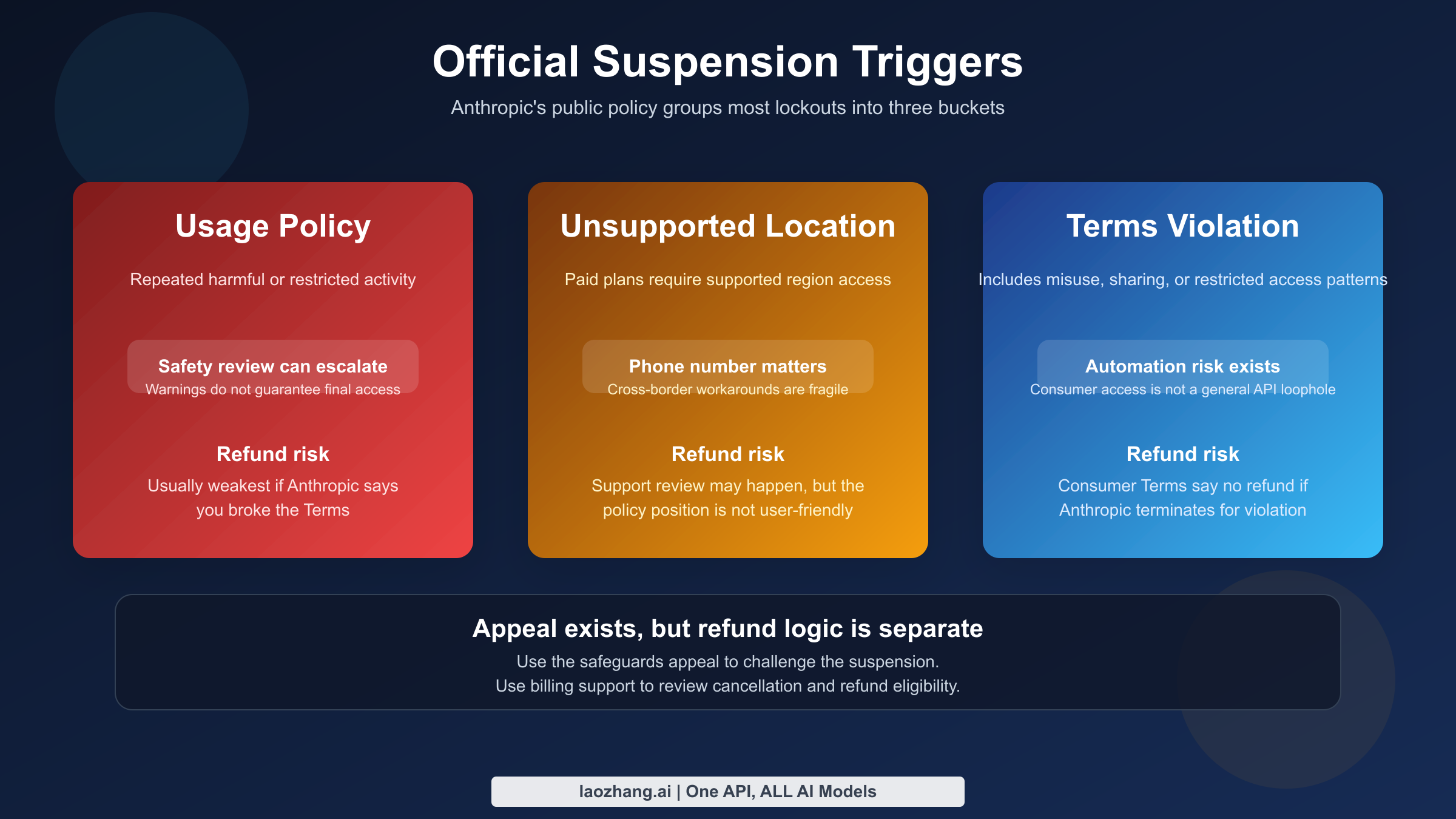
Anthropic's current Safeguards Warnings and Appeals article, checked on March 18, 2026, lists three headline reasons an account may be banned: repeated Usage Policy violations, account creation from an unsupported location, and Terms of Service violations. That is the most direct public support statement Anthropic currently gives users who are trying to understand why their account disappeared.
This matters because most unofficial posts talk about "random bans" as if Anthropic has no declared framework. In reality, the framework is public, but it is distributed across support and legal pages rather than gathered in one consumer-facing matrix. The support article tells you the visible categories. The Consumer Terms tell you the enforcement power behind them. The supported-region and billing articles tell you which user behaviors create risk even before any actual usage-policy question appears.
The first bucket is repeated Usage Policy violations. That usually means Anthropic believes the account kept generating or attempting content that crossed the company's safety thresholds. Anthropic's support article also says warnings exist before full bans in some cases, and it notes that cyber-related traffic can trigger restrictions. In other words, not every safety action starts at the most severe level, but the user may only notice the process once access is already impaired.
The second bucket is unsupported location. For this keyword, that is especially important. Anthropic's Pro signup article says paid plans are available only to users physically located in supported locations and that the company requires a phone number from a supported location to create an account. Anthropic's current supported-locations page, checked on March 18, 2026, includes the United States but does not list mainland China. That absence is not the same as a sentence saying "China is banned," but it is the practical compliance signal users need: if a location is not on the published list, you should assume it is unsupported unless Anthropic says otherwise.
The third bucket is Terms of Service violations. This is where many Claude Code edge cases sit, because the Consumer Terms are broader than obviously abusive prompts. The Terms require compliance with the Acceptable Use Policy and the Supported Regions Policy. They also prohibit sharing account credentials and making the account available to someone else. The Terms further prohibit, except where Anthropic explicitly permits it or where you are accessing through an Anthropic API key, using the services through automated or non-human means. That clause matters for people who try unofficial wrappers, scripted browser automation, credential sharing, or reseller-style workarounds around the consumer product.
Here is the useful policy translation:
| Official trigger | What it means in practice | Why it matters for refunds |
|---|---|---|
| Repeated Usage Policy violations | Anthropic believes the account kept crossing safety lines | Hardest case for refund arguments |
| Unsupported location or account creation from unsupported location | Signup or usage happened from a place Anthropic does not support | Often leads to weak refund posture because the access itself was out of policy |
| Terms of Service violation | Broader than prompt content; can include credentials, automation, or misuse | Consumer Terms explicitly say violation-based termination does not earn a refund |
| Cyber restrictions or safety thresholds | Access may be limited before or instead of full termination | Sometimes fixable through the special cyber use case review |
If you need a sense of scale, Anthropic's Transparency Hub, last updated on January 29, 2026, reported 1.45 million banned accounts for the July to December 2025 period. The same page reported 52,000 appeals and 1,700 appeal overturns. Those numbers do not prove any individual ban was correct, but they do prove two things that are strategically important for users. First, Anthropic does run enforcement at large scale, so "surely a human personally checked my case before the block landed" is not a safe assumption. Second, the appeal channel is not fake. It exists, it is documented, and some decisions do get reversed.
At the same time, the safeguards page itself carries a warning about slow response times due to increased email volume after a recent launch. That detail matters because support silence is often interpreted as rejection. In practice, it may also reflect queue pressure. If you file an appeal on March 18, 2026, you should expect that the first answer may take time, and you should preserve your invoices, screenshots, and timestamps accordingly.
There is also a subtle but important legal separation between consumer Claude subscriptions and Anthropic API usage. The Consumer Terms explicitly say they govern Claude.ai, Claude Pro, and other individual products. They also say Anthropic's Commercial Terms govern use of an Anthropic API key and the Anthropic Console. That separation is why a single error in Claude Code can blur two different policy worlds. If you paid for Max but the terminal is actually authenticating with an API key, you may be dealing with commercial-org status, not consumer subscription enforcement.
In plain English, the official suspension logic is less mysterious than it looks. Anthropic says: follow supported-region rules, follow usage rules, do not misuse the service, and do not assume consumer subscriptions can be stretched into quasi-API or scripted-access patterns that the Terms do not allow. If Anthropic believes you crossed those lines, the legal default is not generous.
Troubleshooting: before you ask for a refund, check whether this is really a ban
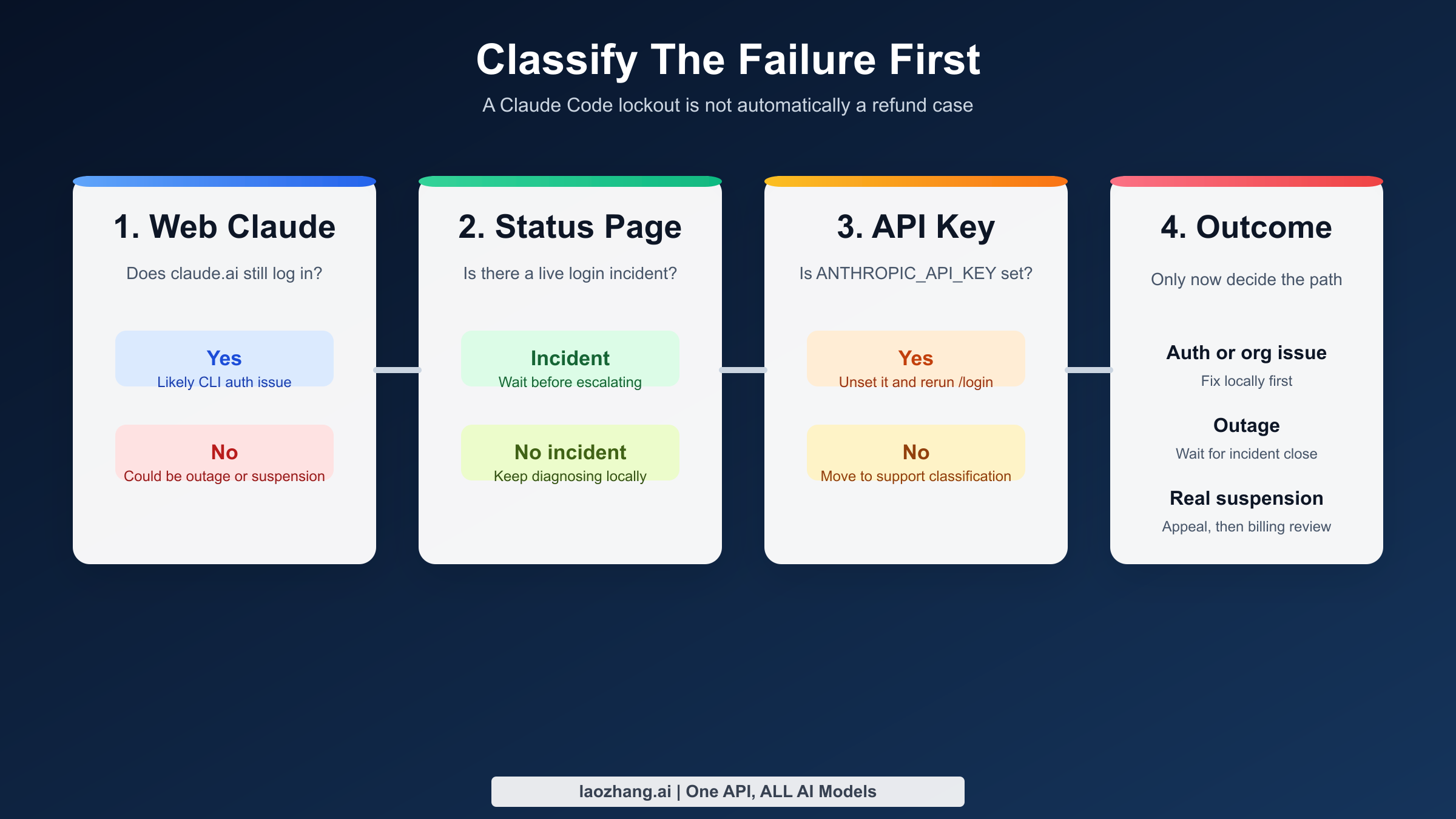
The easiest way to waste time after a Claude Code failure is to skip diagnosis and jump straight to refund demands. That feels satisfying, but it often collapses four different problems into one angry email. Your odds improve if you classify the failure first.
The four most common states are:
- A real consumer-account suspension or termination.
- A disabled Anthropic Console organization or API key.
- A service incident affecting Claude.ai login or Claude Code auth.
- A supported-region or signup-compliance problem.
Each of these can block your work. Only one of them is cleanly described as "I was banned from Claude Code."
Start with the simplest test. Can you still log in at claude.ai in a browser? If the web product still works but the terminal fails, you are less likely to be looking at a full consumer-account ban. You may be looking at CLI auth confusion, a stale local credential, or an API-key override. Anthropic's own plan article says the CLI should authenticate with the same Claude credentials you use for Claude, but it also warns that ANTHROPIC_API_KEY overrides subscription auth and uses API billing instead. That single line explains a surprising amount of panic.
This is not hypothetical. A public GitHub issue in the official anthropics/claude-code repository, issue #8327, opened on September 29, 2025, documents users with valid Pro or Max subscriptions seeing the error This organization has been disabled because an old ANTHROPIC_API_KEY from a disabled organization kept overriding their personal subscription. The reporter included a reproducible fix: unset the environment variable, then retry Claude Code using the subscription login. That issue is not binding policy, but it is excellent troubleshooting evidence because it maps directly to the exact error string users search.
Another public GitHub issue, #5088, opened on August 4, 2025, describes a more painful pattern: payment for Claude Code Max 5x followed by immediate loss of access to both Claude.ai and Claude Code with the same This organization has been disabled message. That kind of report is why this keyword exists. But even there, the key lesson is not "every disabled-organization message means the same thing." The lesson is that the message is broad, user-hostile, and capable of covering different underlying failures.
Here is the practical separation table:
| Symptom | Most likely system | What it usually is not | Best next test |
|---|---|---|---|
| Claude.ai works, Claude Code fails with organization error | Console or API-key path | Full consumer ban | Run `env |
| Claude.ai and Claude Code both fail at the same time, while status shows incident | Service outage | Personal misconduct finding | Wait for status resolution and retry after incident close |
| New Pro or Max payment succeeded, then account access vanished from every surface | Possible safeguards or region enforcement | Simple usage cap | Check supported-region eligibility, then appeal plus support path |
| CLI prompts for API-credit behavior and shows Console messaging | Commercial API path is involved | Pure subscription-only flow | Clarify whether you are using subscription auth or Console auth |
| Normal "usage limit reached" message with reset timing | Capacity limit | Suspension | Check /status and plan limits before escalating |
The status-page check is more important than most users realize. Anthropic's Claude Status page shows a March 11, 2026 incident titled Elevated errors on Claude.ai (including login issues for Claude Code). During that incident, Anthropic said some users could be unable to log in while the Claude API was unaffected. That one entry proves an operational point that should change user behavior: login failures can be platform incidents even when your account is fine.
This distinction is especially useful for engineers who have both a personal Claude subscription and a work or legacy API setup. If web Claude still accepts your login but claude in the terminal throws organization errors, the terminal may simply be following a different auth path. Anthropic's plan article also notes that if you are already logged in via Claude Console pay-as-you-go, you can run /login from within Claude Code to switch back to your subscription plan. That is a troubleshooting step, not a refund step.
There is another source of false escalation: users mix up usage limits with enforcement. Pro plan usage resets every 5 hours at the session level, and Pro also has a weekly usage limit. Max has weekly limits too, including one across all models and another for Sonnet, both resetting 7 days after your session starts. Hitting those limits is frustrating, but it is not the same as being banned. If the product is still telling you about remaining capacity, reset timing, or upgrade options like Max 5x or Max 20x, you are in capacity management, not safeguards enforcement.
In contrast, a real suspension usually has a different feel. Web Claude and terminal Claude break together. Billing and settings may become inaccessible. The safeguards support article becomes relevant. Appeal language becomes relevant. The error is no longer a local-shell or CLI configuration story.
Why does this matter for refunds? Because every minute you spend arguing the wrong theory makes it harder to present the right facts. If you submit "I was banned and demand a refund" when the actual problem is a stale API key overriding Max, support may push you into the wrong queue. If you file a payment dispute with your bank before checking status and support, Anthropic's refund article says support cannot process refunds during pending disputes because the funds are already pulled back. That can turn a fixable support case into a longer billing mess.
The right workflow is boring, but it works better. Test web access. Test CLI access. Check status. Check for ANTHROPIC_API_KEY. Reauthenticate with /login. Only then decide whether you are dealing with support, appeal, or billing.
When a refund is possible, unlikely, or legally protected
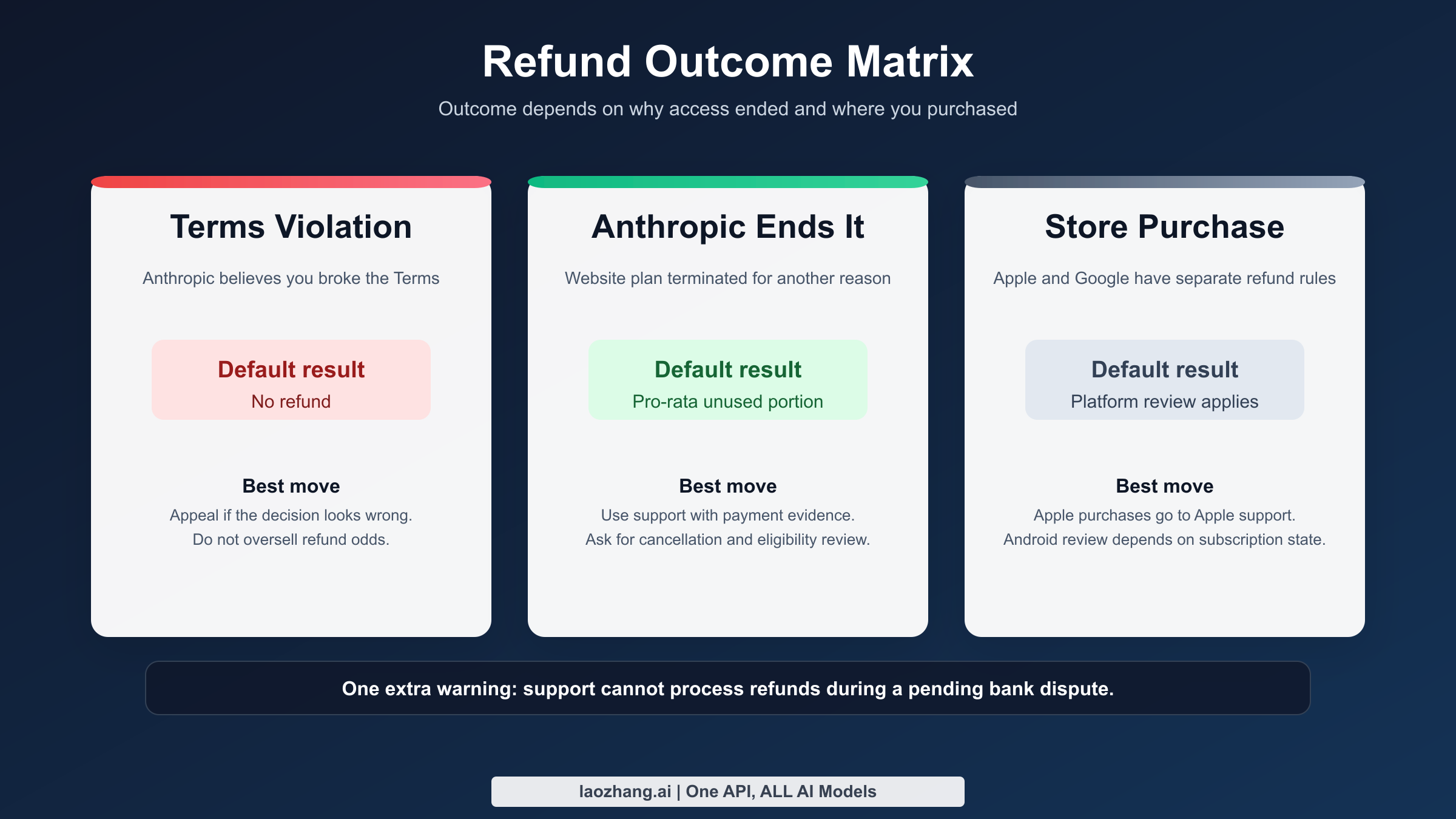
Anthropic's current refund article opens with the sentence most users do not want to read: except where the Consumer Terms or law say otherwise, all payments are non-refundable. That is the default rule. If you stop there, the picture looks grim. But the actual outcome depends on which exception bucket you fall into.
The key legal language lives in the Consumer Terms, effective October 8, 2025. The termination section says Anthropic may suspend or terminate access, including subscriptions, at any time without notice if it believes you breached the Terms or if law requires it. If Anthropic terminates your access due to a Terms violation and you have a subscription, you are not entitled to any refund. That is the strongest official statement on the page for a true policy-based ban.
The same section then creates the main exception. If you have a subscription and Anthropic terminates it for any other reason, and you purchased the subscription through Anthropic's website, Anthropic says it will refund the remaining portion on a pro-rata basis. That is not a promise that every unpleasant account event qualifies. It is a promise about a narrower class of Anthropic-initiated termination that is not grounded in your violation of the Terms.
That means there are really three refund tracks:
- Track 1: violation-based termination. Lowest refund odds.
- Track 2: Anthropic-initiated non-violation termination for website purchases. Pro-rata refund language applies.
- Track 3: manual support review for ambiguous account, access, or billing problems. Outcome depends on the facts and payment channel.
The payment channel matters more than many users expect. Anthropic's refund article says if you paid through iOS, Apple processed the payment and you need to request the refund through Apple Support. If you paid through Android and the subscription is active, Anthropic support says it will check eligibility before helping. But for inactive historical Play Store payments, Anthropic says it cannot issue refunds and directs users to Google Support instead. So even before policy questions, the refund path splits by web, iOS, and Android.
Another operational detail matters: disputes. Anthropic's refund article says support cannot process refunds during pending disputes because disputed funds are pulled back immediately. In practice, that means a chargeback is not a neutral backup plan. It changes the workflow. If you open a bank dispute first, you may block Anthropic from handling the refund in the normal path until the dispute is resolved or withdrawn.
Here is the most useful refund matrix:
| Scenario | Official basis | Likely outcome |
|---|---|---|
| Anthropic says you violated Terms or Usage Policy | Consumer Terms termination clause | No refund is the stated default |
| Anthropic ends a website subscription for another reason | Consumer Terms pro-rata clause | Unused portion should be refunded pro rata |
| You cannot log in, but support validates account and payment details | Help Center subscription support flow | Possible manual review, not guaranteed |
| Payment happened through Apple App Store | Anthropic refund article | Must request through Apple |
| Active Android subscription purchased in app | Anthropic refund article | Anthropic support reviews eligibility |
| Inactive historical Android payment | Anthropic refund article | Google support, not Anthropic |
| Pending bank dispute already filed | Anthropic refund article | Anthropic support cannot process refund during dispute |
Now apply that framework to the question users actually ask: "I paid for Max and got banned right after payment. Do I get my money back?" The honest answer is "not necessarily." If the payment and the block were part of an unsupported-region or Terms-compliance problem, Anthropic has strong contractual language against refund entitlement. If the account was disabled for some non-violation reason and the purchase was through the website, the pro-rata clause becomes relevant. If the problem is actually that your terminal is using a dead API organization while your web subscription is fine, you are probably not in a refund case at all.
This is where timing helps. If the bad event happens minutes after payment, users often assume the payment itself triggered a fraud review or ban. Sometimes that may be directionally true. But current public Anthropic documentation does not say "immediate post-payment bans always get refunded" or "payment-triggered checks always mean fraud." It gives you a support path, a refund path, and a termination rule. That is why your evidence package matters so much.
Collect at least these facts before you contact support:
- purchase date and time
- billing email
- whether the payment was web, iOS, or Android
- whether Claude.ai still works
- whether Claude Code still works
- exact terminal error text
- whether
ANTHROPIC_API_KEYwas set - whether the issue overlaps with a status-page incident
- your physical location at signup and use time
- screenshots of billing confirmation and error pages
Those details do not guarantee a refund, but they do determine whether support can even classify the request. Anthropic's support article says that if you are a paid subscriber who cannot access your account, the team can help locate login information, process subscription cancellations, and check refund eligibility, but it will need to validate details about your account and payment method. Users who arrive with clean timestamps and billing evidence are simply easier to help.
It is also worth separating cancellation from refund. Anthropic's paid-subscription cancellation article says you can cancel at any time, but the cancellation takes effect at the end of the current billing period. To avoid the next renewal charge, Anthropic says to cancel at least 24 hours before the next billing date. That is ordinary subscription management, not retroactive refund law. Many users mix those up. Canceling stops the next charge. A refund tries to undo part of the current charge.
The pricing context matters here too. On March 18, 2026, Anthropic's support pages list Pro at \$20/month, Max 5x at \$100/month, and Max 20x at \$200/month for web subscriptions. Those are not small accidental charges for many individuals, which is why emotions run high. But higher price does not create broader refund rights by itself. Refund rights come from the Consumer Terms, local law, the payment platform's rules, and Anthropic's manual support review.
One more nuance: Anthropic's current Max article says upgrading from a lower tier to a higher tier is billed on a prorated basis for the remainder of the billing cycle. It also says moving from annual Pro to Max can create credits when the remaining annual Pro balance is larger than the Max price, assuming the billing address matches. Those details matter if the account event happened during an upgrade path rather than a brand-new standalone purchase. In those cases, the financial cleanup may be part refund, part credit, and part cancellation timing.
So the real answer is narrower and more useful than blanket advice. Refunds are possible in documented cases, but Anthropic's public rules heavily favor the company when it believes the user violated Terms or supported-region rules. Your best leverage is accuracy, not outrage.
Exact steps if your Claude or Claude Code account is locked
When access disappears, speed matters, but sequence matters more. The first 30 minutes should be about classification and evidence, not guesswork.
-
Take screenshots before you retry anything. Capture the error on Claude.ai, Claude Code, billing confirmations, renewal emails, and any recent usage-limit warnings. Many users overwrite the most informative message by repeatedly reauthenticating or reinstalling.
-
Check Claude Status immediately. If there is an ongoing incident affecting Claude.ai or Claude Code login, wait for that to resolve before you file a safeguards appeal. Anthropic's March 11, 2026 incident proves this step is not paranoid.
-
Test the web product and the terminal separately. If web Claude works but
claudedoes not, you probably have a CLI or auth-path problem rather than a full consumer suspension. -
Check for
ANTHROPIC_API_KEY. In a Unix-like shell, runenv | grep ANTHROPIC_API_KEY. If it exists, temporarily unset it withunset ANTHROPIC_API_KEY, then reopen the terminal and runclaudeagain. Anthropic's own support article says the environment variable overrides your subscription and uses API auth instead. -
Use
/loginfrom inside Claude Code if the CLI is still reachable. Anthropic explicitly documents/loginas the way to switch back to the correct account when Claude Code is already using Claude Console pay-as-you-go instead of your subscription. -
If the web account appears suspended, use the safeguards path. Anthropic's safeguards article says to submit the appeal form if you believe the account was wrongly suspended or terminated.
-
If you cannot log in at all, use the Help Center messenger and choose
I can't login. Anthropic's support article says it can still help with subscription support in this state, including cancellation and refund-eligibility checks. -
State your request with precision. Do not send a vague "refund me" message. Say what happened, on what date, after what payment, through which platform, and whether Claude.ai and Claude Code both failed or only one did.
-
Do not start a bank dispute unless you are intentionally leaving the support path. Anthropic says support cannot process refunds during pending disputes.
-
Preserve location facts. If you signed up while traveling, moved countries, used a foreign payment method, or created the account from a place that might not be supported, document that honestly. Unsupported-region mismatches are an official enforcement reason, and hiding them makes your case weaker.
Here is the fastest support-routing matrix:
| Your state | Best route | What to say |
|---|---|---|
| Web and terminal both suspended | Safeguards appeal + support | "Paid subscriber, access suspended on [date], requesting review and subscription-status clarification" |
| Can't log in anywhere | Help Center messenger -> I can't login | "Need subscription support, cancellation, and refund-eligibility review for locked account" |
| Terminal only broken | CLI troubleshooting first | "Web account works; Claude Code shows disabled organization; checking API-key override" |
| iOS payment | Apple support | "Requesting App Store refund for Claude subscription payment" |
| Android payment | Anthropic support if active, Google if inactive historical payment | "Active Android subscription, locked out, requesting eligibility review" |
When you contact support, include a compact timeline. For example:
2026-03-18 09:12 UTC: upgraded to Max 5x on web
2026-03-18 09:14 UTC: confirmation email received
2026-03-18 09:16 UTC: Claude.ai session logged out
2026-03-18 09:17 UTC: Claude Code showed "This organization has been disabled"
2026-03-18 09:20 UTC: status.claude.com showed all systems operational
2026-03-18 09:25 UTC: ANTHROPIC_API_KEY was not set
That style is better than a long emotional narrative because it gives support something testable. If the issue overlaps with a known incident or a known auth trap, the sequence makes it visible.
You should also decide early what outcome you are asking for. In most cases, one of four requests makes sense:
- restore access
- cancel renewal
- review refund eligibility
- confirm whether this was a safeguards or billing/auth event
Do not ask for all four in a confused wall of text. Prioritize. If you only need continuity for work, restoration matters more than a same-day refund. If you no longer trust the account and want to exit, cancellation and eligibility review should be the focus.
For developers, there is one extra check worth making. If you have both a Claude subscription and Console credits, ask yourself whether the recent activity was meant to run against the consumer plan or the API. Anthropic's current documentation is explicit that Pro does not include API usage through Claude Console. The support article on Pro and Max plan use in Claude Code also explains that switching to API credits is a separate decision. If you accidentally crossed into Console billing territory, you may be asking the wrong support team the wrong refund question.
Finally, remember that appeals and billing support are related but not identical. The safeguards team is deciding whether access should return. Billing support is deciding whether subscription cancellation or refund review applies. The fastest path is often to run both tracks in parallel when the facts justify it, while keeping your story consistent across both.
Region risk, workarounds, and practical alternatives
The Chinese wording in this keyword is not incidental. It points to a real pattern: many users searching for "Claude Code ban refund" are not just general English-speaking subscribers who had a random billing problem. They are often dealing with one of three higher-risk situations:
- they created or used the account from a place Anthropic may not support
- they used a workaround that blurred consumer access and API-style access
- they are trying to recover money after using a cross-border method that was fragile from the start
Anthropic's public documentation is clear enough to make the risk readable. The supported-locations page is the canonical list. The Pro signup article says paid plans are only for users physically located in supported locations and require a phone number from a supported location. As checked on March 18, 2026, mainland China does not appear in the published list. If you built your access strategy around a location that is not on Anthropic's current list, you should treat that as a major compliance risk, not a minor technicality.
That is why "just use a foreign card," "borrow a phone number," or "register through a friend's country" is bad advice even when it seems to work for a while. Those methods may get you past the first payment screen, but they do not create a durable support position later. If the account is reviewed and Anthropic decides the signup or usage location was unsupported, you are back in the exact official suspension category Anthropic already publishes.
The same caution applies to unofficial automation or proxy habits around the consumer product. Anthropic's Consumer Terms prohibit automated or non-human access unless you are using an Anthropic API key or Anthropic explicitly permits it. That means some "growth hack" workflows people recommend in forums are not clever loopholes. They are risk multipliers.
For users who genuinely need coding continuity rather than account recovery, the safest question is not "How do I force this Claude subscription to keep working?" It is "What is the correct product path for my use case?" If you need compliant API access, read our Claude API key guide and Claude API quota tiers and limits guide. Those articles cover the commercial path, which is a different legal and billing system from consumer Claude Pro and Max.
If your real need is terminal coding assistance and your Claude subscription is no longer reliable for your situation, it may be smarter to switch tools than to keep fighting a weak account. That does not mean every alternative is a like-for-like replacement. It means you should match the access method to the job:
- consumer subscription if you want Claude web plus Claude Code inside supported regions
- Anthropic Console or supported cloud provider if you need API-style access
- another coding agent if the real goal is uninterrupted delivery work
There is also a narrow place for relay or aggregation products, but only in the API context. If your problem is "I need OpenAI-compatible or multi-model API routing for production code," a gateway such as laozhang.ai can be relevant because it sits in the API layer, not the consumer subscription layer. If your problem is "my Claude Max subscription was suspended and I want my chat plan back," an API gateway is not the same product category and should not be treated as a refund substitute.
A realistic fallback plan for affected developers looks like this:
- finish the Anthropic support and appeal workflow cleanly
- stop using risky cross-border consumer workarounds
- move to a supported API or cloud route if your use case is actually programmatic
- document the account timeline so you do not repeat the same failure pattern
The most useful FAQ answers are short:
Can I get refunded if Claude banned me right after payment?
Not automatically. If Anthropic believes you violated the Terms, the Consumer Terms say no refund. If Anthropic ends a website subscription for another reason, the Terms say the unused part is refunded pro rata. If the problem is a login, API-key, or status issue, classify that first.
What does This organization has been disabled mean?
It often points to an Anthropic Console organization or API key problem, not necessarily a personal Claude subscription ban. Check whether ANTHROPIC_API_KEY is set and whether web Claude still works.
What if I cannot log in to request a refund?
Anthropic's support article says to use the Help Center messenger, start a conversation, and choose I can't login. The team says it can help with subscription support, cancellation, and refund-eligibility checks after validating your details.
Should I file a chargeback immediately?
Only if you are prepared to leave the normal support path. Anthropic says its support team cannot process refunds during pending disputes.
Does using automation or scripts matter?
Yes. Anthropic's Consumer Terms prohibit automated or non-human access unless you are using an Anthropic API key or Anthropic explicitly allows it. That can turn a "technical trick" into a Terms problem.
Can I simply create a new account?
Sometimes that only compounds the issue. If the original problem was supported-region or Terms compliance, a second account created under the same risky conditions does not fix the underlying problem.
The uncomfortable conclusion is that many "Claude Code ban refund" cases are actually product-fit mistakes exposed by enforcement. A consumer Claude subscription is not a universal access layer. It is a region-limited, Terms-bound consumer product that now happens to include Claude Code. Once you see it that way, the documentation stops looking contradictory. The product, support, and refund behavior become much easier to predict.
For most readers, the practical closing advice is simple. Use the official support routes. Check status first. Separate subscription auth from API auth. Be honest about location and signup facts. Ask for the exact outcome you want. And if your real need is stable coding throughput rather than restoring one fragile consumer account, move to the correct access model instead of doubling down on a workaround that already failed.