
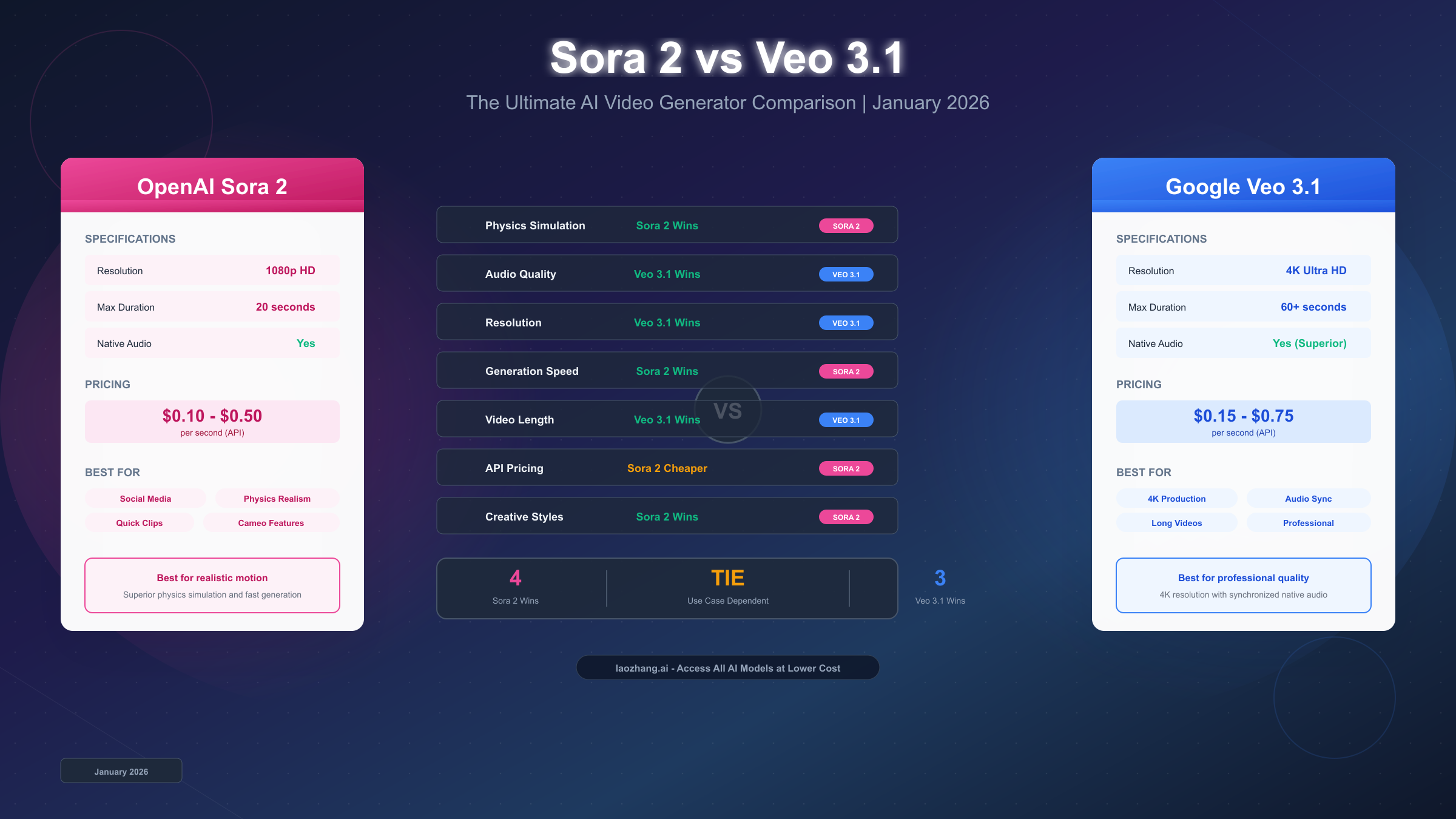
OpenAI's Sora 2 and Google's Veo 3.1 represent the pinnacle of AI video generation technology in early 2026, each bringing distinct strengths to the creative process. Sora 2, released on September 30, 2025, excels at physics simulation with generation speeds of approximately 30 seconds for a 12-second clip, making it ideal for social media creators who need quick turnaround. Veo 3.1, launched on October 15, 2025, delivers 4K resolution with native audio generation, positioning itself as the professional choice for cinematic productions. This comprehensive guide provides the latest specifications, real pricing data, and practical recommendations to help you choose the right tool for your specific video production needs.
Quick Comparison: Sora 2 vs Veo 3.1 at a Glance
Before diving into the detailed analysis, here's a comprehensive comparison table that captures the essential differences between these two AI video powerhouses. This quick reference will help you immediately understand where each platform excels.
| Feature | Sora 2 (OpenAI) | Veo 3.1 (Google) |
|---|---|---|
| Release Date | September 30, 2025 | October 15, 2025 |
| Maximum Resolution | 1080p HD | 4K Ultra HD |
| Maximum Duration | 20 seconds | 8 seconds (60s+ with Scene Extension) |
| Native Audio | Yes (synced) | Yes (superior quality) |
| Generation Speed | ~30 seconds for 12s video | ~45 seconds for 8s video |
| API Pricing | $0.10-0.50/second | $0.15-0.75/second |
| Access Method | ChatGPT Plus/Pro + Invite | Gemini API, Vertex AI |
| Best For | Social media, quick clips | Professional production, 4K content |
The specifications tell an interesting story about how each company approached the AI video challenge. OpenAI prioritized speed and accessibility with Sora 2, creating a model that generates videos faster and costs less per second at lower resolutions. Google, on the other hand, pushed for maximum quality with Veo 3.1, offering 4K output and what many consider superior audio synchronization.
Understanding these core differences is essential because they directly impact which tool will serve your specific workflow better. A social media manager creating daily content has fundamentally different needs than a production studio working on commercial advertisements. The sections that follow will help you understand exactly how these differences play out in real-world scenarios.
Sora 2: Deep Dive into OpenAI's Video Generator
Sora 2 represents OpenAI's bold entry into the AI video generation space, and it brings several innovations that set it apart from previous attempts at text-to-video AI. Released on September 30, 2025, it quickly gained attention for its remarkably realistic physics simulation and fast generation times.
Technical Architecture and Capabilities
The most impressive aspect of Sora 2 lies in its physics engine. Unlike earlier models that often produced videos where objects behaved in physically impossible ways, Sora 2 demonstrates an understanding of real-world physics that approaches photorealism. When you prompt it to show a basketball missing a shot, the ball actually rebounds off the backboard realistically rather than teleporting to the hoop. This attention to physical accuracy extends to complex scenarios like water dynamics, fabric movement, and even athletic performances like gymnastics routines.
The model supports resolutions up to 1080p HD and can generate clips up to 20 seconds in length. For most social media platforms, this resolution and duration are more than sufficient, making Sora 2 particularly attractive for content creators focused on platforms like TikTok, Instagram Reels, and YouTube Shorts. Generation speed is another major advantage, with typical processing times around 30 seconds for a 12-second video, allowing creators to iterate quickly on their ideas.
The Cameos Feature
One of Sora 2's most innovative features is Cameos, which allows users to insert themselves or other people into AI-generated videos. This technology maintains accurate appearance and even voice characteristics, opening up creative possibilities that were previously impossible without extensive post-production work. Filmmakers and content creators have found this particularly valuable for creating personalized content at scale.
Current Limitations
Despite its strengths, Sora 2 has notable limitations that users should understand before committing. The model still struggles with certain complex scenarios, particularly counting on fingers—a limitation it shares with Veo 3.1. When tested with prompts requiring a character to count from 1 to 10 on their fingers, Sora 2 often skips numbers or displays incorrect finger configurations.
Access remains restricted as of January 2026, with users needing either an invite code or a ChatGPT Plus ($20/month) or Pro ($200/month) subscription. For developers seeking API access, the situation is even more constrained, with official API availability still limited. However, third-party services have emerged to bridge this gap. If you need reliable API access to Sora 2, services like free Sora 2 API access options provide alternatives that can save significant costs while delivering the same capabilities.
Veo 3.1: Google's Professional-Grade Video Generator
Google DeepMind's Veo 3.1 takes a different approach to AI video generation, prioritizing output quality and audio capabilities over generation speed. Released on October 15, 2025 as an update to Veo 3 (which debuted at Google I/O 2025), this model targets professional users who require the highest possible production values.
Audio Generation: The Standout Feature
The defining characteristic of Veo 3.1 is its native audio generation capability. Unlike systems that generate video first and require separate audio production, Veo 3.1 creates synchronized audio—including dialogue, sound effects, ambient noise, and music—in a single generation pass. This represents a significant advancement in workflow efficiency, as it eliminates the traditionally separate step of audio post-production.
The audio quality has been specifically praised for dialogue-heavy scenes, where lip synchronization and natural conversation flow are critical. Testing by independent reviewers has shown that Veo 3.1 maintains audio and dialogue consistency even after multiple scene extensions, a capability that Sora 2 handles less reliably.
4K Resolution and Scene Extension
Veo 3.1 supports output at up to 4K Ultra HD resolution, making it the clear choice for any project destined for large displays or professional broadcast. The native clip duration is 8 seconds, but the Scene Extension feature allows creators to chain multiple generations together for videos exceeding 60 seconds. Each new clip is generated based on the final second of the previous one, maintaining visual and narrative continuity.
For detailed guidance on maximizing video length with Veo 3.1, the complete Veo 3.1 video generation guide provides step-by-step instructions for using Scene Extension effectively.
Access and Integration
Unlike Sora 2's restricted access model, Veo 3.1 is available through multiple channels: the Gemini API in Google AI Studio, Vertex AI for enterprise customers, and directly within the Gemini app for subscribers. This broader availability makes it easier for developers to integrate into their workflows, though the API pricing structure can be complex depending on the tier selected.
All videos generated with Veo 3.1 include SynthID watermarking, Google's technology for marking AI-generated content. While this promotes transparency, some commercial users have noted concerns about watermark visibility in professional productions.
Pricing Deep Dive: What Will It Actually Cost?
Understanding the real cost of using these AI video generators requires looking beyond the per-second rates advertised on their pricing pages. The actual expense depends heavily on resolution, quality tier, and usage volume.
Official Sora 2 API Pricing
OpenAI's official Sora 2 API pricing follows a tiered structure based on resolution and quality:
| Quality Tier | Price per Second | 10-Second Video Cost |
|---|---|---|
| 720p Standard | $0.10 | $1.00 |
| 1080p HD | $0.30 | $3.00 |
| Sora 2 Pro (HD) | $0.50 | $5.00 |
For the free tier through ChatGPT Plus or Pro subscriptions, users can generate approximately 30 videos per day without additional API charges. However, these videos include watermarks and have usage limitations that may not suit commercial applications.
Official Veo 3.1 API Pricing
Google's pricing for Veo 3.1 through the Gemini API shows higher rates, reflecting the premium quality output:
| Quality Tier | Price per Second | 8-Second Video Cost |
|---|---|---|
| Veo 3.1 Fast | $0.15 | $1.20 |
| Veo 3.1 Standard | $0.40 | $3.20 |
| Veo 3.0 Full (with audio) | $0.75 | $6.00 |
For subscription access, Google AI Pro ($19.99/month) includes limited Veo 3.1 Fast generations, while Google AI Ultra ($249.99/month) provides larger quotas suitable for teams.
Third-Party API Alternatives
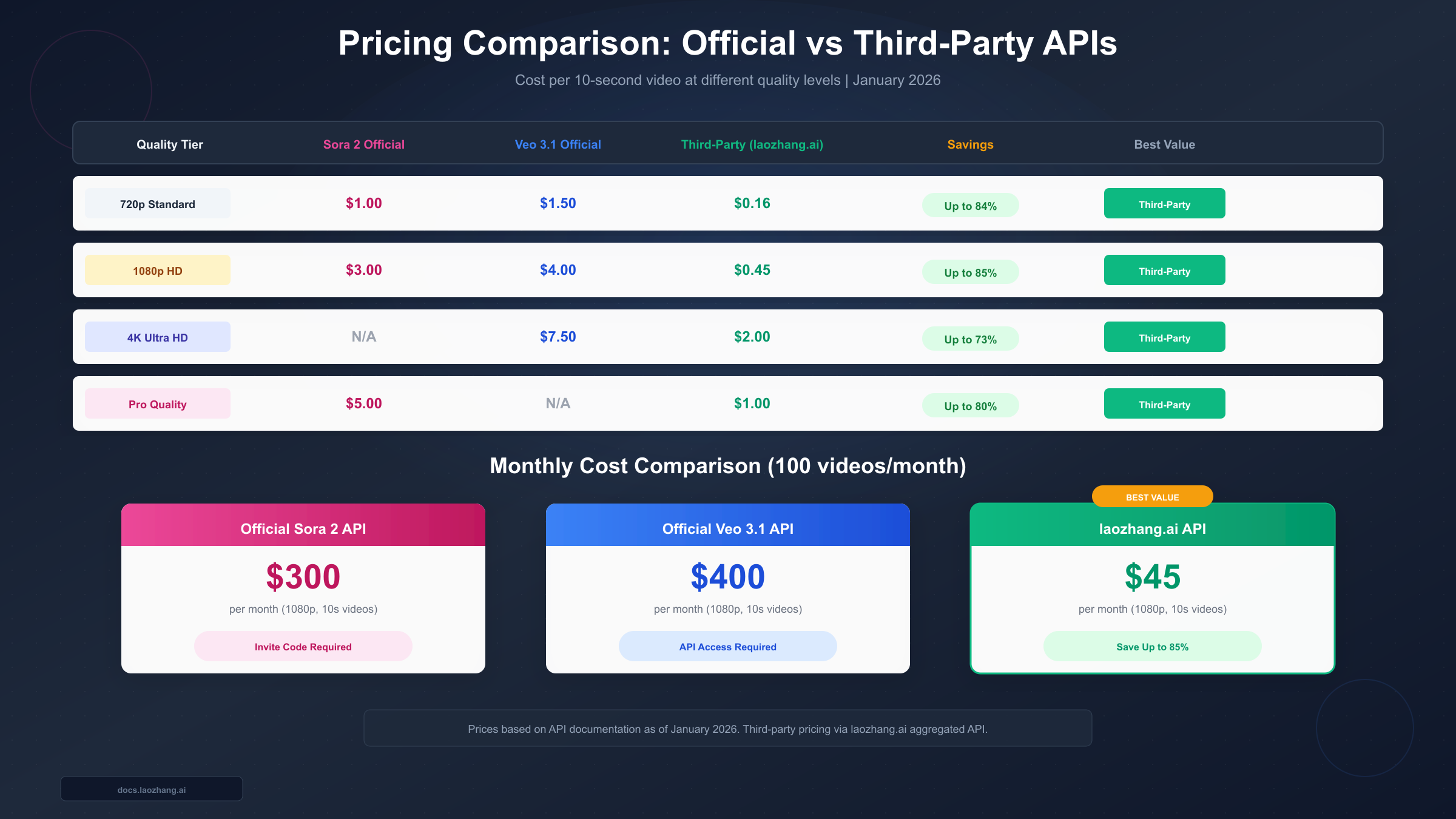
For teams that find official pricing prohibitive, third-party API aggregators offer significant cost savings. These services provide access to the same models through alternative infrastructure, often at 60-85% lower costs. For example, platforms like laozhang.ai aggregate multiple AI models including video generators, with pricing that makes high-volume production more feasible. A 10-second 1080p video that costs $3.00 through official channels might cost as little as $0.45 through third-party providers. For detailed pricing information on Sora 2 specifically, the Sora 2 API pricing and quotas guide provides comprehensive tier breakdowns.
Monthly Cost Projections
For a realistic monthly usage scenario of 100 videos at 10 seconds each in 1080p:
| Provider | Monthly Cost | Notes |
|---|---|---|
| Official Sora 2 | $300 | Requires invite code |
| Official Veo 3.1 | $400 | Via Gemini API |
| Third-Party (laozhang.ai) | ~$45 | Up to 85% savings |
The cost difference becomes substantial at scale, which is why many production teams have shifted to third-party providers for their regular workflow while reserving official API access for projects requiring specific features or compliance requirements.
Third-Party API Options: Affordable Access
When official API pricing exceeds your budget or access restrictions prevent you from using the platforms directly, third-party API services provide a practical alternative. These aggregators have become increasingly popular among developers and content teams who need reliable, cost-effective access to cutting-edge AI video generation.
Why Consider Third-Party APIs?
The primary motivation is cost reduction. Official APIs from OpenAI and Google price their services at premium rates that reflect not just the compute costs but also the value of the technology. Third-party providers achieve lower pricing through volume licensing, alternative infrastructure, and competitive market dynamics.
Beyond pricing, third-party services often solve access problems. Sora 2's invite-only requirement has created significant barriers for many potential users. Similarly, regional restrictions on Google's services can prevent access in certain countries. Third-party APIs typically operate without these geographic or invite-based restrictions.
laozhang.ai Platform Overview
Among the available options, laozhang.ai stands out as a comprehensive AI model aggregator that includes both text and image/video generation capabilities. The platform offers several advantages for video AI users:
The pricing structure aligns with mainstream platforms for text models while offering substantial discounts on image and video generation—often around 50% or less of official rates. For image generation specifically, their Nano Banana Pro model operates at approximately $0.05 per generation, representing roughly 20% of typical official pricing.
Access is straightforward with minimum deposits starting at $5 (approximately 35 RMB), making it accessible for individual creators and small teams. The $100 tier includes bonus credits, bringing effective costs to around 84% of official pricing. Full documentation is available at docs.laozhang.ai for developers looking to integrate these services into their applications.
Considerations When Using Third-Party Services
While third-party APIs offer compelling advantages, users should understand the trade-offs. Service level agreements may differ from official providers, and support channels might be less comprehensive. For mission-critical applications, maintaining access to official APIs as a backup is prudent.
Additionally, commercial licensing terms should be verified carefully. Third-party access doesn't automatically transfer the commercial use rights that come with official API subscriptions. For production work intended for commercial release, understanding these legal distinctions is essential.
Which Should You Choose? Decision Framework
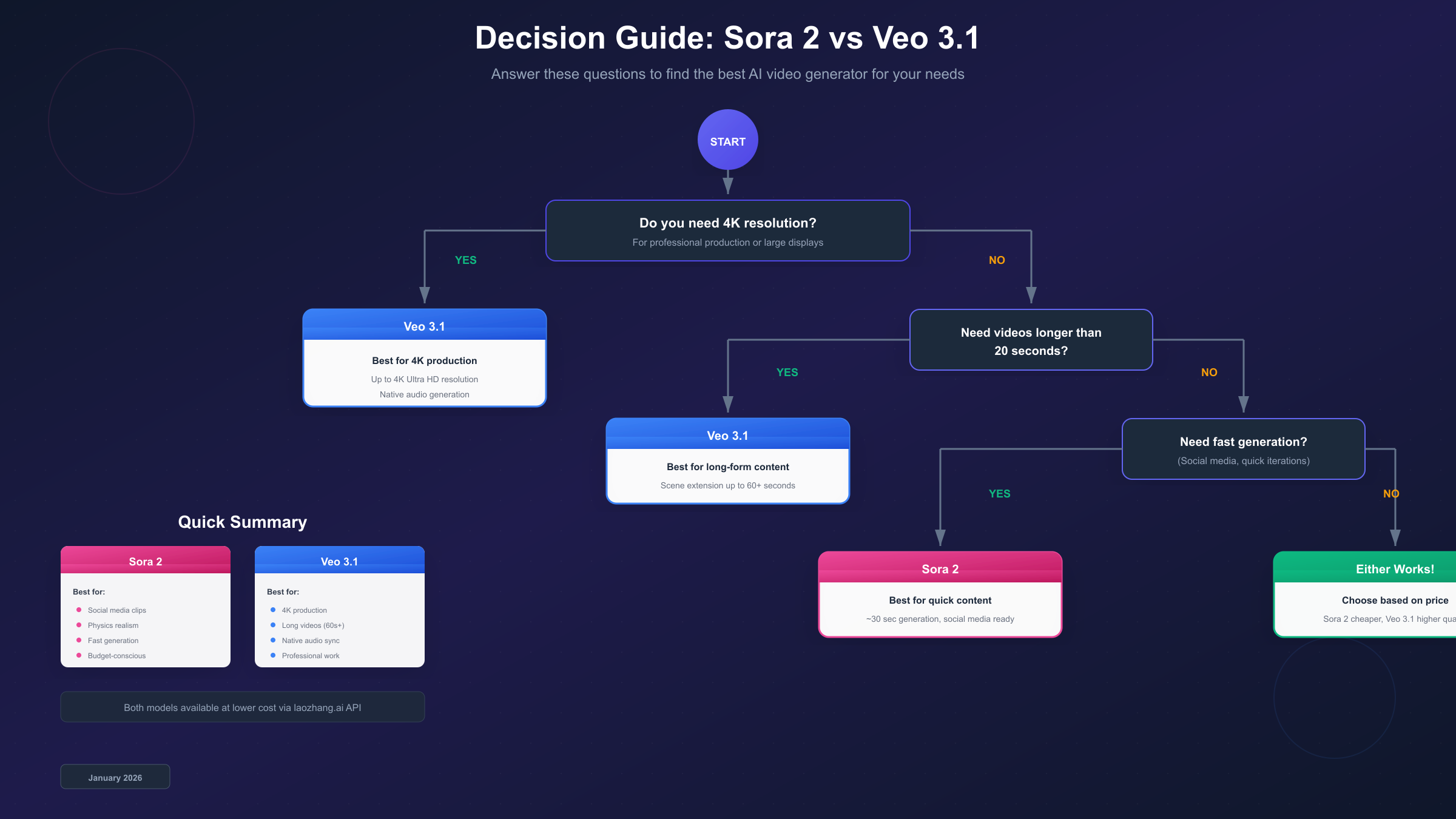
Selecting between Sora 2 and Veo 3.1 isn't about determining which is "better" in absolute terms—it's about matching the right tool to your specific needs. Both platforms excel in different scenarios, and many professional creators maintain access to both.
Choose Sora 2 When:
You're creating content for social media platforms where speed matters more than maximum resolution. Sora 2's faster generation time (30 seconds versus 45 seconds for comparable content) and lower cost per video make it the efficient choice for high-volume content production. The 1080p resolution is perfect for mobile-first platforms like TikTok and Instagram.
Physics realism is critical to your project. If your video concept involves objects interacting realistically—sports, action sequences, physical comedy—Sora 2's superior physics engine will produce more convincing results. This applies to everything from product demonstrations to animated storytelling.
Budget constraints require cost optimization. At the lower quality tiers, Sora 2 offers better value per dollar, especially for creators who don't need 4K output or the extended duration capabilities of Veo 3.1.
The Cameos feature is valuable to your workflow. For personalized content, marketing materials featuring specific individuals, or creative projects requiring character consistency, Sora 2's ability to insert real people into generated videos is unmatched.
Choose Veo 3.1 When:
Maximum resolution is non-negotiable. Any project destined for 4K displays, broadcast television, or large-format presentation requires Veo 3.1. The visual quality difference at 4K is substantial and immediately apparent on appropriate displays.
Audio synchronization is crucial. Dialogue-heavy scenes, music videos, or any content where audio-visual synchronization must be precise will benefit from Veo 3.1's native audio generation. The quality of generated dialogue and ambient sound exceeds what's currently possible with Sora 2.
You need longer videos from a single generation session. With Scene Extension, Veo 3.1 can produce cohesive videos exceeding 60 seconds while maintaining narrative and visual continuity. This is particularly valuable for short films, advertisements, and explainer content.
You require direct API access without invitation restrictions. Veo 3.1's availability through Gemini API makes it immediately accessible to any developer with a Google Cloud account, avoiding the access limitations that still affect Sora 2.
Use Case Recommendations Table
| Use Case | Recommended | Reason |
|---|---|---|
| TikTok/Reels content | Sora 2 | Faster, cheaper, 1080p sufficient |
| Commercial advertisements | Veo 3.1 | 4K quality, superior audio |
| Product demonstrations | Sora 2 | Better physics simulation |
| Music videos | Veo 3.1 | Native audio sync |
| YouTube Shorts | Either | Both perform well |
| Film pre-visualization | Veo 3.1 | Scene extension, quality |
| Personalized marketing | Sora 2 | Cameos feature |
| Educational content | Veo 3.1 | Extended duration |
For broader context on how these models compare to other options in the market, the comprehensive AI video model comparison covers additional alternatives like Runway, Kling, and others.
How to Get Started: Access Guides
Getting access to these platforms requires navigating different pathways depending on which tool you choose. Here's a practical guide to getting started with each.
Accessing Sora 2
The primary access route for Sora 2 runs through ChatGPT subscriptions. ChatGPT Plus ($20/month) provides access to Sora 2 with daily generation limits and watermarked output. ChatGPT Pro ($200/month) offers higher quotas and watermark-free generations suitable for professional use.
For new users, the process is straightforward: sign up for a ChatGPT account, upgrade to Plus or Pro, and access Sora 2 through the ChatGPT interface. The sora.com website provides an alternative interface specifically designed for video generation workflows.
API access remains more restricted. As of January 2026, official API availability requires approval through OpenAI's enterprise program or possession of an invite code. The comprehensive guide to Sora 2 invitation codes explains the various methods for obtaining access, including community programs and partnerships that distribute codes.
Accessing Veo 3.1
Google's access model is more straightforward for developers. The Gemini API provides access through Google AI Studio (aistudio.google.com), where you can create an API key and begin generating videos immediately. Enterprise users can access the same capabilities through Vertex AI with additional security and compliance features.
For individual users, Google AI subscriptions (formerly Gemini Advanced) at $19.99/month include limited Veo 3.1 Fast generations. The $249.99/month Ultra tier provides professional-grade access with higher quotas.
The key steps for API access:
- Create or log into a Google Cloud account
- Navigate to Google AI Studio
- Generate an API key for the Gemini API
- Select the Veo 3.1 model in your API calls
- Begin generating videos following the API documentation
Using Third-Party Access
For those preferring third-party services, the setup typically involves:
- Create an account on the provider's platform
- Add API credits (minimum deposits vary, often starting around $5)
- Generate an API key
- Configure your application to use the provider's endpoint
- Use standard API calls with the third-party key
Documentation for integration is usually available directly on provider websites, with most supporting the same API formats as official services for easy migration.
Frequently Asked Questions
Can Sora 2 and Veo 3.1 generate audio in videos?
Yes, both platforms now support native audio generation, though with different capabilities. Sora 2 generates synchronized audio including sound effects and ambient sounds, with the audio being generated alongside the video. Veo 3.1 is generally considered to have superior audio quality, particularly for dialogue and complex audio scenes, with better lip-sync accuracy and more natural conversational audio. If audio quality is your primary concern, Veo 3.1 currently has the edge.
What's the longest video I can create?
Sora 2 supports videos up to 20 seconds in a single generation. Veo 3.1 generates 8-second clips natively but offers Scene Extension that allows chaining multiple clips for videos exceeding 60 seconds. For truly long-form content, Veo 3.1's approach provides better continuity, though both platforms require multiple generations for anything beyond their native limits.
Which is more cost-effective for high-volume use?
For high-volume production at 1080p or below, Sora 2 offers better value through official channels. However, third-party API providers can reduce costs for either platform by 60-85%, making the pricing difference less significant. At volumes exceeding 100 videos per month, the savings from third-party access often justify the setup overhead.
Do generated videos include watermarks?
Official Sora 2 videos through ChatGPT Plus include visible watermarks; ChatGPT Pro provides watermark-free output. Veo 3.1 uses SynthID, which embeds invisible watermarks that don't affect visual quality but can be detected by specialized tools. Third-party access typically provides watermark-free output, though this varies by provider.
Can I use AI-generated videos commercially?
Both platforms grant commercial usage rights for content generated through their paid tiers. However, specific terms vary—OpenAI prohibits certain uses like creating deepfakes of real people without consent, while Google's policies similarly restrict deceptive content. Always review the current terms of service, as they evolve with regulatory changes.
How do these compare to other AI video generators?
Sora 2 and Veo 3.1 currently represent the highest quality tier of AI video generation. Alternatives like Runway Gen-3, Kling, and Pika offer different trade-offs in terms of price, quality, and features. For a complete landscape view, the AI video model comparison guide covers all major options.
Final Verdict: Making Your Decision
After analyzing specifications, testing capabilities, and evaluating pricing structures, the recommendation comes down to understanding your primary use case and constraints.
For social media creators and content teams focused on platforms like TikTok, Instagram, and YouTube Shorts: Sora 2 is the recommended choice. Its faster generation, lower cost at standard resolutions, and superior physics simulation make it ideal for the high-velocity content creation that social media demands. The 1080p resolution is perfect for mobile viewing, and the Cameos feature opens creative possibilities that can differentiate your content.
For professional video production, advertising, and any project requiring maximum quality: Veo 3.1 is the clear winner. The 4K output, superior audio generation, and Scene Extension for longer videos align perfectly with professional workflow requirements. The higher cost is justified when output quality directly impacts commercial success.
For developers and teams needing reliable API access: Consider both official and third-party options. Official APIs provide the most comprehensive feature sets and commercial licensing clarity, while third-party providers like laozhang.ai offer significant cost savings that can make high-volume production economically viable. Many successful teams use a hybrid approach—third-party for development and iteration, official APIs for final production.
The reality is that both platforms will continue evolving rapidly. OpenAI and Google are in active competition, with each announcement pushing the other to improve. What remains constant is the need to match your tool choice to your specific requirements rather than defaulting to assumptions about which platform is "better."
As you move forward with AI video generation, start with small experiments to understand how each platform handles your specific content types. The learning you gain from hands-on experience will prove more valuable than any comparison guide, including this one. Both Sora 2 and Veo 3.1 are capable of producing remarkable results—your success depends on knowing which to deploy for each creative challenge.