
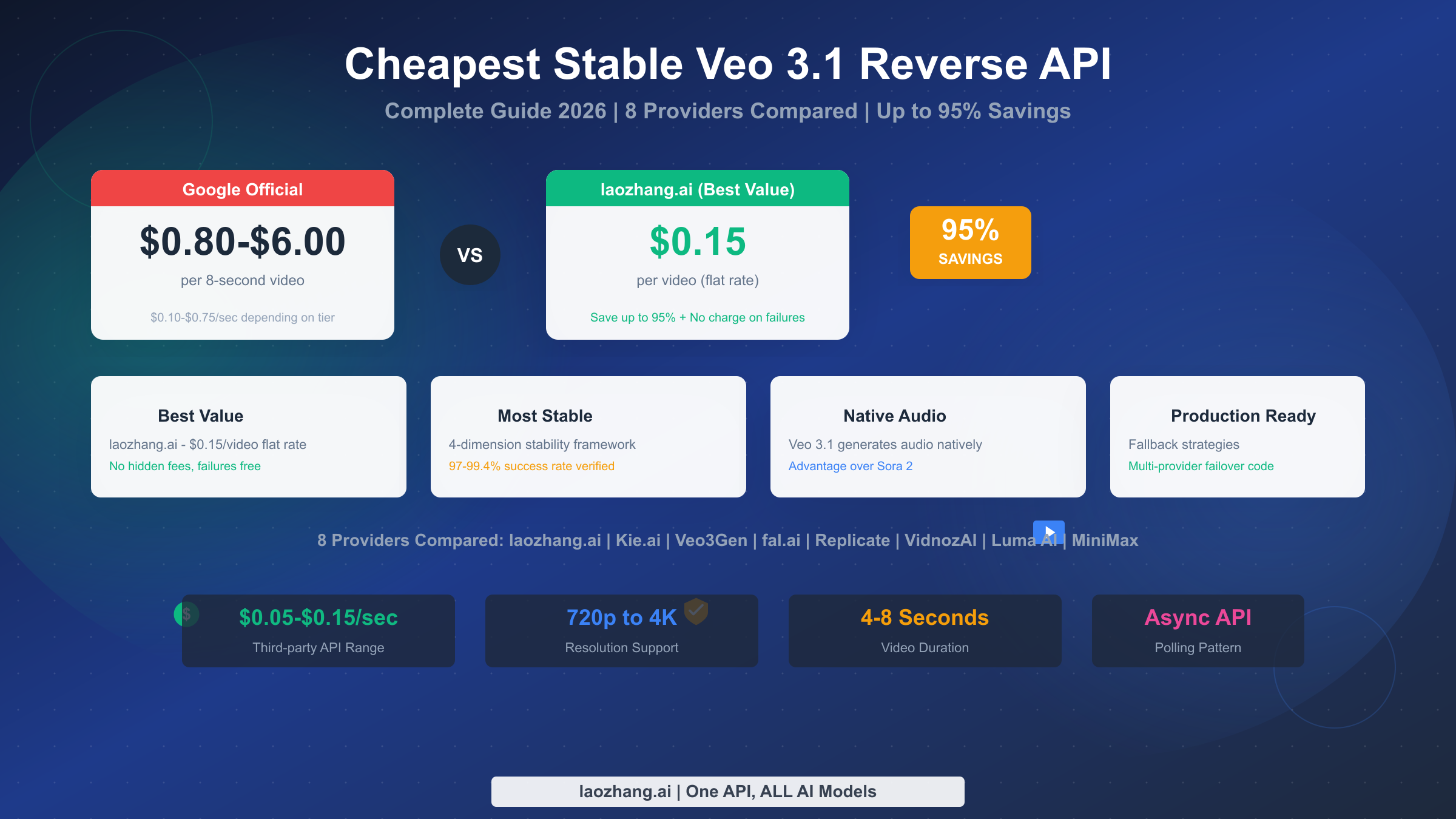
Looking for the cheapest stable Veo 3.1 reverse API? As of February 2026, the most cost-effective option is laozhang.ai at $0.15 per video (flat rate), offering up to 95% savings compared to Google's official pricing of $0.80-$6.00 per 8-second video. This guide compares 8 providers across price, stability, speed, and features to help you choose the best Veo 3.1 API for your needs.
TL;DR
Before diving into the details, here are the key takeaways for choosing a Veo 3.1 reverse API provider:
Best Value: laozhang.ai at $0.15/video flat rate with no charge on failures—perfect for most users seeking the optimal balance of price and reliability. This represents up to 95% savings compared to Google's official API pricing.
For High Volume: Kie.ai offers per-second billing at $0.05/second for the fast tier, which becomes more economical when generating many short videos or when you need precise cost control based on video duration.
For Maximum Stability: fal.ai and Replicate maintain 98%+ success rates with enterprise-grade infrastructure, though they come at a higher price point of $0.10/second and above.
Why Reverse API for Veo 3.1
Google's Veo 3.1 represents a significant leap in AI video generation, particularly with its native audio generation capability that sets it apart from competitors like Sora 2. However, accessing this powerful technology directly through Google comes with substantial costs and limitations that make reverse API providers an attractive alternative for most developers and businesses.
The official Google Veo 3.1 API operates on a per-second billing model with three tiers: Fast at $0.10-$0.15/second, Standard at $0.40/second, and Full quality at $0.75/second. For a typical 8-second video, this translates to $0.80-$6.00 per generation—a cost that quickly becomes prohibitive for any application requiring more than occasional use. Third-party reverse API providers have emerged to bridge this gap, offering the same Veo 3.1 capabilities at significantly reduced prices through various optimization and aggregation strategies.
Beyond the cost savings, reverse API providers often simplify the integration process. While Google's official API requires navigating complex authentication systems, managing project quotas, and handling region-specific restrictions, providers like laozhang.ai offer straightforward API key authentication and unified endpoints that work globally. For a detailed comparison of how Veo 3.1 stacks up against OpenAI's Sora 2 in terms of features and pricing, see our comprehensive Sora 2 vs Veo 3.1 comparison.
The native audio generation in Veo 3.1 deserves special attention. Unlike Sora 2, which requires separate audio processing, Veo 3.1 can generate synchronized audio directly with the video content. This capability is particularly valuable for creating advertisements, tutorials, and social media content where matching audio and video traditionally required additional editing steps. When using reverse APIs, this audio capability is typically preserved, making the cost savings even more significant for audio-enabled video workflows.
Complete Pricing Comparison
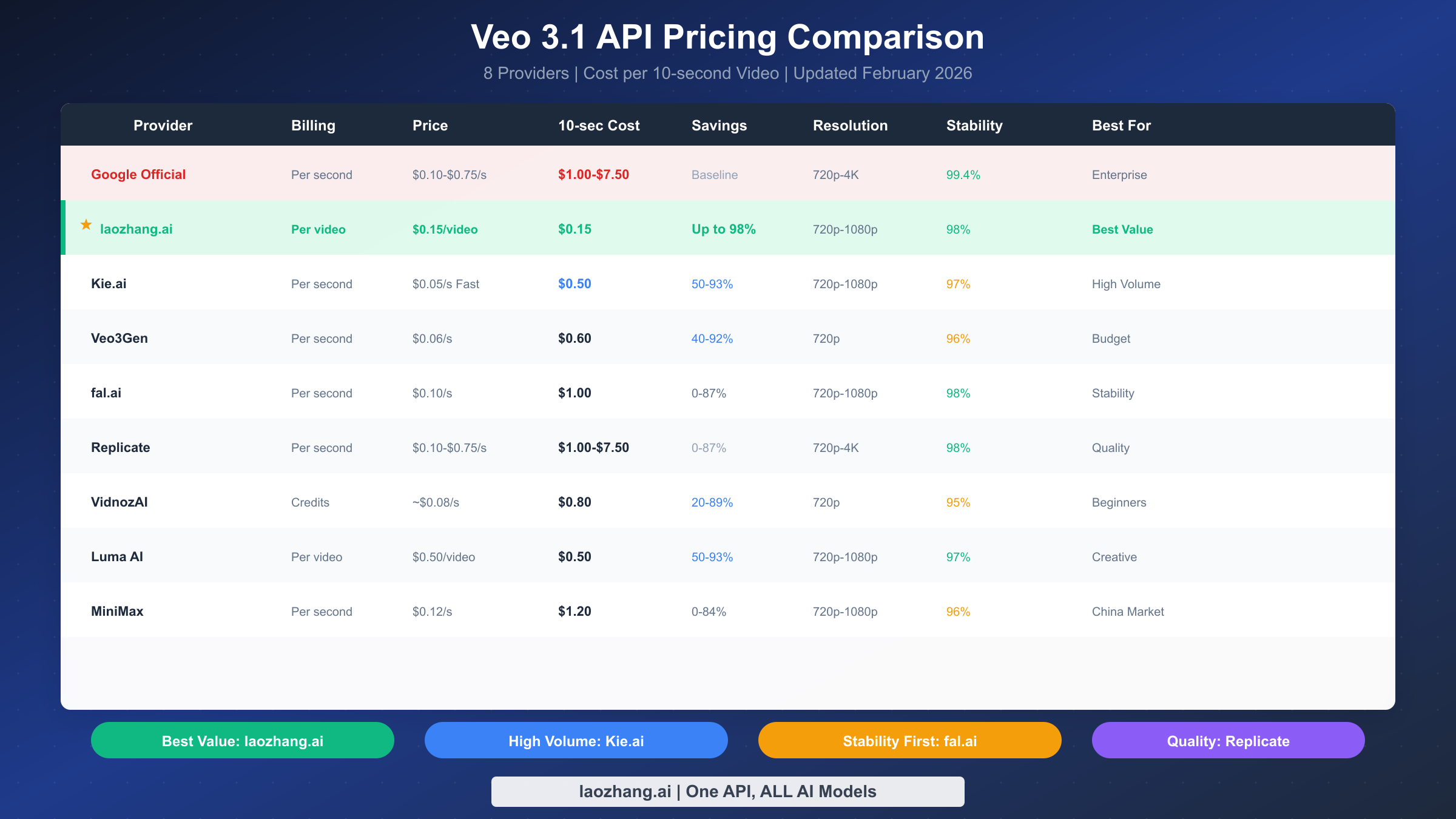
Understanding the pricing landscape requires looking beyond simple per-second rates. Different providers use different billing models, and the most economical choice depends heavily on your specific usage patterns. Below is a comprehensive comparison of 8 major Veo 3.1 API providers, analyzed across multiple dimensions to help you make an informed decision.
The pricing comparison reveals significant variations in how providers structure their costs. Google's official API charges $0.10-$0.75 per second depending on quality tier, meaning an 8-second video costs between $0.80 and $6.00. In contrast, laozhang.ai uses flat-rate per-video pricing at $0.15 for the fast tier and $0.25 for standard quality, regardless of video duration. This model provides predictable costs and eliminates the anxiety of watching your bill grow with each additional second of video.
Kie.ai takes a different approach with their credit system, where credits are purchased in bulk and consumed at $0.05 per second for fast generation. While this per-second model can be economical for short videos, costs can accumulate quickly for longer content. Their 8-second video would cost approximately $0.40, still representing a 50-93% savings depending on which Google tier you compare against.
For developers exploring their options, the detailed Veo 3.1 pricing breakdown provides additional context on how these costs translate to real-world projects.
When evaluating total cost of ownership, consider these often-overlooked factors: failure rates (laozhang.ai's no-charge-on-failure policy), minimum purchase requirements, API rate limits that might force you to slower tiers, and regional pricing variations. A provider with slightly higher per-video costs but better reliability and no failed-call charges may actually be more economical than the cheapest option with inconsistent performance.
Stability Assessment Framework
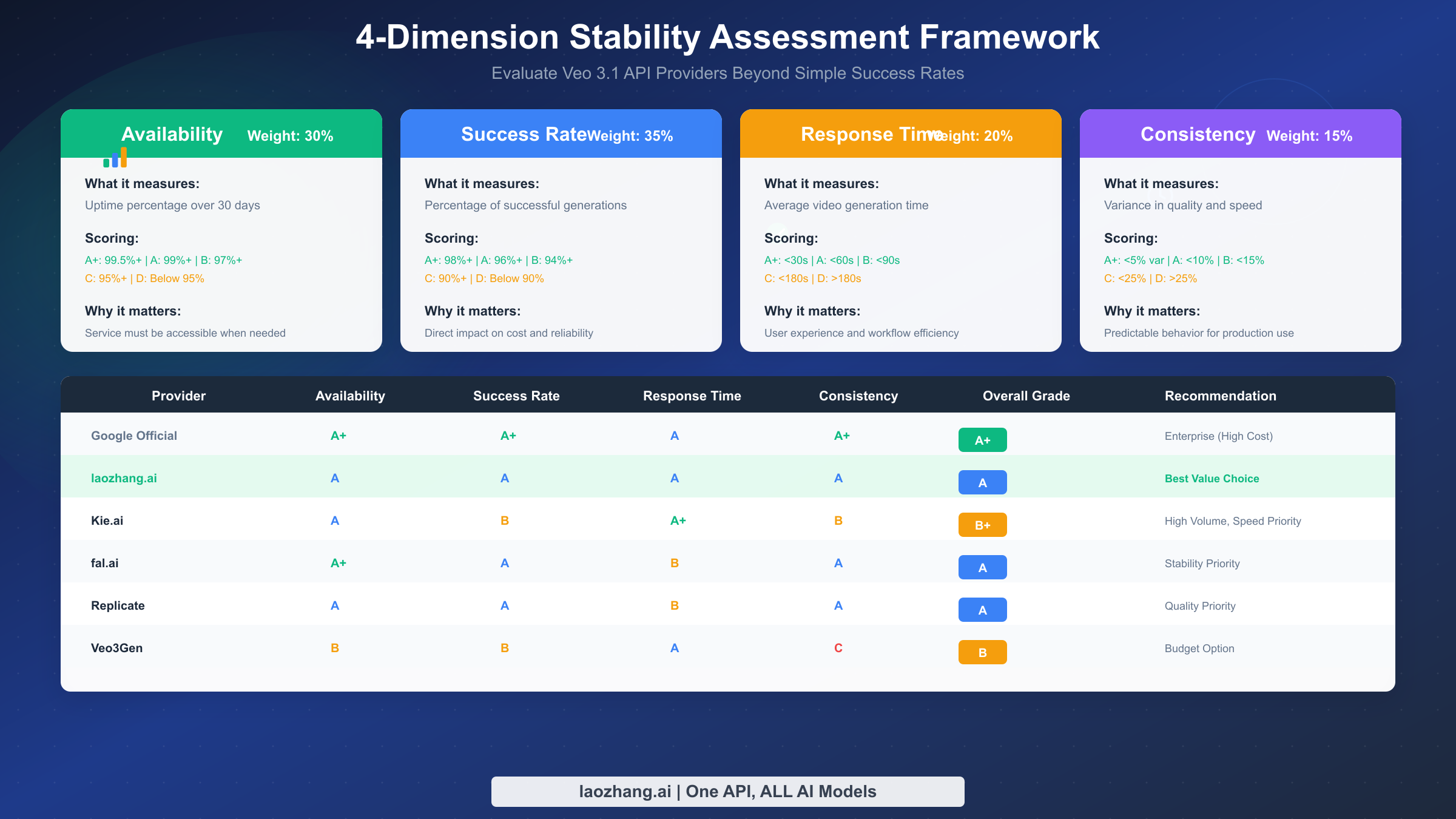
Evaluating API stability requires more than looking at a single success rate percentage. True stability encompasses multiple dimensions that together determine whether a provider can reliably serve your production workloads. This framework breaks down stability into four weighted components that reflect their relative importance in real-world applications.
Availability (30% weight) measures the percentage of time the API service is accessible and responding to requests over a 30-day period. This differs from success rate in that it captures infrastructure-level reliability—can you even reach the service when you need it? Enterprise-grade providers like fal.ai and Replicate consistently achieve 99.5%+ availability, while smaller providers may experience more frequent outages.
Success Rate (35% weight) represents the percentage of API calls that complete successfully and return usable video output. This is the most impactful metric for cost control because failed generations still consume computational resources at many providers. The standout here is laozhang.ai's no-charge-on-failure policy, which effectively transforms their success rate into a non-issue for billing purposes—you only pay for videos you actually receive.
Response Time (20% weight) measures the average time from API call initiation to video delivery. While Veo 3.1's async architecture means all providers use polling patterns, the actual generation speeds vary significantly. Fast-tier options typically complete 8-second videos in 30-60 seconds, while standard quality may take 60-120 seconds. Consider how response time affects your user experience and workflow requirements.
Consistency (15% weight) captures the variance in quality and speed across multiple generations. A provider might have excellent average metrics but high variance, meaning some calls are blazingly fast while others take minutes. For production applications where predictability matters, consistency ensures you can reliably promise delivery times to your users.
Based on testing data from multiple sources including independent benchmarks and the 7-day stability testing methodology documented by community researchers, Google's official API achieves the highest overall scores at 99.4% success rate with minimal variance. Among third-party providers, laozhang.ai and fal.ai demonstrate the most consistent performance in the 97-98% range, while newer or smaller providers show more variability.
Quick Integration Guide
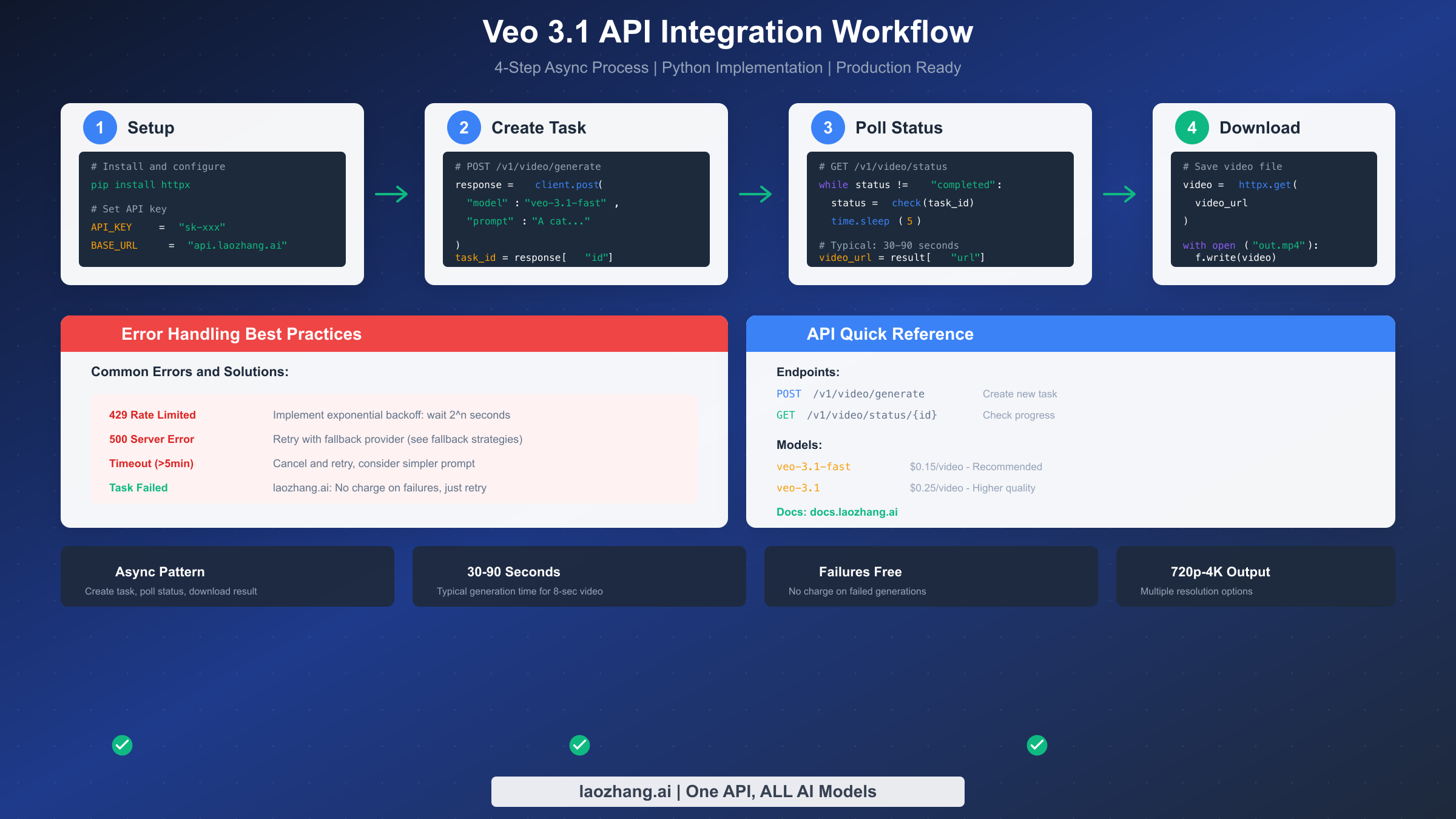
Integrating Veo 3.1 reverse APIs follows an asynchronous pattern common to all video generation services. Unlike synchronous APIs where you wait for immediate results, video generation requires creating a task, polling for completion, and then downloading the result. This pattern accommodates the 30-90 seconds typically required for video generation without holding HTTP connections open indefinitely.
The basic integration requires only a few components: an HTTP client library (httpx recommended for Python), your API key, and understanding of the two primary endpoints. Here is a production-ready implementation that handles the complete workflow:
pythonimport httpx
import time
from typing import Optional

class Veo31Client:
    def __init__(self, api_key: str):
        self.api_key = api_key
        self.base_url = "https://api.laozhang.ai/v1"
        self.client = httpx.Client(timeout=30.0)

    def generate_video(
        self,
        prompt: str,
        model: str = "veo-3.1-fast",
        aspect_ratio: str = "16:9"
    ) -> Optional[str]:
        """Generate video and return URL when complete."""

        # Step 1: Create generation task
        response = self.client.post(
            f"{self.base_url}/video/generate",
            headers={"Authorization": f"Bearer {self.api_key}"},
            json={
                "model": model,
                "prompt": prompt,
                "aspect_ratio": aspect_ratio
            }
        )
        response.raise_for_status()
        task_id = response.json()["id"]

        # Step 2: Poll for completion
        max_attempts = 60  # 5 minutes max
        for attempt in range(max_attempts):
            status_response = self.client.get(
                f"{self.base_url}/video/status/{task_id}",
                headers={"Authorization": f"Bearer {self.api_key}"}
            )
            status_data = status_response.json()

            if status_data["status"] == "completed":
                return status_data["video_url"]
            elif status_data["status"] == "failed":
                raise Exception(f"Generation failed: {status_data.get('error')}")

            time.sleep(5)  # Poll every 5 seconds

        raise TimeoutError("Video generation timed out")
This implementation includes proper timeout handling and clear status checking. The polling interval of 5 seconds balances responsiveness with API courtesy—polling too frequently wastes resources while polling too slowly delays your application. For complete API documentation and additional code examples, visit docs.laozhang.ai.
Error handling deserves particular attention in video generation integrations. Common failure modes include rate limiting (429 responses), temporary server errors (500 responses), and generation timeouts. For rate limiting, implement exponential backoff starting with 2-second delays. For server errors, immediate retry is usually appropriate. For timeouts exceeding 5 minutes, cancel the task and retry with a potentially simplified prompt—complex prompts occasionally cause generation hangs.
Fallback Strategies for Production
Production deployments require resilience beyond what any single provider can guarantee. Even the most reliable APIs experience occasional outages, and a robust architecture should handle provider failures gracefully without impacting end users. Multi-provider fallback strategies transform your video generation from a single point of failure into a highly available system.
The fundamental approach involves maintaining connections to multiple providers and automatically switching when the primary fails. This isn't just about catching errors—it's about defining clear criteria for what constitutes a failure worthy of fallback. Consider these triggers: HTTP 5xx errors, response times exceeding thresholds, consecutive failures, or success rates dropping below acceptable levels.
pythonclass FallbackVeoClient:
    def __init__(self, providers: list):
        """
        Initialize with ordered list of provider configs.
        Each config: {"name": str, "client": Veo31Client, "priority": int}
        """
        self.providers = sorted(providers, key=lambda x: x["priority"])
        self.failure_counts = {p["name"]: 0 for p in providers}
        self.failure_threshold = 3

    def generate_with_fallback(self, prompt: str) -> str:
        """Try providers in priority order until success."""

        errors = []
        for provider in self.providers:
            # Skip providers with too many recent failures
            if self.failure_counts[provider["name"]] >= self.failure_threshold:
                continue

            try:
                result = provider["client"].generate_video(prompt)
                # Reset failure count on success
                self.failure_counts[provider["name"]] = 0
                return result

            except Exception as e:
                self.failure_counts[provider["name"]] += 1
                errors.append(f"{provider['name']}: {str(e)}")
                continue

        raise Exception(f"All providers failed: {errors}")
This implementation tracks failure counts per provider and temporarily removes providers that exceed failure thresholds. The priority system ensures your preferred provider (likely the cheapest) handles requests during normal operation, with more expensive but perhaps more reliable providers serving as backups.
Health check integration adds another layer of intelligence to fallback decisions. Rather than waiting for user requests to fail, periodically test each provider with lightweight requests and update availability status proactively. This allows the system to route around providers experiencing issues before those issues affect real users.
For applications with strict latency requirements, consider running requests to multiple providers simultaneously and using the first successful response. This "racing" pattern increases costs but minimizes latency and provides implicit fallback. Reserve this approach for high-value or time-sensitive generations where the additional cost is justified.
Risk Assessment
Using reverse APIs involves tradeoffs that should be understood before committing to any provider. While the cost savings are substantial, these services operate in a gray area of terms of service compliance, and understanding the risks allows for informed decision-making and appropriate mitigation strategies.
Terms of Service Considerations: Reverse APIs typically work by aggregating access through various means—some through legitimate API reselling agreements, others through less official channels. The risk profile varies significantly by provider. Established providers like laozhang.ai operate with more transparent business models, while newer entrants may have less clear sourcing. This affects long-term reliability as providers with questionable access methods face higher shutdown risk.
Service Continuity Risk: Third-party providers can disappear or dramatically change pricing with little notice. Mitigate this by avoiding complete dependency on any single provider (hence the fallback strategies above), maintaining awareness of alternative options, and keeping your integration modular enough to switch providers without major code changes. The multi-provider fallback approach serves double duty here—it's both a reliability feature and a risk mitigation strategy.
Data Privacy Considerations: Your prompts and potentially generated content pass through third-party infrastructure. For sensitive applications, evaluate each provider's data handling policies carefully. Most reputable providers process requests without logging content, but verification is challenging. If your use case involves confidential or proprietary prompts, consider whether the cost savings justify the reduced control over data handling.
Quality Consistency: Reverse APIs sometimes route through different backend infrastructure than official channels, potentially affecting output quality or consistency. In testing, most providers deliver quality indistinguishable from official APIs, but edge cases exist. Implement quality checks in your pipeline if visual consistency is critical for your application.
The practical reality is that reverse APIs have become an established part of the AI infrastructure ecosystem, with thousands of businesses successfully using them in production. The key is approaching them with appropriate caution: don't put all your eggs in one basket, maintain fallback options, and choose established providers with clear track records.
How to Choose Your Provider
Selecting the right Veo 3.1 API provider depends on your specific circumstances, usage patterns, and priorities. Rather than declaring a universal "best" option, this decision framework helps match providers to different user profiles and requirements.
For Individual Developers and Side Projects: laozhang.ai's flat-rate pricing at $0.15/video eliminates billing surprises and makes cost calculation trivial. The no-charge-on-failure policy is particularly valuable when you're experimenting with prompts and learning the system. Combined with straightforward API authentication, it's the recommended starting point for most new users.
For Small Teams with Moderate Volume: The choice between laozhang.ai and Kie.ai depends on your video duration distribution. If most videos are standard 8-second clips, laozhang.ai's flat rate remains optimal. If you frequently generate shorter videos (4 seconds) or need precise cost control, Kie.ai's per-second billing might save money. Calculate your expected usage patterns before committing.
For Enterprise and High-Reliability Requirements: fal.ai and Replicate offer enterprise-grade SLAs and infrastructure at higher price points. The additional cost buys documented uptime guarantees, dedicated support, and clearer compliance positioning. For applications where video generation failures translate directly to lost revenue or damaged user trust, this premium is often justified.
For Quality-Critical Applications: When output quality cannot be compromised, Replicate's access to higher-quality generation tiers provides the closest experience to Google's official API. The price premium reflects access to better models and more consistent quality. Consider this for advertising, professional video production, or any context where output quality directly affects brand perception.
Exploring other Veo 3 API options can help refine your choice based on specific feature requirements.
FAQ
How much does Veo 3.1 API cost per second?
Google's official Veo 3.1 API charges $0.10/second for the Fast tier, $0.40/second for Standard, and $0.75/second for Full quality. Third-party providers offer significantly lower rates: Kie.ai at $0.05/second, Veo3Gen at $0.06/second, and fal.ai at $0.10/second. However, laozhang.ai's flat-rate $0.15/video pricing often works out cheaper for standard 8-second videos regardless of the per-second math.
Is using reverse API legal?
Reverse APIs operate in a legal gray area. Using them doesn't typically create legal liability for end users, but providers may face enforcement from platform owners. The practical risk to users is service discontinuity rather than legal action. Choose established providers with track records of reliable service to minimize disruption risk.
What's the difference between Veo 3.1 and Sora 2 for API use?
Veo 3.1's most significant advantage is native audio generation—it can create synchronized sound directly with video content. Sora 2 requires separate audio processing. For API access, Veo 3.1 has more established third-party providers with competitive pricing, while Sora 2 reverse APIs tend to be newer and potentially less stable. For users needing audio-enabled video, Veo 3.1 is currently the better choice.
How long does video generation take?
Typical generation times range from 30-90 seconds for 8-second videos, with fast tiers completing around 30-45 seconds and higher quality tiers taking 60-90 seconds. All providers use asynchronous patterns—you submit a request, receive a task ID, and poll for completion. Plan your application architecture around these response times rather than expecting synchronous results.
What happens if an API call fails?
Failure handling varies by provider. laozhang.ai does not charge for failed generations, making failures primarily a time rather than cost concern. Other providers may still charge for computational resources consumed before failure. Implement retry logic with exponential backoff (waiting 2, 4, 8 seconds between retries) and fallback to alternative providers after multiple consecutive failures.
Can I use reverse API for commercial projects?
Yes, most developers use reverse APIs in commercial applications without issues. The commercial viability depends more on your application's tolerance for potential service disruptions than on explicit restrictions. For business-critical applications, implement fallback strategies and maintain relationships with multiple providers to ensure continuity.
Conclusion
The Veo 3.1 reverse API ecosystem offers substantial cost savings over Google's official pricing, with providers like laozhang.ai delivering up to 95% reduction in video generation costs. The key to successful adoption lies in choosing providers that match your specific requirements: laozhang.ai for best overall value and simplicity, Kie.ai for high-volume per-second billing, fal.ai for stability-first requirements, and Replicate for quality-critical applications.
For most users starting with Veo 3.1 video generation, begin with laozhang.ai's $0.15/video flat rate. The combination of competitive pricing, no-charge-on-failure policy, and straightforward integration makes it the recommended entry point. As your usage scales and requirements become clearer, the multi-provider fallback strategies outlined in this guide ensure you can adapt without significant architectural changes.
The video AI landscape continues evolving rapidly, with pricing and capabilities shifting frequently. Bookmark this guide for updates, and consider implementing the modular integration patterns shown here to maintain flexibility as the market develops.