
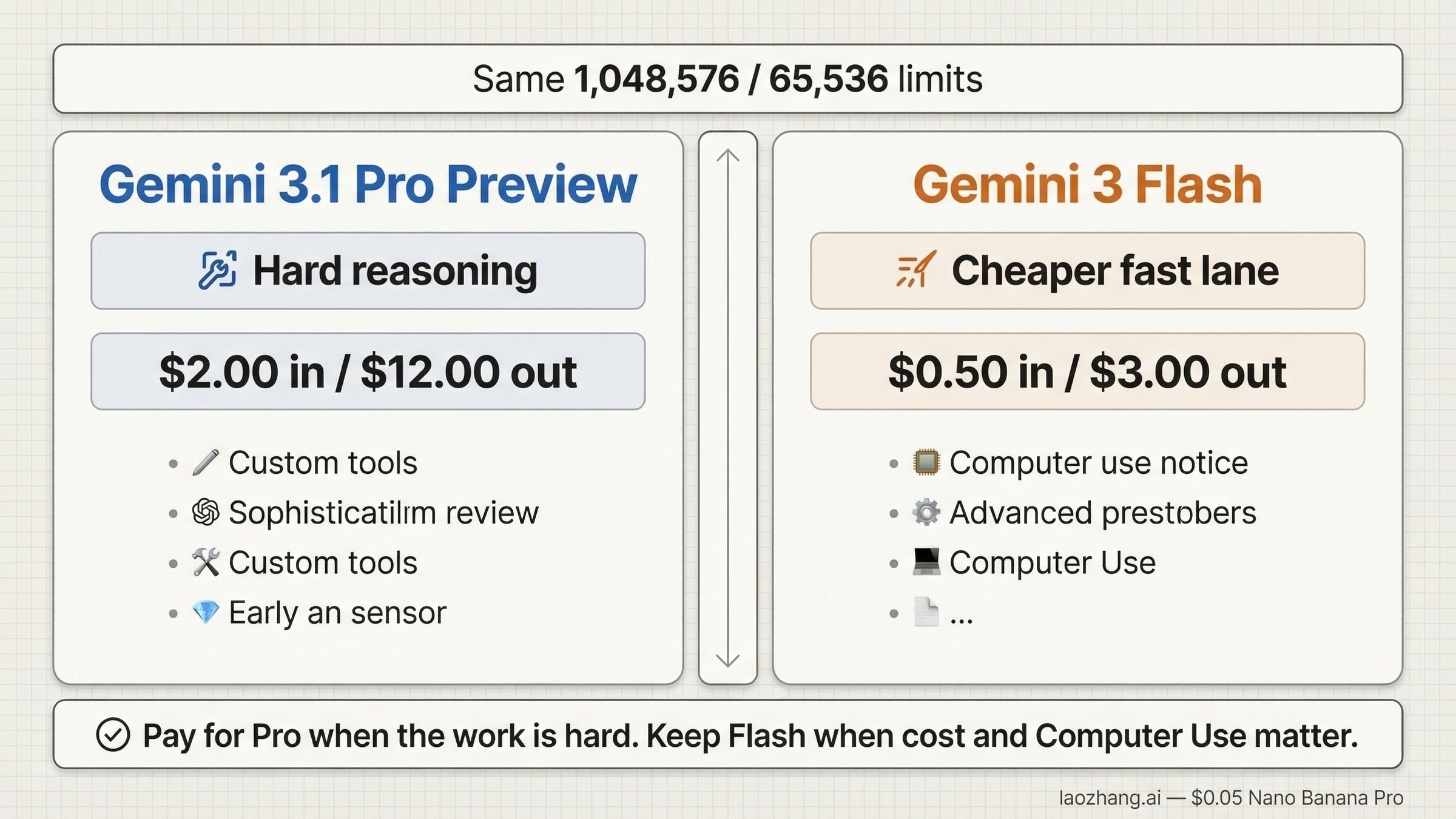
As of March 21, 2026, Gemini 3.1 Pro Preview is worth paying for when your bottleneck is hard reasoning, software-engineering depth, and reliable custom-tool orchestration. Gemini 3 Flash is still the better default when you want a cheaper premium-fast lane, free-tier access, and explicit Computer Use support without paying Pro's 4x token premium. That is the short answer behind this comparison.
The confusing part is that the naming makes this look like a simple upgrade ladder. It is not. The current official pages do not present Gemini 3.1 Pro Preview and Gemini 3 Flash as the same lane with different speed settings. They describe two current premium lanes with different strengths: Pro 3.1 as the higher-ceiling reasoning and software-engineering model, Flash as the faster and cheaper flagship lane with clearer browser and UI-agent support on the published model page.
That matters because the current answer is spread across several places: the pricing page, the model pages for Gemini 3.1 Pro Preview and Gemini 3 Flash Preview, the rate-limits page, the release notes, the Gemini 3.1 Pro model card, and the DeepMind page for Gemini 3 Flash. This article turns those current facts into one routing recommendation.
TL;DR
If you only need the decision, use this rule:
- Choose Gemini 3.1 Pro Preview when failed answers are expensive, the workflow is multi-step, and better software-engineering or custom-tool behavior can save real review time.
- Choose Gemini 3 Flash when you still need a strong fast model, but cost, free-tier access, and
Computer Usematter more than squeezing out the highest reasoning quality. - Use both if your traffic mix is real. For many teams, this is the most defensible March 2026 answer.
The current official comparison looks like this:
| Area | Gemini 3.1 Pro Preview | Gemini 3 Flash | What it means |
|---|---|---|---|
| Status | Preview | Preview | Neither is the "forget about it" stable default |
| Launch date | February 19, 2026 | December 17, 2025 | Pro 3.1 is newer, but Flash remains a current flagship lane |
| Model ID | gemini-3.1-pro-preview | gemini-3-flash-preview | Route explicitly; do not rely on old family assumptions |
| Free tier | No | Yes | Flash is much easier to test and stage |
| Standard price | $2.00 in / $12.00 out up to 200k, then $4.00 / $18.00 | $0.50 in / $3.00 out | Pro costs about 4x more on standard text pricing |
| Batch price | $1.00 in / $6.00 out | $0.25 in / $1.50 out | Flash keeps the same 4x price advantage in batch |
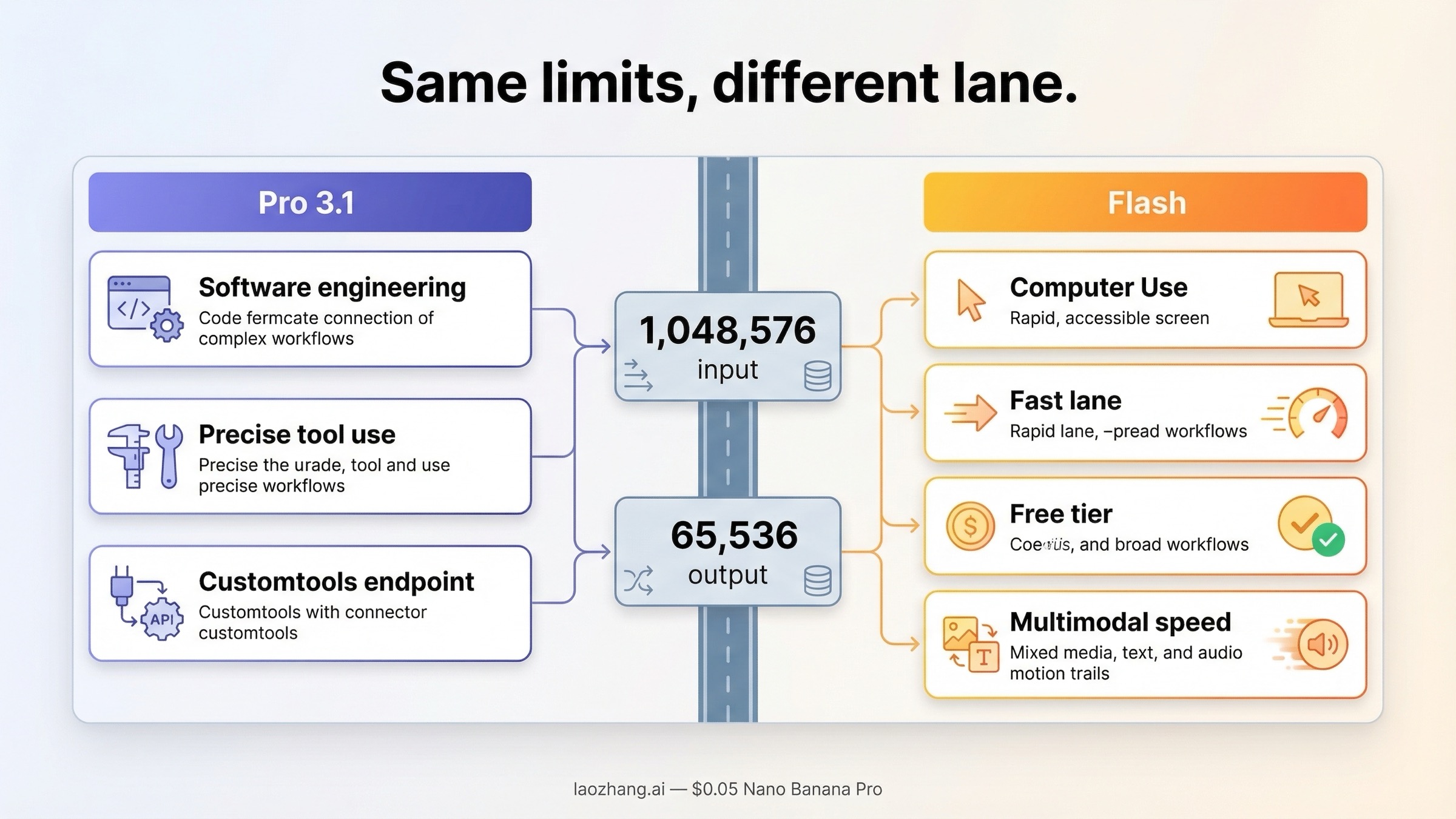
| Token limits | 1,048,576 in / 65,536 out | 1,048,576 in / 65,536 out | Context size is not the buying decision |
| Tier 1 batch ceiling | 5,000,000 tokens | 3,000,000 tokens | Pro has the larger public batch ceiling for this pair |
| Key tooling signal | gemini-3.1-pro-preview-customtools endpoint | Computer Use listed as supported | The real split is tool surface, not only speed |
| Best fit | Hard reasoning, software engineering, custom-tool-heavy agents | Cheaper premium-fast lane, browser/UI agents, cost-sensitive production traffic | This is the core routing split |
That table is the answer most pages still do not give you clearly enough. The rest of the article explains where the premium is justified, where Flash still wins, and when the honest answer is to keep both.
Why This Is Not A Simple Upgrade Path
The easiest way to get this topic wrong is to assume "3.1 Pro is newer, so it must replace Flash" or "Flash is cheaper, so it must be the practical default for almost everything." The current docs do not support either shortcut.
Start with the part that looks deceptively simple. On the current official model pages, both models list 1,048,576 input tokens and 65,536 output tokens. Both support a large modern Gemini API surface, including batch, caching, code execution, function calling, search grounding, Maps grounding, URL context, and structured outputs. If you skim the checklists, they can look much closer than they really are.
That is exactly why the comparison has to be interpretation-led. Since both models already share the same headline context window and output ceiling, the reader should stop asking which one buys "more room" and start asking what each model buys in workflow terms.
The second thing that makes the SERP messy is naming churn. Google's release notes say the older gemini-3-pro-preview was shut down on March 9, 2026 and now points to gemini-3.1-pro-preview. That means older "Gemini 3 Pro vs Gemini 3 Flash" pages can still rank or circulate even when the current buyer is making a different decision. A good article has to neutralize that confusion early instead of assuming the user has already mapped the old and new names correctly.
So the productive question is not "which one wins the family." It is:
- Which workloads truly benefit from Pro 3.1's higher reasoning ceiling and custom-tool focus?
- Which workloads still belong on Flash because the price gap is real and the current Flash page exposes the clearer
Computer Usestory? - Is your production traffic mixed enough that split-routing is safer than forcing a single winner?
That framing is what turns scattered official pages into a useful decision.
Pricing, Free Tier, Grounding, And Rate-Limit Reality On March 21, 2026
Pricing is where the recommendation becomes concrete.
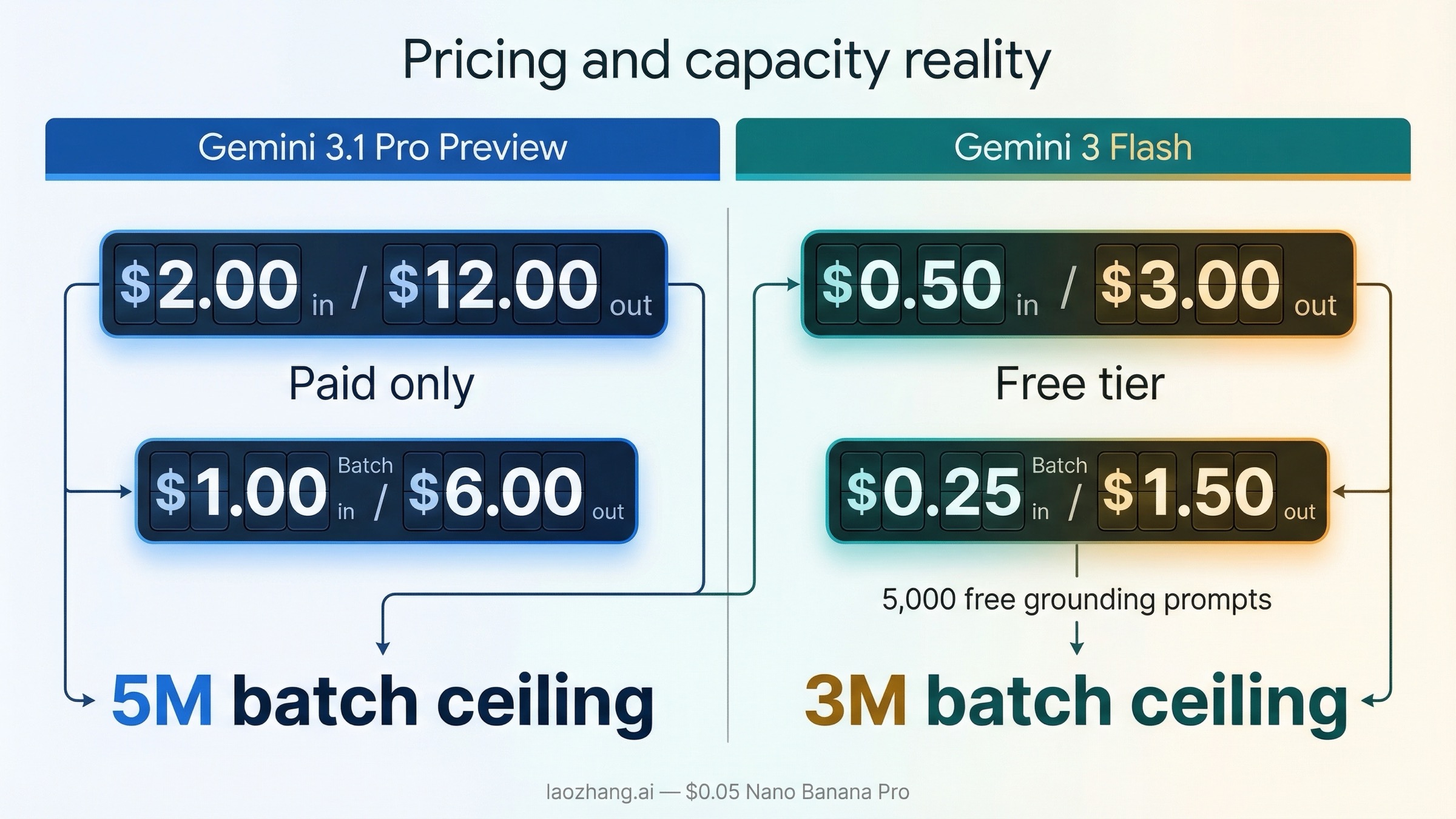
On the current official Gemini Developer API pricing page, Gemini 3.1 Pro Preview is paid-only. Up to 200k prompt tokens, Google lists $2.00 per 1M input tokens and $12.00 per 1M output tokens. Above 200k prompt tokens, the standard lane rises to $4.00 input and $18.00 output. Batch pricing cuts that in half, but even there the cost is still $1.00 input and $6.00 output.
Gemini 3 Flash is not cheap in an absolute sense, but it is much cheaper than Pro. The same pricing page says Flash has a free tier, then charges $0.50 input and $3.00 output per 1M tokens in paid usage. Batch pricing is $0.25 input and $1.50 output.
That means Pro 3.1 is currently a straight 4x premium over Flash on both standard input and standard output pricing, and the same multiple holds in batch. This is not a small pricing nudge. It is large enough that Pro has to earn its keep through better first-pass quality, fewer retries, lower human review cost, or stronger agent behavior. If it cannot do that for your workload, the premium becomes very hard to defend.
There are three other pricing details worth keeping in view.
First, the free-tier difference matters operationally. Flash is easier to test, safer to stage, and cheaper to keep in low-risk validation loops. For teams still tuning prompts or routing logic, that can change how fast they can learn.
Second, grounding does not meaningfully favor either side. On the current pricing page, both models list 5,000 free grounding prompts per month in paid usage before charging $14 per 1,000 Google Search queries or $14 per 1,000 Google Maps queries. So this comparison should not imply that one of these two models has a special grounding-economics edge.
Third, the public rate-limit story is less fixed than many articles pretend. Google's current rate-limits page says active RPM and TPM values should be checked in AI Studio, and it also warns that preview models have more restrictive limits. That means a responsible current article should not hard-code one eternal RPM number that may already be stale next week.
What the public page does still give you is the Batch API ceiling. At Tier 1, Google lists 5,000,000 enqueued batch tokens for Gemini 3.1 Pro Preview and 3,000,000 for Gemini 3 Flash Preview. That is an interesting reversal versus the pricing story. Flash is cheaper, but Pro has the larger public batch queue allowance in this pair.
That combination is exactly why the decision cannot be reduced to one price row. If you care about cheap fast traffic, Flash has the better economics. If you care about big queued premium work, Pro's batch ceiling is part of the picture. The article has to hold both truths at once.
Why Gemini 3.1 Pro Preview Actually Earns Its Premium
There are real workloads where paying 4x more for Pro 3.1 makes sense.
The official Gemini 3.1 Pro Preview page is direct about what Google thinks you are buying. It says Pro 3.1 provides better thinking, improved token efficiency, and a more grounded, factually consistent experience. More importantly, it says the model is optimized for software engineering behavior, precise tool usage, and reliable multi-step execution across real-world domains.
That is premium-lane language. It is not language you use for a general cheap-throughput model. It is language you use when the model is supposed to make fewer expensive mistakes in harder workflows.
The Gemini 3.1 Pro model card reinforces the same story. Its February 2026 benchmark table shows strong performance on hard coding and tool-use evaluations such as Terminal-Bench 2.0, SWE-Bench Verified, APEX-Agents, and MCP Atlas. You should still treat those results as directional rather than as a promise about your exact application, but the message is clear enough: Google wants serious engineering and multi-step agent builders to see Pro 3.1 as the higher-ceiling option.
There is also one current product-surface detail that matters a lot for real buyers. The official page exposes gemini-3.1-pro-preview-customtools as a separate endpoint that is better at prioritizing your custom tools. That does not automatically mean every agent should move to Pro. But it does mean the published docs are signaling a very specific use case: tool-heavy systems where custom tool selection quality is part of the product.
That matters because the true cost of a weak answer is often not the token bill. It is:
- a broken code patch
- a skipped tool call
- a hallucinated action
- a multi-step failure that forces a restart
- another human review pass that cancels out any token savings
In those situations, paying more for the stronger model can be rational very quickly. Pro becomes worth it when the cost of a bad answer is materially higher than the cost of extra tokens.
This is the clean practical rule:
Use Gemini 3.1 Pro Preview when workflow failures are expensive enough that better reasoning or better custom-tool behavior can pay back the 4x premium.
If your workload does not meet that standard, Pro is hard to justify as the default.
Why Gemini 3 Flash Still Wins Important Production Lanes
The main mistake many Pro-first comparisons make is treating Flash like a temporary compromise. The current docs do not support that.
The official Gemini 3 Flash Preview page calls Flash "the best model in the world for multimodal understanding" and Google's "most powerful agentic and vibe-coding model yet." The DeepMind page for Gemini 3 Flash goes even harder on the same identity: frontier intelligence at speed, strong function-call handling, and broad deployment across the Gemini ecosystem.
More importantly, the current Flash model page lists Computer Use as supported. The current Pro 3.1 page does not list Computer Use in its capability block. Instead, it emphasizes precise tool usage and the customtools endpoint. That is not a small wording difference. It changes who should care about which model.
If your system is closer to:
- browser automation
- UI interaction
- visible screen workflows
- a premium fast model that still needs cost discipline
- production setups where free-tier experimentation matters
then Flash has a stronger currently published case than many Pro-first articles admit.
Flash also keeps a broad ecosystem surface that shapes buyer behavior. On the DeepMind page, Flash shows availability across Gemini API, Google AI Studio, Vertex AI, Gemini CLI, Gemini app, Gemini Enterprise, Google AI Mode, Antigravity, and Android Studio. That does not automatically make it the better API model. But it does explain why many teams still experience Flash as the more broadly operational lane.
There is also a practical capacity angle. Community friction around both models is real, but Flash-specific operational issues are easy to find. A January 2026 thread on Google's own developer forum reports truncated output, hallucinated data, and incomplete tool calls in production testing with gemini-3-flash-preview, while a Reddit thread reports 503 high-demand errors hitting both Flash and Pro endpoints on the same day. These are not official guarantees, but they are useful signals: preview-model choice is partly a fallback and reliability question, not just a benchmark question.
That still does not make Flash weak. It just means the honest recommendation is narrower and more useful:
Choose Flash when you want the cheaper current fast lane, when Computer Use is part of the plan, or when your quality needs are high but not high enough to justify Pro's premium on every call.
Which Workloads Change The Answer
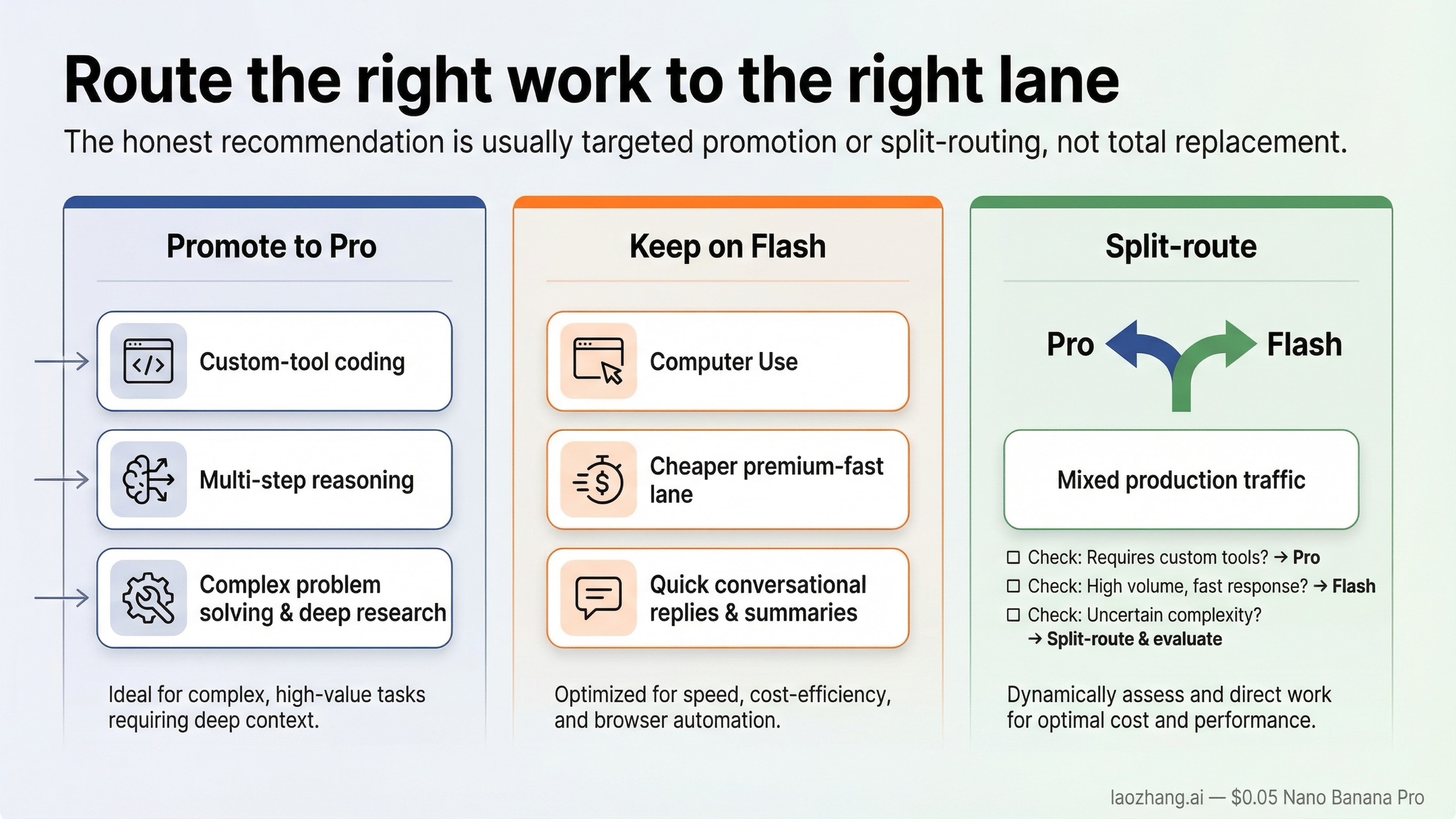
The easiest way to make the comparison actionable is to turn it into workload routing instead of leaving it as an abstract "best model" debate.
| Workload | Better default | Why |
|---|---|---|
| Custom-tool coding agent | Gemini 3.1 Pro Preview | This is the cleanest fit for Pro's software-engineering and customtools story |
| Multi-step engineering assistant | Gemini 3.1 Pro Preview | Better reasoning depth and multi-step reliability are the actual buying criteria |
| Browser or UI-driven agent | Gemini 3 Flash | Flash has the clearer currently published Computer Use support |
| Latency-sensitive premium assistant | Gemini 3 Flash | Lower price and stronger fast-lane positioning are easier to justify |
| Translation at scale | Gemini 3 Flash only if you still need premium-fast quality; otherwise consider Flash-Lite | Flash is cheaper than Pro, but still not the cheapest Gemini 3 family lane |
| Structured extraction where cost matters | Gemini 3 Flash | Pro can work, but Flash often gives the better quality-per-dollar balance |
| Large batch premium jobs | Gemini 3.1 Pro Preview | Pro has the larger current Tier 1 batch ceiling in this pair |
| Mixed production stack | Split-route | Use Flash broadly and escalate specific hard workflows to Pro |
That last line is the one most teams should pay the most attention to. In many real systems, the right question is not "which one replaces the other?" It is "which classes of prompts deserve Pro, and which do not?"
That also keeps you from paying a tax on every easy request just because the hard requests exist somewhere in the same product.
Should You Replace, Split-Route, Or Keep Both?
For most serious API teams, the safest answer is not full replacement.
If you move everything to Pro 3.1, you risk overpaying for a large amount of traffic that would have worked fine on Flash. If you standardize on Flash for everything, you may find that your hardest custom-tool and engineering workflows were exactly the ones that needed Pro's stronger reasoning or better tool prioritization.
That is why the most defensible rollout path is usually:
- Keep Flash as the broad default lane first.
Use gemini-3-flash-preview for the places where you want a strong fast model, free-tier-friendly testing, or Computer Use support.
- Promote hard workflows to Pro intentionally.
Move the slices that are genuinely expensive to get wrong to gemini-3.1-pro-preview or gemini-3.1-pro-preview-customtools.
- Evaluate the expensive failures, not just the average wins.
Do not benchmark only for average quality. Track:
- failed tool sequences
- schema drift
- rework burden
- retries
- cost per successful task
- whether Pro saves more human time than it costs in tokens
That is the cleanest way to decide whether Pro belongs on 5% of your traffic, 30%, or almost none of it.
If you want sibling pages that sharpen those boundaries, our Gemini 3.1 Flash-Lite vs Gemini 3 Flash guide helps position Flash against a cheaper 3-series lane, and our Gemini 3.1 Pro Preview vs Gemini 3.1 Flash-Lite comparison shows when Pro is worth paying for against a truly cheap high-volume option. For quota planning, our Gemini API rate limits per tier guide is the most useful companion read.
The practical bottom line is this:
Do not force a single winner unless your workload is unusually pure. For mixed production traffic, keep Flash as the cheaper current fast lane and route the hardest custom-tool and reasoning-heavy work to Pro 3.1.
FAQ
Is Gemini 3.1 Pro Preview better than Gemini 3 Flash?
For harder reasoning, software engineering, and custom-tool-heavy workflows, yes. For cost-sensitive premium-fast traffic, not automatically. Flash still has real advantages that make it the better default for many teams.
Which one is cheaper?
Gemini 3 Flash. On the March 21, 2026 pricing page, Flash is $0.50 input and $3.00 output per 1M tokens, while Gemini 3.1 Pro Preview is $2.00 input and $12.00 output up to 200k prompt tokens.
Do both models have the same token limits?
Yes. Both current model pages list 1,048,576 input tokens and 65,536 output tokens, which is why this is not a bigger-context decision.
Which one supports Computer Use?
The current Gemini 3 Flash model page explicitly lists Computer Use as supported. The current Gemini 3.1 Pro Preview page does not list Computer Use in its capability block; instead it emphasizes precise tool usage and the customtools endpoint.
Which one should I use for coding agents?
If the agent depends heavily on custom tools, bash, or harder multi-step engineering behavior, start by testing Pro 3.1. If the agent is more about speed, cost, and browser or UI interaction, Flash may still be the better first choice.
Should I replace Gemini 3 Flash with Gemini 3.1 Pro Preview everywhere?
Usually no. Replace or promote only the slices where Pro's quality actually pays back its higher token cost. Otherwise keep Flash or split-route them.