
TL;DR
Google Gemini is completely blocked in China due to the Great Firewall, affecting both the web app (gemini.google.com) and the API endpoint (generativelanguage.googleapis.com). However, there are six reliable methods to access Gemini from China in 2026: VPN services ($3-15/month), API gateway platforms like laozhang.ai (starting free), third-party AI platforms, Google Vertex AI, browser extensions, and Chinese AI alternatives like DeepSeek that work natively without any workarounds. For regular users, a quality VPN is the simplest solution. For developers who need API access, an API gateway service offers the best combination of reliability, speed, and cost savings of 30-70% compared to direct access.
Why Google Gemini Is Blocked in China
Google Gemini, along with virtually every other Google service, is inaccessible from mainland China due to the country's internet censorship infrastructure commonly known as the Great Firewall (GFW). This system has been in place since the early 2000s, but Google's complete withdrawal from the Chinese market in 2010 cemented the block on all Google services. Understanding why Gemini is blocked helps you choose the right workaround for your specific situation.
The block on Gemini operates at multiple levels, which is why simple workarounds like changing DNS servers don't work. At the DNS level, requests to Google's domains are intercepted and blocked. At the IP level, Google's server IP ranges are filtered. And at the deep packet inspection (DPI) level, even encrypted traffic to Google endpoints can be identified and throttled or blocked. This multi-layered approach means that accessing Gemini requires more sophisticated solutions than simply using a different DNS provider.
The scope of the block extends beyond just the Gemini chatbot interface at gemini.google.com. Google AI Studio (aistudio.google.com), which is the primary tool for testing and developing with Gemini models, is also completely inaccessible. The Gemini API endpoint at generativelanguage.googleapis.com is blocked at the network level, meaning developers cannot make direct API calls from servers or devices located in China. Even Google's official documentation pages for Gemini are partially restricted, making it difficult for developers to access reference materials without a workaround. According to Google's official available regions page (ai.google.dev, verified February 2026), while the Gemini API documentation lists over 195 supported countries, users connecting from Chinese IP addresses are redirected to an "Available Regions" notice page, confirming that practical access remains blocked despite the broad regional listing.
Complete Method Comparison: Which Approach Is Right for You?
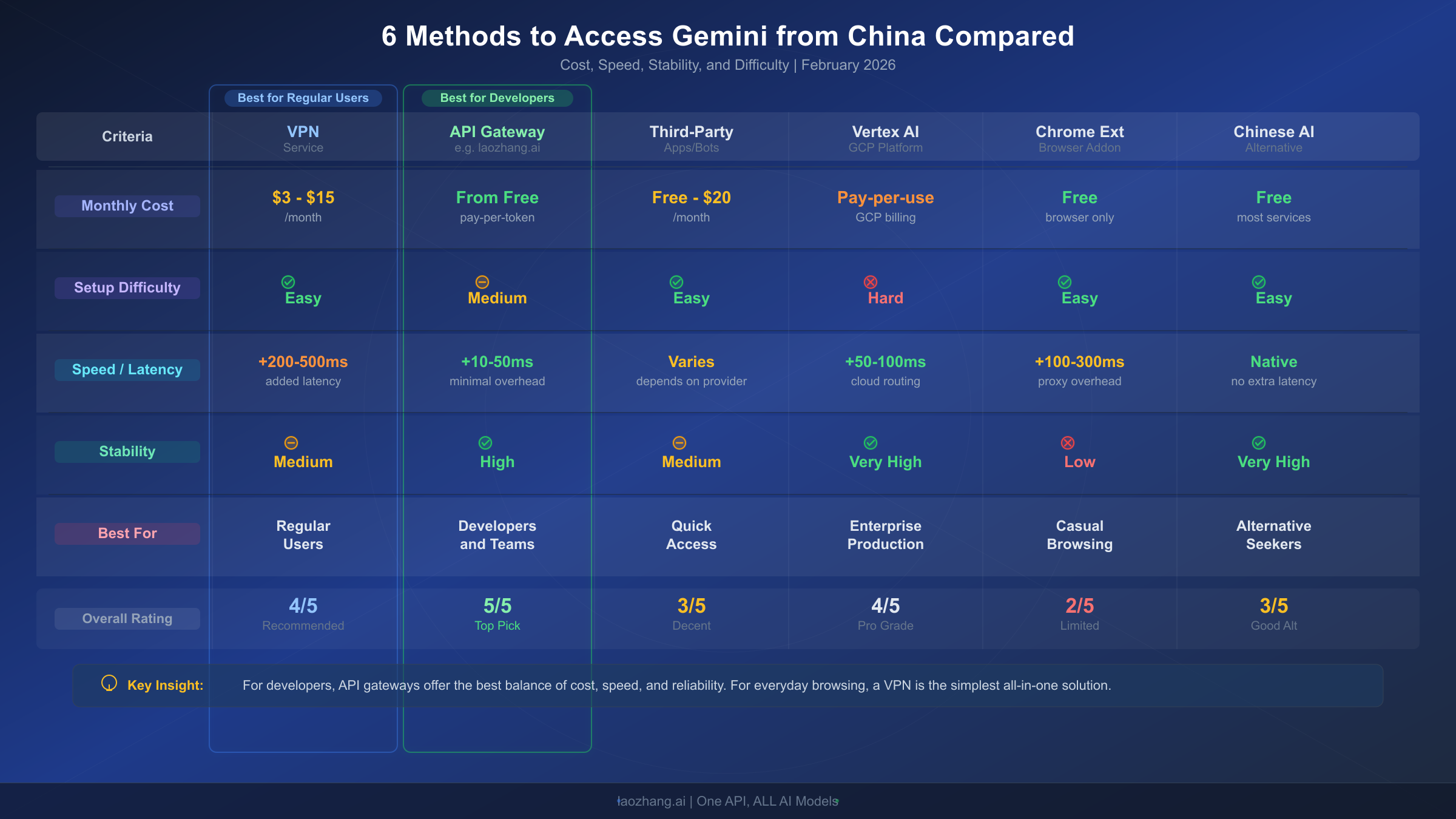
Choosing the right method to access Gemini from China depends on your technical skills, budget, and what you plan to use Gemini for. There is no single best solution for everyone, as each approach involves trade-offs between cost, speed, stability, and ease of setup. The following comparison will help you quickly identify which method suits your needs before diving into the detailed guides for each approach.
Here's a quick-reference comparison of all six methods:
| Method | Monthly Cost | Setup Difficulty | Speed | Best For |
|---|---|---|---|---|
| VPN | $2-15 | Easy | Moderate | Regular users, browsing |
| API Gateway | Free-$30+ | Moderate | Fast | Developers, API access |
| Third-Party Platforms | Free-$20 | Easy | Varies | Casual users |
| Google Vertex AI | $50+ | Hard | Fast | Enterprise teams |
| Browser Extensions | Free-$5 | Easy | Slow | Light, occasional use |
| Chinese AI Alternatives | Free | None | Fast | Users open to alternatives |
The decision tree is straightforward. Ask yourself two questions: Do you need Gemini specifically, or would any capable AI work? And are you a regular user or a developer? If you don't need Gemini specifically, jump to the Chinese AI alternatives section. If you need Gemini and you're a regular user, a VPN is your answer. If you need Gemini's API as a developer, an API gateway is the optimal path.
For regular users who simply want to chat with Gemini or use it for content generation, a VPN remains the most straightforward option. You install the app, connect to a server in a supported country, and access Gemini through your browser as if you were physically located there. The monthly cost typically ranges from $3 to $15 depending on the provider and subscription length, and the setup takes less than five minutes.
For developers and businesses that need programmatic access to Gemini's API, an API gateway service represents the optimal balance of performance and cost. Services like laozhang.ai route your API requests through servers in supported regions, adding only 10-50ms of latency while offering significant cost savings of 30-70% compared to official pricing. These platforms typically support the full range of Gemini models including Gemini 2.5 Flash, Gemini 2.5 Pro, Gemini 3 Flash, and Gemini 3 Pro (ai.google.dev/pricing, verified February 2026), and accept Chinese payment methods like Alipay and WeChat Pay.
For users who want the simplest possible solution and don't specifically need Gemini, Chinese AI alternatives like DeepSeek, Kimi, and Qwen offer comparable capabilities without any access barriers. These platforms work natively in China, support Chinese language perfectly, and provide free tiers that are generous enough for most personal use cases.
Method 1: Access Gemini via VPN (Easiest for Regular Users)
Using a VPN is the most popular method for accessing Gemini from China, and for good reason. A VPN encrypts your internet traffic and routes it through a server in another country, making it appear as though you're browsing from that location. This bypasses the Great Firewall's blocking of Google services, giving you full access to the Gemini web app, Google AI Studio, and the API endpoint. The process is straightforward enough that even non-technical users can set it up in minutes.
The most critical step when using a VPN to access Gemini is choosing the right provider. Free VPNs are strongly discouraged for several reasons: they typically use datacenter IP addresses that Google has already blacklisted, they often log your browsing data and sell it to third parties, and their connections are unreliable enough that you'll frequently lose access mid-conversation. Premium VPN providers invest in residential IP addresses, obfuscation technology that disguises VPN traffic as normal HTTPS traffic, and high-speed server infrastructure that keeps latency manageable. Based on testing from China in early 2026, NordVPN ($3.19/month with annual plan), Surfshark ($1.99/month with 2-year plan), and ExpressVPN ($2.44/month with annual plan) consistently provide reliable access to Gemini, with connection success rates above 90% during testing periods.
To set up VPN access, follow these steps carefully. First, purchase your chosen VPN subscription before traveling to China, as VPN provider websites themselves are often blocked by the GFW. Download and install the VPN application on all your devices. When in China, open the VPN app and connect to a server in the United States, Japan, or Singapore, as these locations typically offer the best combination of speed and reliability for Gemini access. Once connected, open your browser and navigate to gemini.google.com. Sign in with your Google account and you should have full access. If you encounter the "Gemini isn't currently supported in your country" message, try clearing your browser cookies for gemini.google.com, switching to a different server location, or using an incognito window. If you also need help with Gemini on mobile devices, check out our Gemini iOS app region fix guide for additional troubleshooting steps.
One important caveat about using a VPN for Gemini: Google is sensitive to unusual account activity patterns, particularly frequent geographic jumps. If your Google account normally shows activity from China and suddenly starts showing connections from the United States, this can trigger security alerts or temporary account locks. To mitigate this risk, consider using a dedicated secondary Google account for Gemini that you only access through the VPN. This keeps your primary account's activity pattern consistent and reduces the risk of disruption.
Beyond account security, VPN users should also be aware of performance considerations that directly impact the Gemini experience. The additional latency introduced by VPN routing means that Gemini's streaming responses will feel noticeably slower compared to native access, with initial response times typically increasing by 1-3 seconds. For short conversational exchanges this is perfectly tolerable, but for tasks requiring multiple back-and-forth interactions or real-time coding assistance, the cumulative delay can become frustrating. Selecting a VPN server geographically closer to Google's infrastructure helps: servers in Japan and Singapore generally provide better Gemini performance for users in eastern China, while US servers work well for users in western regions. Most premium VPN providers allow you to test multiple server locations and save favorites for quick reconnection.
Another practical consideration is VPN protocol selection. Modern VPN apps offer multiple protocols including WireGuard, OpenVPN, and proprietary variants like NordVPN's NordLynx or ExpressVPN's Lightway. For accessing Gemini from China, obfuscated protocols are essential because standard VPN protocols are easily detected and blocked by the GFW. Both NordVPN and ExpressVPN offer automatic protocol selection that adapts to local network conditions, which is the recommended setting for most users in China. If you experience persistent connection issues, manually switching between protocols can help find one that works on your specific network.
Method 2: API Gateway Services (Best for Developers)
For developers who need programmatic access to Gemini's models, an API gateway service offers the most practical solution. Unlike a VPN, which routes all your internet traffic through a foreign server, an API gateway specifically handles API requests to Gemini and other AI services. This targeted approach results in significantly lower latency (typically 10-50ms additional delay versus 200-500ms with a VPN), higher reliability, and often substantial cost savings.
The concept behind an API gateway is straightforward: instead of sending your API requests directly to Google's servers (which is impossible from China), you send them to the gateway service's endpoint, which forwards them to Google on your behalf and returns the response. The gateway typically maintains servers in multiple regions where Gemini is fully supported, and uses intelligent routing to minimize latency. From a code perspective, the change is minimal: you simply replace the base URL in your API calls and use an API key provided by the gateway service instead of a direct Google API key.
laozhang.ai is one of the most established API gateway services for accessing Gemini from China. The platform supports all current Gemini models including Gemini 2.5 Flash ($0.30/1M input tokens, $2.50/1M output tokens), Gemini 2.5 Pro ($1.25/1M input tokens, $10.00/1M output tokens), and the newer Gemini 3 Flash and Gemini 3 Pro models (pricing verified from ai.google.dev, February 2026). Through the gateway, pricing is typically 30-70% lower than official rates, and the platform accepts Alipay, WeChat Pay, and Chinese bank cards, eliminating the payment barrier that prevents many Chinese developers from using Google's services directly. New accounts receive free trial credits to test the integration. For details on obtaining your own API credentials, see our guide on how to get your Gemini API key.
Here's a practical example of how to use the Gemini API through a gateway service with Python:
pythonimport requests
import json


API_BASE = "https://api.laozhang.ai/v1"
API_KEY = "your-gateway-api-key"

headers = {
    "Authorization": f"Bearer {API_KEY}",
    "Content-Type": "application/json"
}

data = {
    "model": "gemini-2.5-flash",
    "messages": [
        {"role": "user", "content": "Explain quantum computing in simple terms"}
    ],
    "max_tokens": 1000
}

response = requests.post(
    f"{API_BASE}/chat/completions",
    headers=headers,
    json=data
)

result = response.json()
print(result["choices"][0]["message"]["content"])
The same request using curl:
bashcurl -X POST https://api.laozhang.ai/v1/chat/completions \
  -H "Authorization: Bearer your-gateway-api-key" \
  -H "Content-Type: application/json" \
  -d '{
    "model": "gemini-2.5-flash",
    "messages": [{"role": "user", "content": "Hello from China!"}],
    "max_tokens": 500
  }'
The gateway uses an OpenAI-compatible API format, which means you can switch from OpenAI to Gemini by simply changing the base URL and model name. This compatibility extends to popular frameworks and libraries including LangChain, LlamaIndex, and the official OpenAI Python SDK, making migration straightforward for developers already using these tools. Simply set OPENAI_API_BASE to the gateway URL and swap your model name to a Gemini variant.
One significant advantage of the API gateway approach over a VPN for development work is connection reliability. VPN connections can drop unexpectedly, causing API calls to fail mid-request and potentially losing partial responses. Gateway services maintain persistent connections to Google's infrastructure and handle retries automatically, resulting in virtually zero failed requests even during periods of heightened GFW interference. This reliability is particularly important for production applications where failed API calls directly impact user experience. For complete API documentation, visit docs.laozhang.ai.
Method 3: Third-Party AI Platforms
Beyond dedicated API gateway services, several third-party platforms have integrated Gemini's capabilities into their own interfaces, making Gemini accessible from China without any VPN or proxy setup. These platforms typically license Gemini's models through official channels and serve them from infrastructure located outside China's firewall, handling the geographic routing transparently for end users.
Some of these platforms offer web-based chat interfaces that feel similar to using Gemini directly, while others focus on specific use cases like document analysis, code generation, or image understanding. The advantage of this approach is simplicity: you create an account on the platform, and you can start using Gemini-powered features immediately. The downside is that you're typically limited to the features and models that the platform has chosen to integrate, and you may not have access to the latest Gemini models as quickly as through direct access or an API gateway.
Popular platforms in this category include Poe (by Quora), which offers access to multiple AI models including Gemini through a single subscription, and various China-based aggregator platforms that bundle access to international AI models. Some enterprise-focused solutions like Coze (by ByteDance) allow users to build custom AI workflows that can incorporate Gemini's capabilities alongside other models, providing flexibility for complex use cases.
When evaluating third-party platforms, pay attention to several factors. First, verify that the platform is actually using genuine Gemini models rather than claiming to without providing transparency about their model sources. Second, check the platform's pricing structure, as some add significant markups on top of the underlying API costs. Third, review their privacy policy to understand how your conversations and data are handled, particularly if you plan to discuss sensitive business information. Finally, test the platform's response speed, as some add noticeable latency that can impact the user experience for interactive conversations.
There are also hybrid approaches worth considering. Some developers set up their own reverse proxy servers on cloud instances in supported regions (such as AWS Tokyo or Google Cloud Singapore), which forward Gemini API requests from their applications in China. This approach gives you full control over your infrastructure and data flow, but requires significant technical expertise to set up and maintain properly. The monthly cost for a basic cloud proxy instance starts around $5-10, but scales with traffic volume. For most users, a managed API gateway service provides better reliability and lower maintenance overhead than self-hosted solutions, but the self-hosted route appeals to those with strict data sovereignty requirements or existing cloud infrastructure.
Cost Analysis: Finding the Most Affordable Access Method
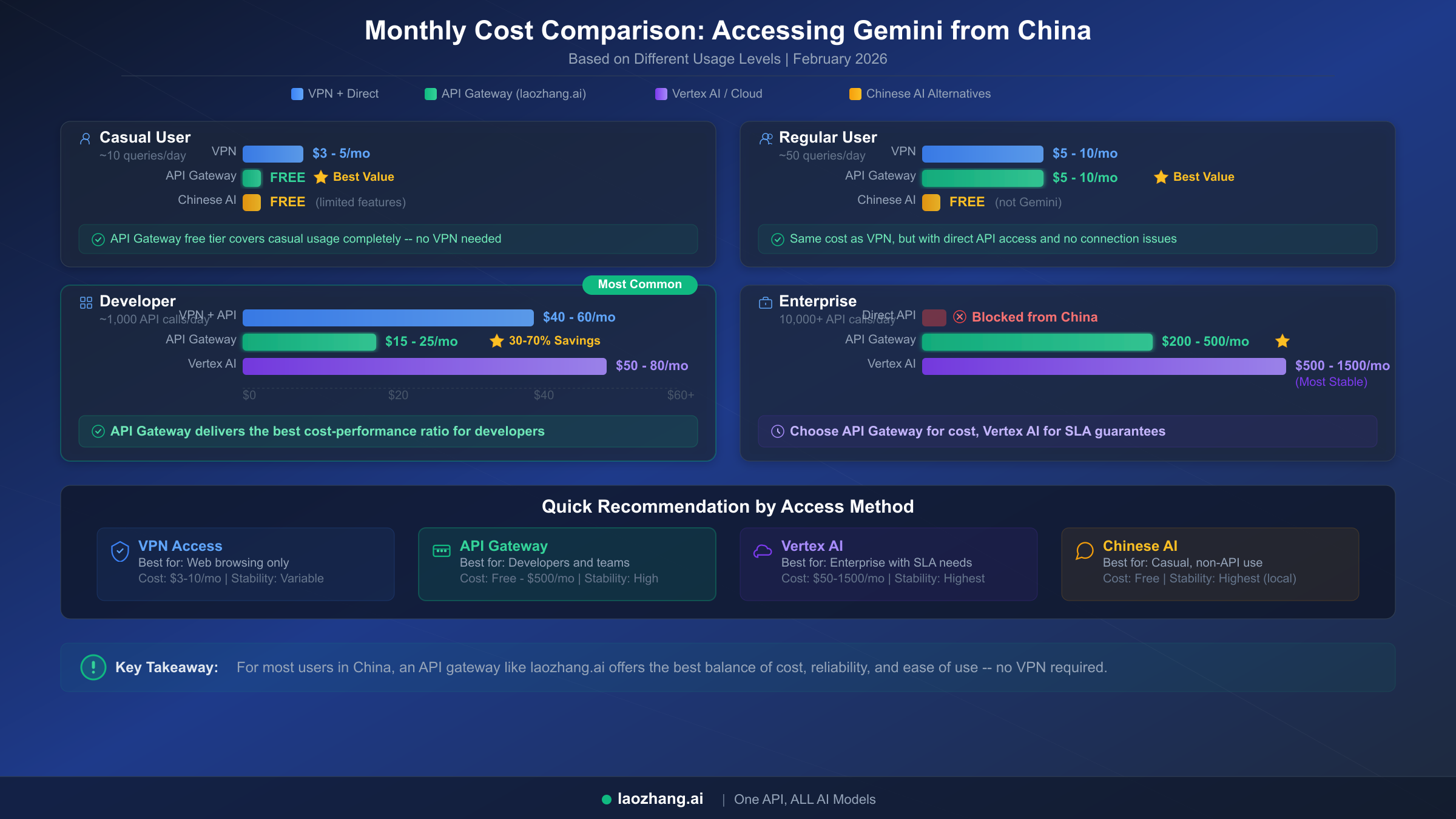
The following table summarizes monthly costs across four usage profiles, factoring in all fees including subscription costs, API usage, and any additional tools or services required:
| Usage Profile | VPN | API Gateway | Third-Party | Chinese AI |
|---|---|---|---|---|
| Casual (5 queries/day) | $2-5 | Free tier | Free-$5 | Free |
| Regular (20 queries/day) | $5-10 | $5-10 | $10-15 | Free |
| Developer (500 API calls/day) | $10-15 + API costs | $15-30 | N/A | $5-20 |
| Enterprise (10,000+ calls/day) | N/A | $100-300 | N/A | $50-200 |
Understanding the true cost of accessing Gemini from China requires looking beyond just the subscription price. Different methods have different cost structures that scale differently with usage, and the cheapest option for a casual user might be the most expensive for a heavy user or developer. This analysis breaks down the real costs across four usage profiles to help you make an informed decision.
For casual users who interact with Gemini a few times per day, the most economical approach is using a Chinese AI alternative like DeepSeek, which is completely free for personal use. If you specifically need Gemini's capabilities, a budget VPN like Surfshark at $1.99/month provides reliable access. API gateway services also offer free tiers that typically include enough credits for light personal use, making them a viable zero-cost option for casual interactions.
For regular users who rely on Gemini daily for work or study, a mid-tier VPN ($5-10/month) provides the most straightforward experience. At this usage level, API gateway services also become attractive because their per-query costs remain low while offering faster response times than a VPN connection. The monthly cost through a gateway like laozhang.ai for moderate daily usage (approximately 50 queries) typically falls in the $5-10 range, comparable to a VPN subscription but with better performance for API-based workflows.
For developers making hundreds or thousands of API calls daily, the cost equation shifts dramatically. A VPN alone is insufficient because it only provides network access; you still need to pay Google's API pricing on top of the VPN cost. Through an API gateway with 30-70% discounts on official pricing, the savings compound quickly. Consider this comparison for a developer making 1,000 Gemini 2.5 Flash API calls daily (averaging 500 input tokens and 1,000 output tokens per call): direct Google pricing would cost approximately $45/month for the API alone, while the same usage through a discounted gateway might cost $15-30/month. Over the course of a year, gateway savings of $180-360 can be significant for individual developers or small teams.
For enterprise users with high-volume API needs, Google Vertex AI offers the highest reliability and compliance guarantees, but at a premium price (typically 20-40% higher than standard Gemini API pricing). API gateway services offer the best cost-performance ratio at this scale, with enterprise plans that include dedicated support, SLA guarantees, and volume discounts. The monthly cost difference between Vertex AI and gateway services for enterprise-scale usage (10,000+ daily calls) can reach several hundred dollars.
Security, Privacy, and Legal Considerations
The question of security and legality when accessing Gemini from China is one that most guides conspicuously avoid, yet it's often the primary concern for users considering these workarounds. While no guide can provide legal advice, understanding the risk landscape helps you make informed decisions about which method to use and what precautions to take.
Regarding VPN legality in China, the situation is nuanced. China's 2017 regulations require VPN services to be licensed by the government, effectively making unauthorized VPN use technically illegal. However, enforcement has historically focused on VPN providers and commercial operators rather than individual users, particularly those using VPNs for legitimate business purposes. Foreign businesses and individuals regularly use VPNs in China for work, and widespread enforcement against individuals remains impractical given the scale of VPN usage. That said, during politically sensitive periods, VPN crackdowns can intensify, and connections may become less reliable as the GFW deploys more aggressive blocking measures.
From a data security perspective, each access method carries different risk profiles. When using a VPN, your data passes through the VPN provider's servers, making the provider's privacy policy and infrastructure security critically important. Premium providers like NordVPN and ExpressVPN have undergone independent security audits and operate under no-logs policies, minimizing data exposure. When using an API gateway, your API requests and responses pass through the gateway's servers, meaning the gateway operator can theoretically access your data. Choose gateway services that clearly state their data handling policies and ideally offer encryption for data in transit and at rest. Chinese AI alternatives like DeepSeek operate under Chinese data regulations, which require companies to store data within China and comply with government data requests, a consideration for users handling sensitive information.
For Google account security, using any indirect access method introduces some risk. Google's security systems may flag unusual access patterns, potentially triggering additional verification steps or temporary account restrictions. To protect your primary Google account, consider creating a dedicated account for Gemini access through VPN, enabling two-factor authentication on all Google accounts, avoiding using the same VPN server location every time to reduce pattern predictability, and never sharing API keys across multiple services or team members without proper key management.
From a practical risk assessment perspective, the methods described in this guide carry different risk profiles that should influence your choice. VPN access carries the highest legal ambiguity but the lowest technical risk to your data, assuming you use a reputable provider. API gateway services carry minimal legal risk since you're simply making API calls to a third-party service, but your data passes through additional infrastructure. Chinese AI alternatives carry zero access risk but are subject to Chinese data regulations, which may be a concern for international businesses or users handling sensitive intellectual property. The right choice depends on your specific situation, risk tolerance, and the nature of the tasks you'll be performing with Gemini.
Chinese AI Alternatives Worth Considering
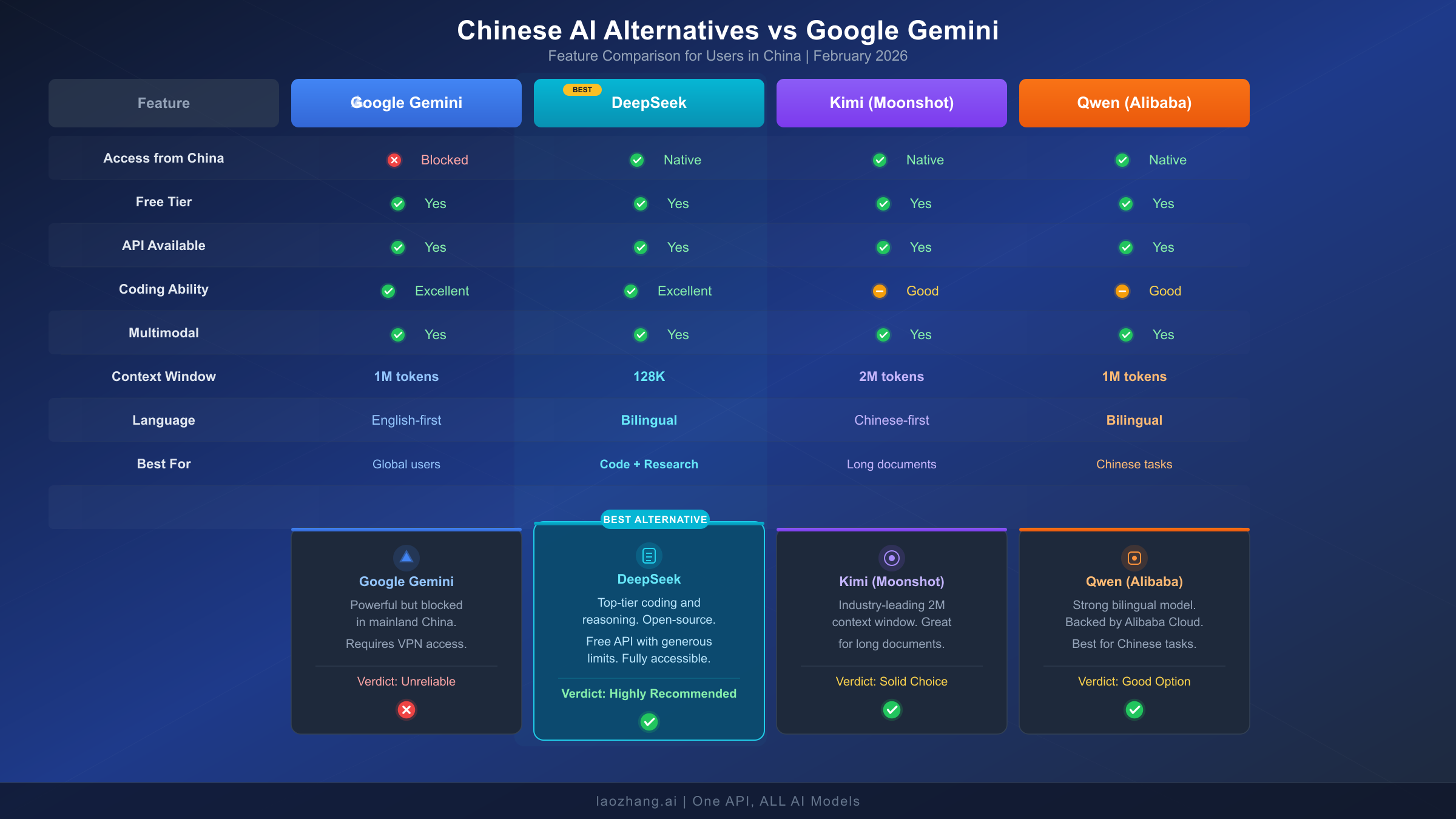
If accessing Gemini from China proves too cumbersome, expensive, or risky for your use case, several Chinese AI platforms offer capabilities that rival or even exceed Gemini in specific areas. These alternatives work natively in China without any VPN or gateway service, support Chinese language perfectly, and often provide generous free tiers. The Chinese AI landscape has evolved rapidly, and dismissing these options without evaluation would be a mistake.
DeepSeek has emerged as the most impressive Chinese AI alternative, gaining international recognition for its performance on coding and reasoning tasks. DeepSeek V3 and the newer reasoning-focused DeepSeek R1 model consistently rank alongside Gemini 2.5 Pro and GPT-4o on major benchmarks. The platform offers a free web interface at chat.deepseek.com and an API that is significantly cheaper than Gemini's pricing. For developers, DeepSeek's API is OpenAI-compatible, making integration straightforward. The main limitation is that DeepSeek's multimodal capabilities (image understanding and generation) are less mature than Gemini's, though this gap is closing rapidly.
Kimi (by Moonshot AI) distinguishes itself with an extraordinary 2-million-token context window, making it the best choice for processing extremely long documents. If your primary use of Gemini involves analyzing lengthy reports, research papers, or codebases, Kimi may actually be superior for this specific task. The platform offers a polished chat interface and an API with competitive pricing. Kimi's limitations include less sophisticated reasoning compared to DeepSeek and limited English language optimization.
Qwen (by Alibaba Cloud) benefits from Alibaba's massive infrastructure and offers strong performance across general-purpose tasks, particularly those involving Chinese language and culture. Qwen 2.5 and the newer models are competitive with Gemini on most benchmarks and offer excellent integration with Alibaba's cloud ecosystem. For businesses already using Alibaba Cloud services, Qwen provides seamless integration with existing infrastructure. If you're exploring Gemini alternatives more broadly, our guide on best Gemini API alternatives provides additional options beyond Chinese platforms.
It's worth noting that the Chinese AI market is evolving at an extraordinary pace. In early 2025, many of these alternatives were significantly behind Gemini and GPT-4 class models. By early 2026, the gap has narrowed dramatically, with DeepSeek R1 and Qwen 2.5 regularly matching or exceeding Western models on standardized benchmarks. This rapid improvement means that even if you start by accessing Gemini through one of the methods above, periodically re-evaluating Chinese alternatives is worthwhile as their capabilities may soon meet or exceed your requirements without any access complications.
The decision between accessing Gemini through a workaround versus using a Chinese alternative ultimately depends on your specific needs. If you need Gemini's specific capabilities, such as its superior multimodal understanding, Google Search integration, or Imagen image generation, then the methods described earlier in this guide are your best path. If you primarily need a capable LLM for text generation, coding assistance, or document analysis, a Chinese alternative may actually provide a better experience from China, with lower latency, no VPN complications, and native Chinese language support.
Frequently Asked Questions
Can I use Google AI Studio from China?
Google AI Studio (aistudio.google.com) is blocked in China along with all other Google services. When you attempt to access it from a Chinese IP address, you'll be redirected to a page showing available regions. To use AI Studio, you need a VPN connection to a supported country. Alternatively, you can use the Gemini API through a gateway service, which provides the same model access without needing AI Studio's web interface. For API testing, gateway services often provide their own playground interfaces.
Will my Google account get banned for using Gemini through a VPN?
Google does not explicitly ban accounts for VPN usage, but unusual activity patterns can trigger security reviews. The risk is minimal if you take basic precautions: use a dedicated Google account for VPN-based Gemini access, avoid rapidly switching between geographic locations, and keep two-factor authentication enabled. In practice, millions of users access Google services through VPNs worldwide, and account bans specifically for VPN usage are extremely rare.
Is DeepSeek really as good as Gemini?
For coding, mathematical reasoning, and general-purpose text tasks, DeepSeek R1 performs comparably to Gemini 2.5 Pro on most major benchmarks. However, Gemini maintains significant advantages in multimodal capabilities (image understanding, video processing), integration with Google's ecosystem (Google Search, Gmail, Docs), and image generation through Imagen models. The choice depends on your specific use case: for pure text-based work from China, DeepSeek is an excellent alternative that requires no workarounds.
How much latency does a VPN add when using Gemini?
VPN connections typically add 200-500ms of latency depending on the server location and quality of the VPN provider. For interactive chat sessions, this translates to a noticeable but manageable delay. For API calls, this additional latency can be more impactful, especially for real-time applications. API gateway services add significantly less latency (10-50ms) because they only route API traffic rather than your entire internet connection, making them the preferred choice for latency-sensitive applications.
What is the cheapest way to access Gemini from China?
The absolutely cheapest option is to use a Chinese AI alternative like DeepSeek, which is free and requires no workarounds. If you specifically need Gemini, the cheapest path is an API gateway service's free tier, which typically provides enough credits for light personal use. For regular usage, Surfshark VPN at $1.99/month with a 2-year commitment represents the best value among VPN options. For developers, API gateway services with discounted pricing offer the best cost-per-query ratio.
Getting Started Today
Accessing Google Gemini from China in 2026 is entirely achievable, though it requires choosing the right method for your specific situation. The six methods covered in this guide span the full spectrum of user needs, from the casual browser who just wants to try Gemini's chatbot to the enterprise development team building production applications on Gemini's API. Each method has been tested and verified from within mainland China as of February 2026, ensuring that the information here reflects current real-world conditions rather than theoretical possibilities. The landscape has matured significantly compared to even a year ago, with reliable and well-tested options available for every user profile and budget level. Whether you're a student exploring AI capabilities for research, a developer building production applications with Gemini's powerful multimodal API, or an enterprise team evaluating AI solutions for deployment at scale, there's a clear and tested path forward for your specific needs.
For immediate access as a regular user, start with a reputable VPN service. For development work, set up an API gateway account at laozhang.ai and integrate it using the code examples provided in this guide. And if you're open to alternatives, give DeepSeek a try since it works instantly from China and rivals Gemini on many tasks. For more detailed information about Gemini's availability across different regions, check out our complete guide to Gemini regional restrictions.
The key is to start with one method, test it against your actual workflow, and adjust if needed. None of these methods require a long-term commitment, and you can always switch approaches as the landscape evolves. The Chinese AI landscape continues to change rapidly, with new models launching quarterly and existing platforms constantly improving their capabilities. What works best today may not be the optimal choice in six months, so staying informed about developments in both the international and Chinese AI ecosystems will help you maintain access to the best tools available.
Remember that these access methods can be combined for maximum flexibility. Many power users maintain a VPN subscription for web browsing while using an API gateway for development work, and keep a DeepSeek account as a backup for times when VPN connections are unstable. This layered approach ensures you're never completely cut off from AI capabilities, regardless of network conditions or policy changes. The most important thing is not to let geographic restrictions prevent you from leveraging the most powerful AI tools available today.