
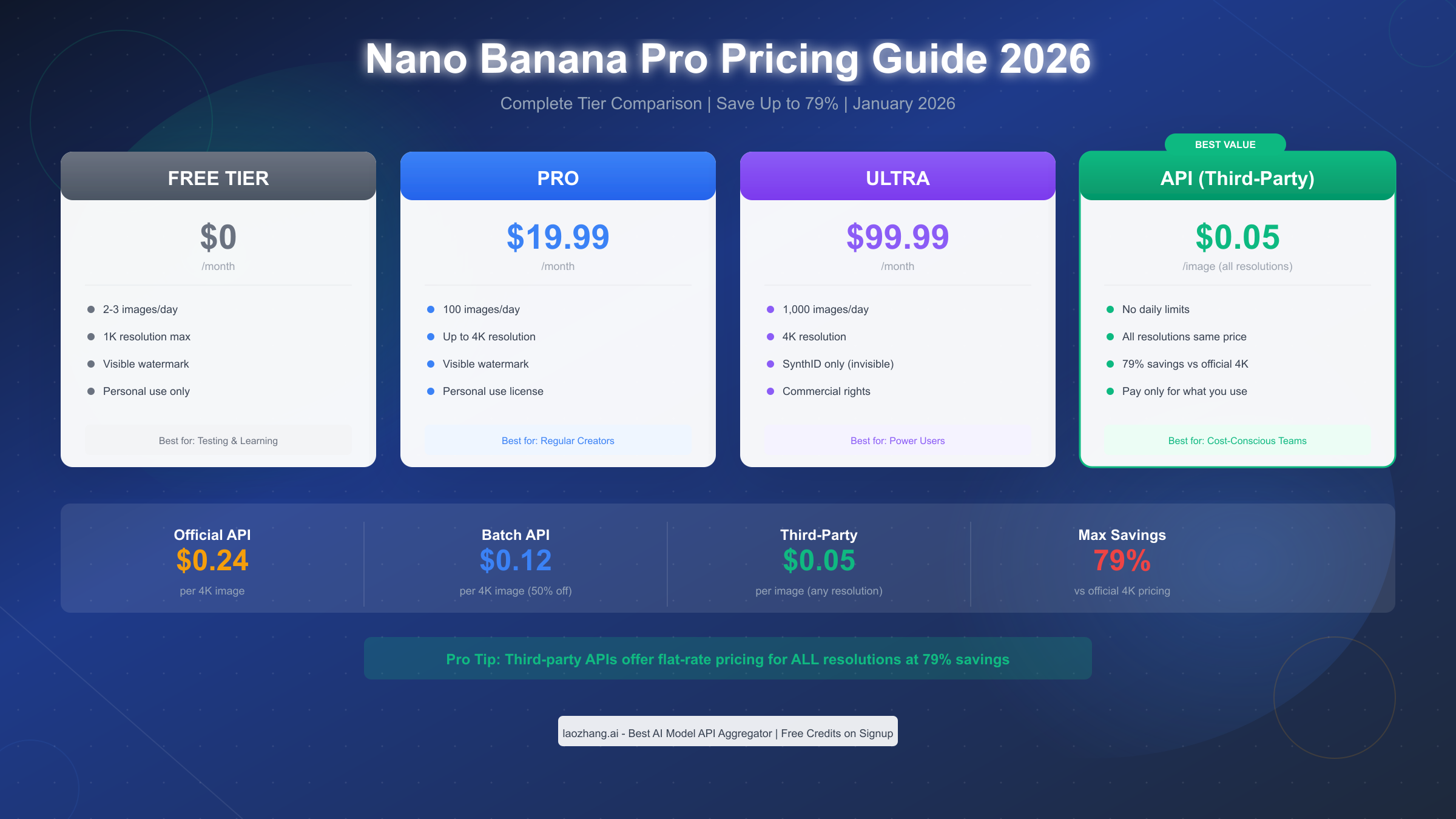
Nano Banana Pro pricing ranges from free to $0.24 per image depending on your access method. As of January 2026, Google's official API charges $0.134 for 2K resolution and $0.24 for 4K images, while subscription users pay $19.99/month (Pro) or $99.99/month (Ultra) for generous daily quotas. Third-party providers like laozhang.ai offer flat-rate pricing at $0.05 per image regardless of resolution—representing up to 79% savings compared to official 4K rates. This comprehensive guide covers all pricing tiers, break-even calculations, quota management, and cost optimization strategies to help you make the most informed decision.
Quick Answer: Nano Banana Pro Pricing at a Glance
Before diving into detailed analysis, here's what you need to know about Nano Banana Pro pricing in January 2026. The model—officially known as Gemini 3 Pro Image—offers multiple access paths with dramatically different cost structures, and understanding these differences can save you hundreds of dollars monthly.
| Access Method | Price | Daily Limit | Resolution | Commercial Use |
|---|---|---|---|---|
| Free Tier | $0 | 2-3 images | 1K | No |
| Pro Subscription | $19.99/mo | 100 images | 4K | No |
| Ultra Subscription | $99.99/mo | 1,000 images | 4K | Yes |
| Official API (2K) | $0.134/image | Rate-limited | 2K | Yes |
| Official API (4K) | $0.24/image | Rate-limited | 4K | Yes |
| Batch API | $0.067-0.12/image | Delayed | 4K | Yes |
| Third-Party API | $0.05/image | Unlimited | All | Yes |
The pricing landscape has evolved significantly since Nano Banana Pro launched in late 2025. Google's subscription model targets casual users who prefer predictable monthly costs, while the API serves developers needing programmatic access. However, the emergence of legitimate third-party aggregators has created a compelling middle ground—offering the flexibility of API access at a fraction of official pricing.
For most users generating between 500 and 5,000 images monthly, third-party APIs represent the optimal value proposition. At $0.05 per image, you're paying 79% less than Google's $0.24 4K rate, while getting the same model quality, commercial rights, and no daily quotas to worry about. For detailed information about the Gemini API pricing structure, check our comprehensive guide.
Complete Tier Comparison: Free, Pro, Ultra, and API
Understanding the nuances between each pricing tier requires looking beyond simple per-image costs. Each option carries hidden considerations around quotas, watermarks, commercial rights, and practical usability that significantly impact total cost of ownership.
The Free Tier Reality
Google's free tier allows 2-3 Nano Banana Pro generations daily at 1K resolution (1024×1024 pixels). While this sounds limiting, it serves an important purpose: letting users test the model's capabilities before committing financially. The catch? Free tier images carry visible watermarks, and when you exceed your daily quota, the system silently falls back to standard Nano Banana (Gemini 2.5 Flash Image)—a lower-quality model that produces noticeably inferior results.
Free tier users also face the longest queue times. During peak hours, generation can take 30-60 seconds compared to 10-15 seconds for paying customers. For anyone doing more than occasional experimentation, the free tier quickly becomes impractical. If you're exploring whether Nano Banana Pro meets your needs, our comprehensive free tier guide covers all limitations and workarounds.
Pro Subscription Deep Dive
At $19.99/month, Pro subscribers receive approximately 100 images daily at resolutions up to 4K. This translates to roughly 3,000 images monthly—enough for most individual creators and small content teams. The subscription model's primary advantage is predictability: your cost never exceeds $19.99 regardless of how many images you generate within the quota.
However, Pro's visible watermarks present a significant limitation for professional use. While the watermark is less obtrusive than the free tier's, it still appears on generated images. This makes Pro unsuitable for client work, product imagery, or any commercial application requiring clean outputs. Additionally, Pro's personal-use license means you technically cannot sell images or use them in commercial products.
The effective per-image cost varies dramatically based on utilization. If you generate all 100 daily images (3,000 monthly), you're paying approximately $0.0067 per image—exceptional value. But if you only average 30 images daily (900 monthly), your effective cost rises to $0.022 per image. Many users overestimate their needs, ending up with significant quota waste.
Ultra Subscription Analysis
Ultra at $99.99/month represents the premium subscription tier, offering 1,000 images daily (30,000 monthly) at 4K resolution with invisible SynthID watermarks and full commercial rights. For power users fully utilizing the quota, the effective per-image cost drops to an remarkable $0.0033—the lowest possible rate for legitimate Nano Banana Pro access.
Ultra also unlocks advanced features unavailable to other tiers: integrated lighting controls, extended creative studio tools, and priority processing during peak periods. For agencies, e-commerce businesses, or content studios generating thousands of images monthly, Ultra's combination of high quotas and commercial rights makes it the most cost-effective subscription option.
The challenge with Ultra lies in the high baseline cost. You need to generate roughly 417 4K images monthly just to match third-party API pricing ($0.24 official rate). Most individual users and small teams won't consistently hit this threshold, making Ultra's value proposition dependent on genuinely high-volume needs.
Official API Pricing Structure
Google's API pricing operates on a per-image model with resolution-based tiers. Standard resolutions (1K and 2K) share identical pricing at $0.134 per image—a quirk that means you should always request 2K for free quality improvement. 4K images cost $0.24 each, making high-resolution generation 79% more expensive than standard outputs.
The API also incurs minor additional costs often overlooked in comparisons. Text prompts charge $2.00 per million input tokens (typically negligible at ~$0.0002 per request), while optional search grounding adds $0.035 per request. For most users, these extras remain rounding errors, but they compound at scale.
API access requires technical setup—obtaining API keys, configuring authentication, and integrating with your application. For developers comfortable with REST APIs, setup takes 15-30 minutes. Non-technical users should consider subscription tiers or managed third-party services instead. For step-by-step instructions, see our Nano Banana Pro rate limits guide.
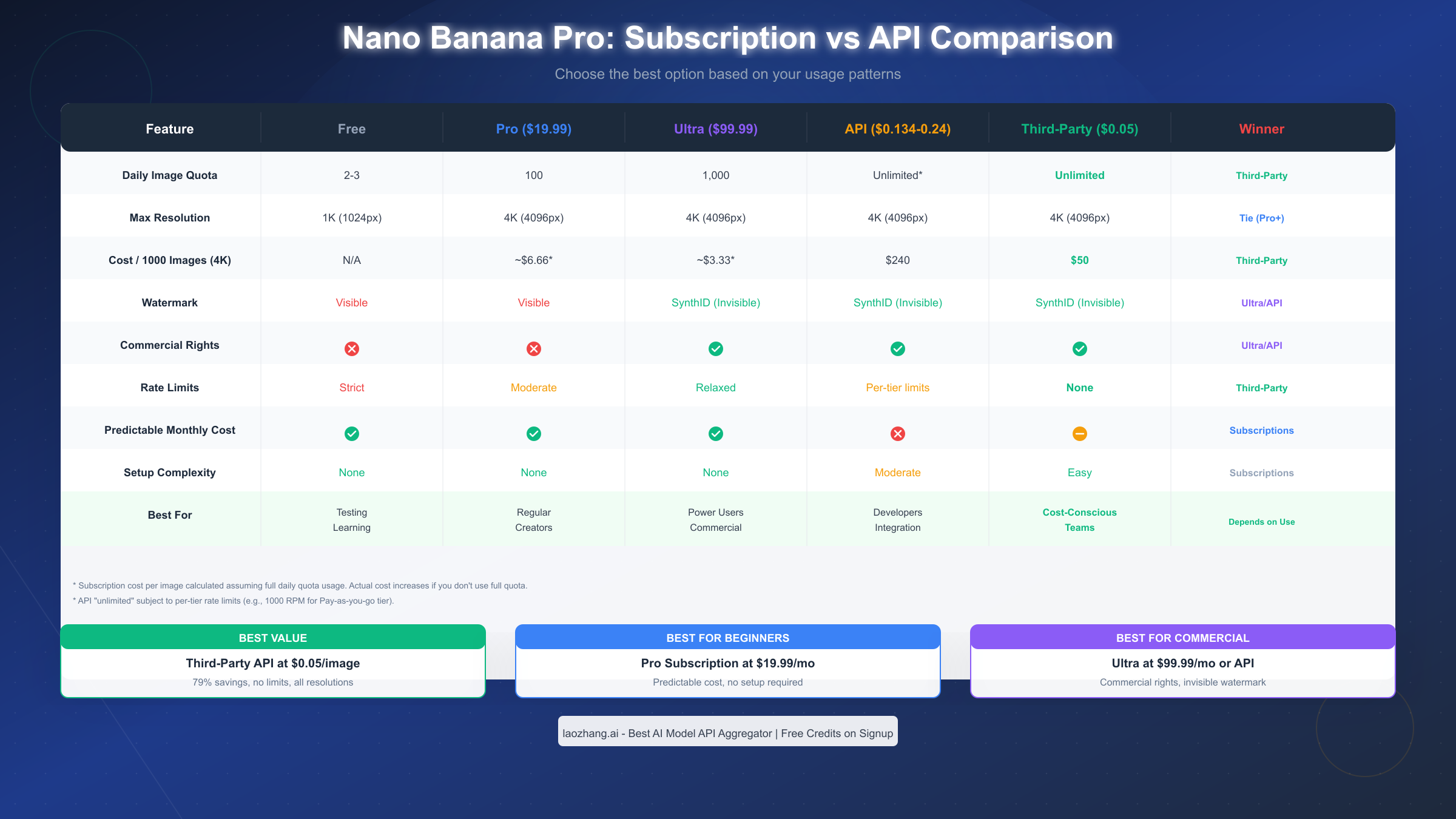
When Subscription Beats API: The Break-Even Analysis
The subscription vs. API decision fundamentally depends on your monthly volume and consistency. Understanding the break-even points helps identify which option delivers better value for your specific usage pattern.
Pro Subscription Break-Even Calculation
Pro subscription costs $19.99/month with a 100 image/day quota. Compared to official API pricing:
- vs. 2K API ($0.134): Break-even at 149 images/month
- vs. 4K API ($0.24): Break-even at 83 images/month
- vs. Third-party ($0.05): Break-even at 400 images/month
If you consistently generate more than 149 images monthly at 2K resolution (or 83 at 4K), Pro subscription costs less than pay-per-use API. However, comparing against third-party alternatives shifts the calculation dramatically—you'd need to generate 400+ images monthly before Pro becomes cheaper than $0.05/image third-party pricing.
Ultra Subscription Break-Even Calculation
Ultra at $99.99/month makes sense only at high volumes:
- vs. 2K API ($0.134): Break-even at 746 images/month
- vs. 4K API ($0.24): Break-even at 417 images/month
- vs. Third-party ($0.05): Break-even at 2,000 images/month
For Ultra to outperform third-party pricing, you need consistent 2,000+ image monthly generation. Few individual users or small teams reach this threshold, making Ultra primarily valuable for its commercial rights and invisible watermarks rather than pure cost efficiency.
The Hidden Variable: Quota Utilization
Break-even calculations assume perfect quota utilization—generating exactly your monthly allocation with zero waste. Reality differs significantly. Most subscription users experience:
- Irregular demand: Busy periods followed by light usage
- Quota timing mismatches: Daily limits don't roll over; unused images disappear at midnight
- Seasonal variation: Project-based workflows with inconsistent monthly volumes
A user averaging 50% quota utilization effectively pays double the theoretical per-image rate. If you're uncertain about consistent high-volume needs, API or third-party options provide flexibility without waste risk.
Understanding Quotas: The Hidden Pricing Factor
Quotas represent the most overlooked aspect of Nano Banana Pro pricing. While per-image costs attract attention, daily and monthly limits fundamentally alter the effective economics—especially for subscription users.
Daily vs. Monthly Quota Economics
Subscription quotas reset daily, not monthly. This seemingly minor detail has major implications:
- 100 images/day ≠ 3,000 images/month: You cannot "bank" unused daily quota for busy days
- Weekend waste: If you only generate images on weekdays, you lose 2/7 of your subscription value
- Burst limitations: Large projects requiring 500+ images in one day exceed daily caps regardless of monthly average
Consider a freelance designer with variable workload: one week might require 50 images daily, the next week only 10. On Pro subscription, the light week "wastes" 90% of quota value. The heavy week still hits the 100-image ceiling, potentially forcing additional API charges for overages.
Rate Limits and Effective Throughput
Beyond daily quotas, API users face rate limits measured in requests per minute (RPM):
| Tier | RPM Limit | Daily Effective Maximum |
|---|---|---|
| Free API | 10 RPM | ~14,400 images |
| Pay-as-you-go | 100 RPM | ~144,000 images |
| Enterprise | Custom | Negotiated |
While these limits seem generous, they create practical constraints for automated workflows. A batch processing job generating 10,000 images at 100 RPM requires 100 minutes of continuous operation—plus overhead for error handling and retry logic. Third-party providers often eliminate these constraints entirely, offering higher or unlimited RPM for burst workloads.
Quota-Adjusted Value Calculation
To assess true subscription value, calculate your quota-adjusted cost:
Effective Cost = Monthly Price / (Daily Quota × Days Used × Utilization Rate)
For a Pro user generating images 20 days/month at 60% daily utilization:
- Effective Cost = $19.99 / (100 × 20 × 0.6) = $0.0167/image
Compare this to third-party's flat $0.05—the subscription still wins, but the margin narrows considerably from the theoretical $0.0067 assuming perfect utilization.
Real-World Cost Scenarios: From Hobbyist to Enterprise
Abstract pricing comparisons only go so far. Let's examine concrete monthly costs for four representative user profiles to understand how pricing differences compound at various scales.
Scenario 1: Hobbyist Creator (50 images/month)
A hobbyist generating 50 images monthly for personal projects or social media has these options:
| Option | Monthly Cost | Per-Image Cost |
|---|---|---|
| Free Tier | $0 | $0 (with limits) |
| Pro Subscription | $19.99 | $0.40 |
| Third-Party API | $2.50 | $0.05 |
| Official API (2K) | $6.70 | $0.134 |
Recommendation: Free tier if watermarks are acceptable; otherwise third-party API at $2.50/month—85% cheaper than the subscription.
Scenario 2: Freelance Designer (500 images/month)
A freelance designer handling client work needing commercial rights and professional quality:
| Option | Monthly Cost | Per-Image Cost | Notes |
|---|---|---|---|
| Pro Subscription | $19.99 | $0.04 | No commercial rights |
| Ultra Subscription | $99.99 | $0.20 | Commercial rights |
| Third-Party API | $25.00 | $0.05 | Commercial rights |
| Official API (4K) | $120.00 | $0.24 | Commercial rights |
Recommendation: Third-Party API at $25/month—75% cheaper than Ultra while including commercial rights.
Scenario 3: E-commerce Business (3,000 images/month)
An e-commerce company generating product imagery at scale:
| Option | Monthly Cost | Per-Image Cost | Notes |
|---|---|---|---|
| Ultra Subscription | $99.99 | $0.033 | Limited to 1000/day |
| Third-Party API | $150.00 | $0.05 | No daily limits |
| Official API (4K) | $720.00 | $0.24 | Highest quality guarantee |
| Batch API | $360.00 | $0.12 | 50% off, delayed delivery |
Recommendation: Ultra for predictable cost if daily distribution works; third-party API if burst capacity needed. Teams prioritizing cost efficiency at this scale should explore aggregators like laozhang.ai, which offers flat $0.05/image pricing with OpenAI-compatible endpoints that simplify integration with existing workflows.
Scenario 4: Enterprise (30,000+ images/month)
Large-scale operations requiring tens of thousands of images monthly:
| Option | Monthly Cost | Per-Image Cost | Notes |
|---|---|---|---|
| Ultra Subscription | $99.99 | $0.0033 | Maxed quota |
| Third-Party API | $1,500.00 | $0.05 | Unlimited |
| Batch API | $3,600.00 | $0.12 | High volume |
| Official API (4K) | $7,200.00 | $0.24 | Highest reliability |
Recommendation: Ultra subscription if 1,000/day ceiling works; otherwise hybrid approach mixing Ultra for guaranteed capacity plus third-party for overflow.
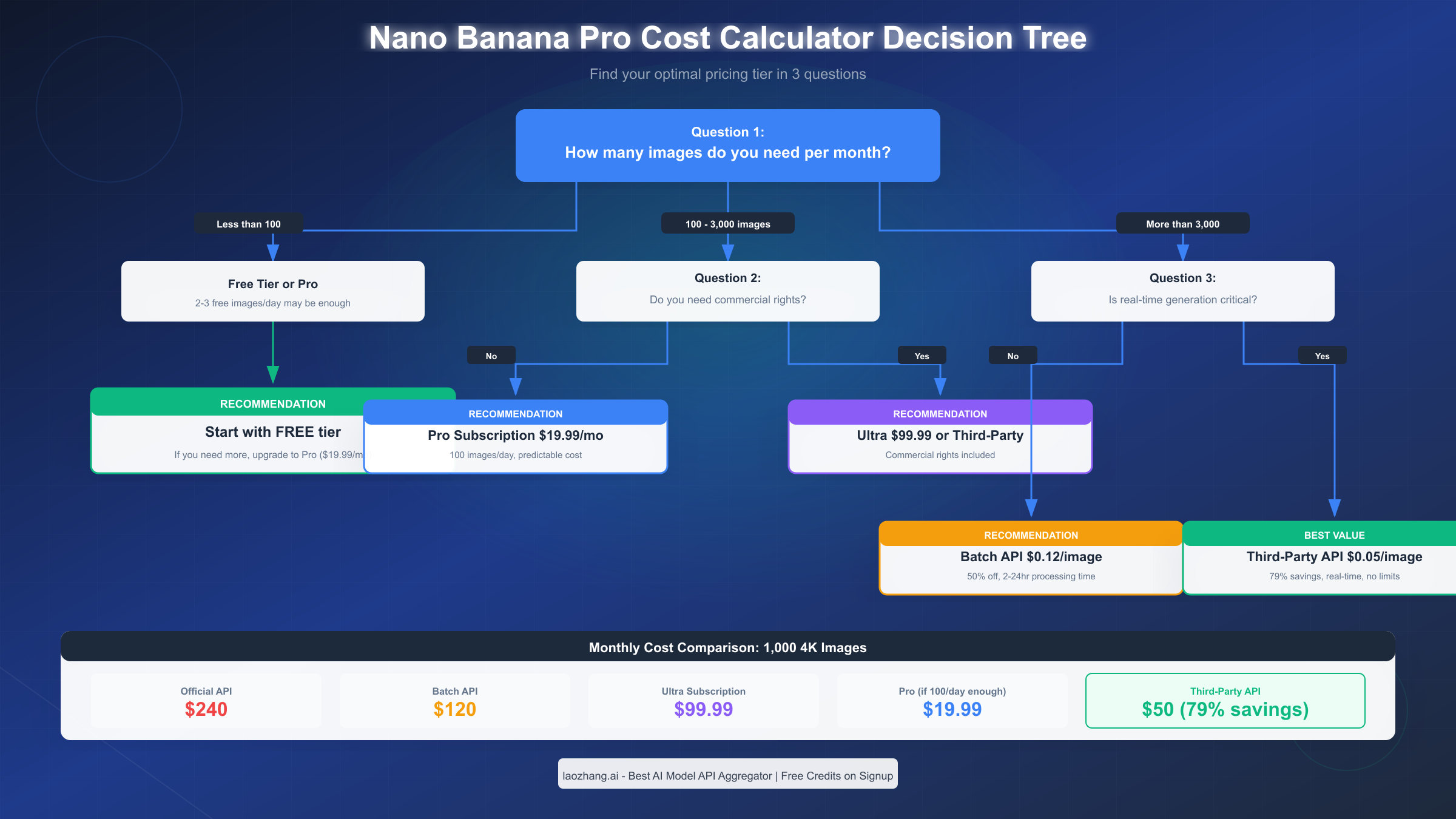
Third-Party Alternatives: Save Up to 79% Safely
The emergence of legitimate third-party API aggregators has transformed Nano Banana Pro economics. These services provide official model access at dramatically reduced costs—but understanding their trade-offs is essential for informed decisions.
How Third-Party Providers Work
Aggregators like laozhang.ai don't run their own AI models. Instead, they maintain enterprise agreements with Google (and other providers), purchasing API access at volume-discounted rates and reselling to end users at prices below official retail. This arbitrage model benefits everyone: Google gains enterprise customers, aggregators earn margins, and end users access premium models affordably.
The technical implementation typically mirrors official APIs. Most aggregators offer OpenAI-compatible endpoints, meaning existing code integrating with GPT-4V or DALL-E requires minimal modification to switch providers. Authentication uses aggregator-issued API keys rather than Google credentials, with billing handled through the aggregator's dashboard.
laozhang.ai Platform Overview
Among third-party options, laozhang.ai stands out for Nano Banana Pro access. Their key offerings include:
- Flat-rate pricing: $0.05/image for all resolutions (1K, 2K, or 4K)
- No daily limits: Generate as needed without quota management
- Multi-model access: 200+ AI models through unified API
- Low entry barrier: $5 minimum deposit (~35 CNY)
- OpenAI compatibility: Drop-in replacement for existing integrations
At $0.05/image, laozhang.ai delivers 79% savings versus Google's $0.24 4K rate and 63% versus the $0.134 2K rate. For users generating 1,000 images monthly, this translates to $190 saved compared to official 4K pricing.
Trust and Reliability Considerations
Third-party providers introduce considerations absent from direct Google access:
- Uptime dependency: Aggregator outages affect your access regardless of Google's status
- Data routing: Prompts and images pass through aggregator infrastructure
- Support channels: Issues may require coordinating between aggregator and Google
- Pricing stability: Third-party rates can change with less notice than official pricing
Reputable aggregators mitigate these concerns through transparent SLAs, documented uptime metrics (laozhang.ai reports 99.5% uptime), and responsive support. However, mission-critical applications requiring guaranteed availability may prefer official API access despite higher costs.
When to Use Third-Party vs. Official
Third-party aggregators make sense when:
- Cost optimization is primary concern
- Volume exceeds subscription quotas
- You need burst capacity without long-term commitment
- Multi-model access simplifies your stack
Official access remains preferable when:
- Maximum reliability is essential
- Enterprise SLAs required for compliance
- Direct Google support relationship needed
- Absolute minimum latency critical
For comprehensive analysis of cheapest Nano Banana API options, including additional providers and current pricing, see our detailed comparison.
7 Money-Saving Strategies (Ranked by Impact)
Beyond choosing the right tier, several optimization strategies can meaningfully reduce Nano Banana Pro costs. Here are seven approaches ranked by potential savings impact.
Strategy 1: Use Third-Party Aggregators (79% Savings)
Impact: ★★★★★
As discussed, third-party providers offer the single largest cost reduction. Switching from official 4K API ($0.24) to aggregator pricing ($0.05) saves 79% immediately. For most users without specific requirements demanding official access, this represents the highest-impact optimization available.
Strategy 2: Leverage Batch API for Non-Urgent Work (50% Savings)
Impact: ★★★★☆
Google's Batch API provides 50% discount ($0.12 4K vs. $0.24 standard) for requests tolerating 2-24 hour processing delays. E-commerce product imagery, marketing asset libraries, and other non-real-time needs can batch overnight for substantial savings.
Batch is particularly effective combined with workflow automation—queue images during business hours, process overnight, review results next morning. The 24-hour turnaround suits weekly content calendars while halving generation costs.
Strategy 3: Request 2K Instead of 1K (Free Quality Upgrade)
Impact: ★★★★☆
Google charges identical rates for 1K and 2K resolutions ($0.134 via API). Always request 2K unless you specifically need 1K outputs—you're getting double the resolution at no additional cost. Many users default to 1K unnecessarily, missing this free quality improvement.
Strategy 4: Optimize Prompt Efficiency (15-25% Savings)
Impact: ★★★☆☆
While prompt tokens cost only $2/million (negligible), inefficient prompting causes regeneration waste. Clear, specific prompts produce usable results more often than vague requests requiring multiple attempts.
Track your first-attempt success rate. If you're averaging 2-3 generations per usable image, prompt optimization can effectively cut costs 50-67%. Techniques include:
- Specific style references instead of generic descriptors
- Clear composition instructions (framing, perspective)
- Explicit negative guidance for common failures
Strategy 5: Resolution Tiering Based on Use Case (20-30% Savings)
Impact: ★★★☆☆
Not every image needs 4K resolution. Match resolution to actual use case:
| Use Case | Recommended Resolution | Cost Savings vs. 4K |
|---|---|---|
| Social media thumbnails | 1K | 44% |
| Blog images | 2K | 44% |
| Print materials | 4K | Baseline |
| Hero images | 4K | Baseline |
Analyzing your output distribution often reveals 30-50% of images could use 2K without quality compromise.
Strategy 6: Free Tier Maximization (Variable)
Impact: ★★☆☆☆
Free tier users can stretch their 2-3 daily images through strategic timing:
- Save complex generations for paid access
- Use free tier for quick tests and iterations
- Leverage Google AI Studio's separate free allocation
For low-volume users, disciplined free tier usage can indefinitely defer paid costs—though watermarks and quality limitations constrain professional applications.
Strategy 7: Annual Subscription Discounts (Variable)
Impact: ★★☆☆☆
Some subscription platforms offer annual payment discounts (typically 10-20%). If you've validated consistent monthly usage over 6+ months, annual commitment locks in savings. However, only commit after confirming sustained need—unused annual subscriptions represent sunk costs.
FAQ: Your Nano Banana Pro Pricing Questions Answered
How much does Nano Banana Pro cost per image?
Pricing varies by access method: Free tier ($0 with limits), official API ($0.134 for 2K, $0.24 for 4K), Batch API ($0.067-0.12), and third-party aggregators ($0.05). Subscription users pay effective per-image rates ranging from $0.0033 (Ultra, full utilization) to $0.40+ (Pro, low utilization).
Is there a free way to use Nano Banana Pro?
Yes. Google offers 2-3 free images daily at 1K resolution through the Gemini app and AI Studio. Free tier includes visible watermarks and falls back to lower-quality models when quota exceeded. New Google Cloud users also receive $300 in credits applicable to API usage.
Which is cheaper: subscription or API?
Depends on volume and utilization. Pro subscription beats API at 149+ images/month (assuming full quota usage). However, comparing to third-party API ($0.05/image), subscription only wins at 400+ monthly images. For inconsistent or burst usage, pay-per-use options often deliver better value.
Do I need Ultra for commercial use?
Not necessarily. Ultra ($99.99/mo) includes commercial rights, but so do API options (official and third-party). If your volume exceeds Ultra's 1,000 daily quota or you prefer pay-per-use flexibility, API with commercial rights may be more economical.
Are third-party APIs legitimate?
Reputable aggregators maintain enterprise agreements with model providers, offering genuine access at volume-discounted rates. Look for established providers with documented uptime, transparent terms, and responsive support. Services like laozhang.ai have built solid reputations in the developer community. For documentation and setup instructions, visit https://docs.laozhang.ai/.
How do I calculate my expected monthly cost?
Estimate monthly image volume, select your target resolution, then multiply by appropriate per-image rate. Add 20-30% buffer for regeneration attempts. For subscriptions, divide monthly cost by expected images to confirm you'll beat API pricing.
What's the difference between Nano Banana and Nano Banana Pro?
Nano Banana (Gemini 2.5 Flash Image) costs less (~$0.04/image) but produces lower quality results with maximum 1K resolution. Nano Banana Pro (Gemini 3 Pro Image) supports 4K output, superior text rendering, and more complex compositions—worth the premium for professional applications.
Can I exceed my subscription quota?
Subscription quotas are hard limits—exceeding requires additional API charges at standard rates. Plan usage to avoid overages, or consider hybrid approaches combining subscription base with API overflow capacity.
Understanding Nano Banana Pro pricing requires looking beyond simple per-image costs to consider quotas, utilization rates, and practical workflow needs. For most users, third-party APIs at $0.05/image deliver optimal value—79% savings versus official rates while maintaining full model quality and commercial rights. Higher-volume users may benefit from Ultra subscription's predictable costs, while developers with burst needs should explore aggregator services offering unlimited rate limits. Whatever your use case, this guide provides the framework for making informed pricing decisions that balance cost, capability, and convenience.