
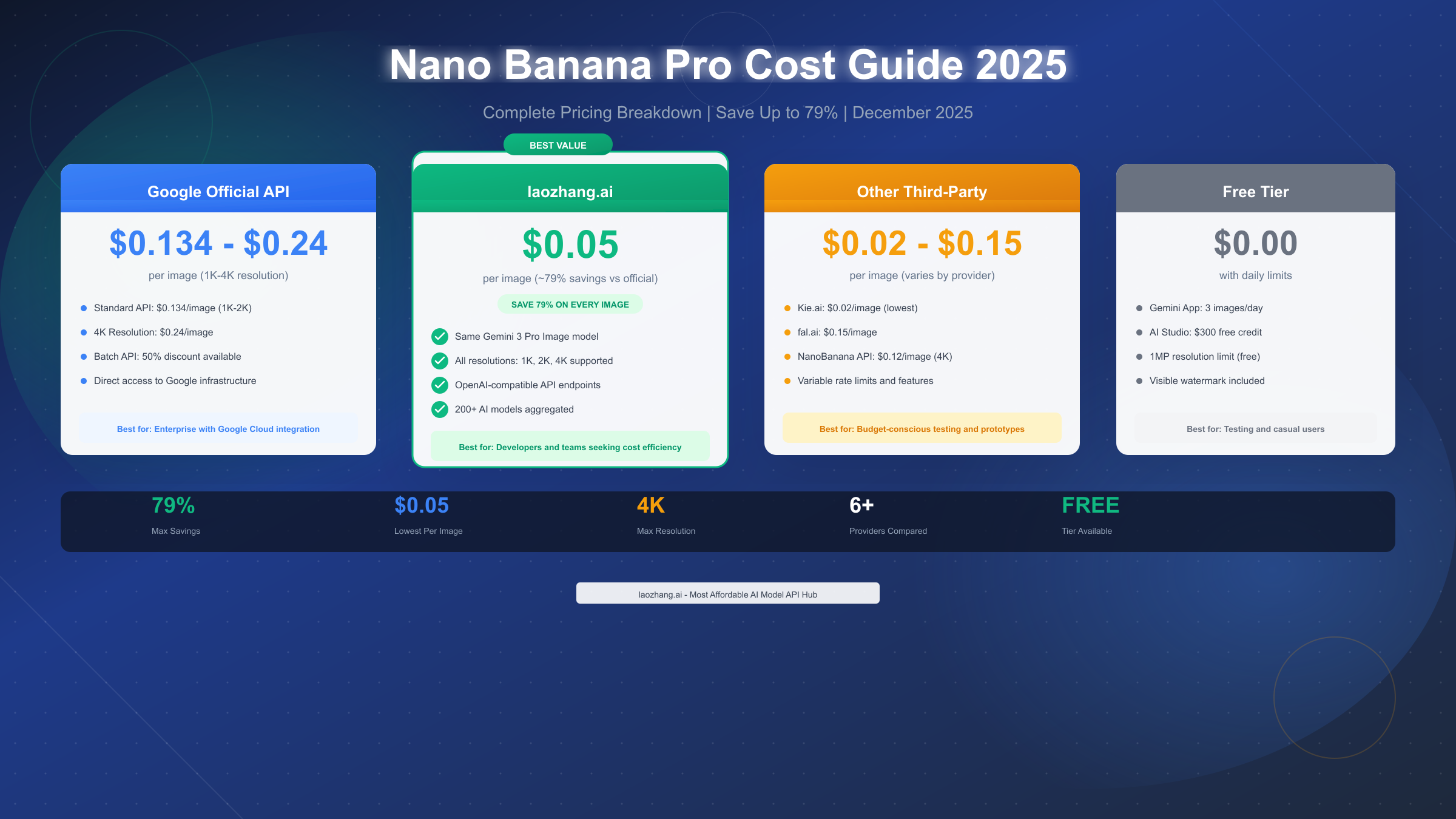
Nano Banana Pro costs $0.134 per image for standard resolution (1K/2K) and $0.24 per image for 4K resolution through Google's official API. However, third-party providers like laozhang.ai offer the same model at just $0.05 per image—a 79% savings that can translate to thousands of dollars annually for production workloads. As of December 2025, Nano Banana Pro (officially Google Gemini 3 Pro Image) represents the cutting edge of AI image generation, featuring industry-leading text rendering accuracy of 94% and support for resolutions up to 4096x4096 pixels. Whether you're a hobbyist generating a handful of images monthly or an enterprise processing thousands daily, understanding the complete pricing landscape is essential for optimizing your AI image generation budget.
Nano Banana Pro Pricing Quick Answer
Before diving into the complete breakdown, here's what you need to know about Nano Banana Pro costs in December 2025. The pricing structure varies significantly based on your chosen access method, ranging from completely free (with limitations) to $0.24 per image through official channels. Understanding these tiers will help you make an informed decision based on your specific requirements and budget constraints.
The official Google API remains the baseline for pricing comparisons, charging $0.134 per image at standard resolutions (1024x1024 to 2048x2048) and $0.24 for 4K output (4096x4096). These rates reflect Google's premium positioning for Nano Banana Pro as their flagship image generation model, which launched on November 20, 2025 as part of the Gemini 3 Pro Image preview. The model incorporates advanced "thinking" capabilities that enable it to follow complex instructions and render high-fidelity text—features that justify the premium pricing for certain use cases.
However, savvy developers and teams have discovered significant cost savings through alternative access methods. Google's own Batch API offers a straightforward 50% discount, reducing costs to $0.067 for standard resolutions and $0.12 for 4K output. The trade-off is latency: batch processing can take up to 24 hours to complete, making it unsuitable for real-time applications but ideal for background processing workflows.
Third-party API providers represent the most dramatic cost reduction opportunity. Platforms like laozhang.ai offer Nano Banana Pro access at just $0.05 per image—approximately 79% less than Google's 4K pricing and 63% less than standard resolution rates. These providers operate as API aggregators, routing requests through optimized infrastructure while maintaining compatibility with the same underlying model. For teams generating hundreds or thousands of images monthly, this price differential translates to substantial budget savings.
The free tier remains an option for testing and casual use. The Gemini app provides 3 free images daily at 1MP resolution, while Google AI Studio offers $300 in trial credits for new developers—enough for approximately 2,240 image generations before incurring any costs. These options provide excellent entry points for evaluating Nano Banana Pro's capabilities without financial commitment.
Complete Pricing Breakdown by Provider
Understanding the full landscape of Nano Banana Pro providers requires examining not just per-image costs, but also factors like rate limits, setup complexity, and feature availability. This section provides a comprehensive comparison to help you identify the optimal provider for your specific requirements.
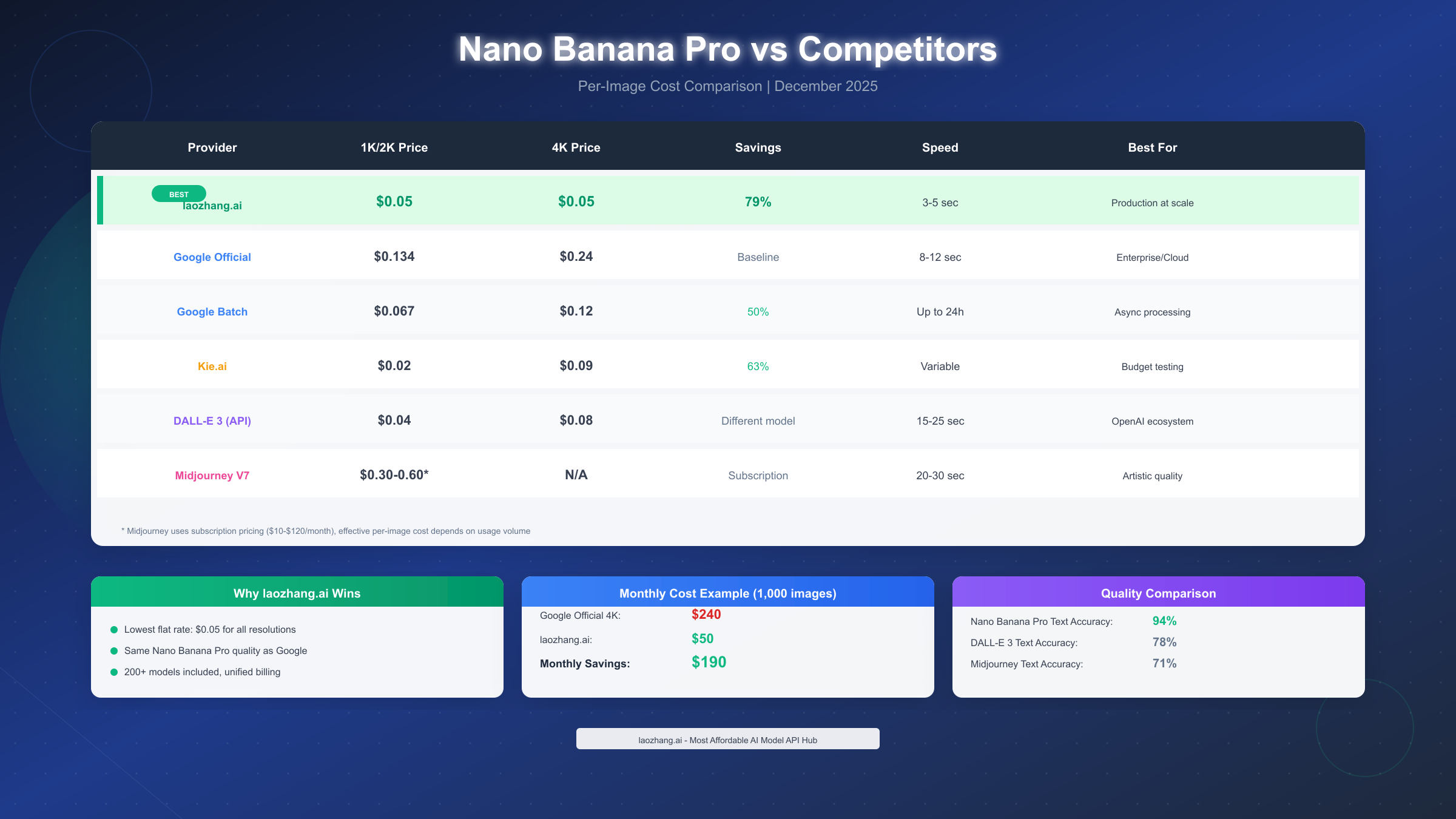
Google's Official API represents the baseline against which all alternatives are measured. At $0.134 per image for 1K/2K resolutions and $0.24 for 4K output, it provides direct access to Google's infrastructure with enterprise-grade reliability. The official API includes full support for advanced features like Search grounding (enabling real-time information integration), multi-image blending with identity preservation across up to five subjects, and an expanded visual context window supporting up to 14 reference images. For organizations already invested in Google Cloud, the integration simplicity and guaranteed SLAs may justify the premium pricing. If you're already working with Google's AI ecosystem, you might find our complete Gemini API pricing guide helpful for understanding the broader context.
Google Batch API offers identical quality at half the cost. By accepting asynchronous processing with delivery times up to 24 hours, you can reduce expenses to $0.067 per 1K/2K image and $0.12 per 4K generation. This option works exceptionally well for non-time-sensitive workloads like content library building, batch marketing asset creation, or overnight processing pipelines. The key limitation is latency—if you need images within seconds or minutes, the Batch API isn't suitable.
laozhang.ai stands out as the most cost-effective option for production workloads, offering Nano Banana Pro at a flat $0.05 per image regardless of resolution. This represents approximately 79% savings compared to Google's 4K pricing and 63% savings on standard resolutions. Beyond pure cost savings, laozhang.ai provides several practical advantages for developers: OpenAI-compatible API endpoints enable drop-in replacement for existing integrations, unified billing across 200+ AI models simplifies accounting, and flexible rate limits accommodate burst traffic without the strict quotas of Google's direct API.
Kie.ai offers the absolute lowest per-image cost at $0.02 for 1K/2K resolutions and $0.09 for 4K output. However, this aggressive pricing comes with trade-offs including variable rate limits and less documentation compared to larger providers. For budget-constrained testing or prototype development, Kie.ai presents an attractive option.
fal.ai positions itself in the middle ground at $0.15 per image with commercial use rights explicitly included. This clarity on licensing can simplify legal considerations for commercial projects, though the per-image cost exceeds other alternatives.
| Provider | 1K/2K Price | 4K Price | Savings vs Official | Best For |
|---|---|---|---|---|
| Google Official | $0.134 | $0.24 | Baseline | Enterprise/Cloud integration |
| Google Batch | $0.067 | $0.12 | 50% | Async background processing |
| laozhang.ai | $0.05 | $0.05 | 79% (4K) | Production at scale |
| Kie.ai | $0.02 | $0.09 | 63-85% | Budget testing |
| fal.ai | $0.15 | $0.15 | N/A | Commercial licensing clarity |
When selecting a provider, consider your specific requirements beyond just per-image cost. Rate limits, latency guarantees, support quality, and API compatibility all influence the total cost of ownership for your image generation workflow.
Free and Low-Cost Access Options
For developers and creators just beginning to explore Nano Banana Pro, several free and low-cost pathways provide access without immediate financial commitment. Understanding these options helps you evaluate the model's capabilities before committing to paid usage.
The Gemini App offers the most accessible free tier, providing 3 images daily at 1MP (megapixel) resolution. While this resolution is lower than paid options, it's sufficient for social media posts, profile images, and general experimentation. The limitation here is both quantity and quality—free-tier outputs include a visible Gemini sparkle watermark, and you're restricted to lower resolutions. For casual personal use or initial capability testing, this tier serves its purpose well.
Google AI Studio represents a more generous option for developers specifically. New users receive $300 in free trial credits, which translates to approximately 2,240 image generations at standard resolution pricing before any charges apply. This credit pool enables substantial testing and prototype development without cost. The catch is that this credit expires and you'll need to transition to paid usage once depleted. To access AI Studio's free tier, navigate to aistudio.google.com and select "Nano Banana Pro (Gemini 3 Pro Image)" from the model picker after creating your account.
Strategic Free Tier Usage can extend your complimentary access significantly. Consider these approaches: First, use the Gemini App's 3 daily images for quick concept validation and initial prompting experiments. Second, reserve your AI Studio credits for higher-fidelity testing once you've refined your prompts through free iterations. Third, when you're confident in your workflow, transition to a cost-effective provider like laozhang.ai for production use. This staged approach maximizes value extraction from free resources while minimizing wasted paid credits on experimental prompts.
The subscription pathway through Google One AI Premium ($19.99/month) provides another access route with higher quotas—approximately 100 images daily at Pro tier versus the 3-image free limit. However, for developers and teams generating significant volumes, the per-image economics of API access typically prove more favorable than subscription pricing. A $19.99 monthly subscription generating 100 images daily yields an effective cost of approximately $0.0067 per image—technically cheaper than even third-party providers. The limitation is the daily cap; if you need burst capacity or higher volumes, API access remains more flexible.
For those exploring alternative image generation models, comparing pricing across different options can reveal additional savings opportunities. Our guide to GPT Image 1 cost optimization provides insights into OpenAI's competing offering.
Real Monthly Cost Scenarios
Abstract per-image pricing becomes meaningful only when applied to realistic usage patterns. This section translates Nano Banana Pro costs into concrete monthly budgets across four typical usage scenarios, helping you project actual expenses based on your anticipated volume.
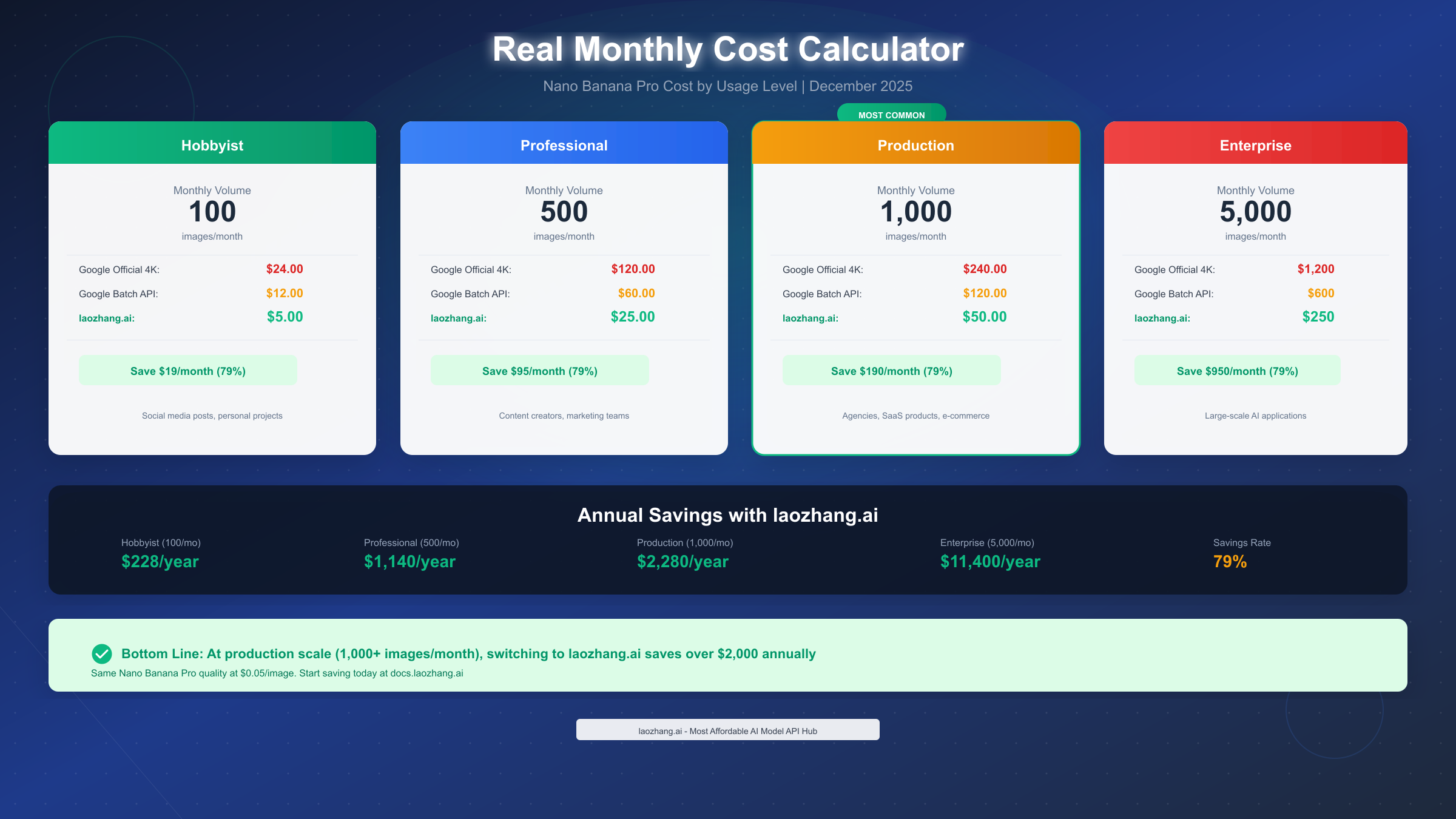
Hobbyist (100 images/month): For personal projects, social media content, or occasional creative work, 100 monthly images represents typical casual usage. At Google's official 4K pricing, this volume costs $24/month. Using the Batch API reduces this to $12/month. However, with laozhang.ai at $0.05/image, the same 100 images cost just $5/month—a savings of $19 monthly or $228 annually. At this scale, even the "cheap" option is genuinely affordable, but the percentage savings remain significant for budget-conscious creators.
Professional (500 images/month): Content creators, marketing teams, and small agencies typically generate between 300-700 images monthly for blog posts, advertisements, and social media campaigns. At 500 images, Google official pricing reaches $120/month for 4K output, while the Batch API reduces this to $60/month. laozhang.ai delivers the same volume for $25/month—representing $95 in monthly savings and $1,140 annually. At this volume, the cumulative savings begin justifying the minor setup effort required for third-party integration.
Production (1,000 images/month): Established agencies, e-commerce platforms, and SaaS products with integrated image generation features commonly process around 1,000 images monthly. Official Google pricing at this scale reaches $240/month (4K) or $134/month (standard resolution). The Batch API reduces 4K costs to $120/month. With laozhang.ai at $50/month total, you save $190 monthly and $2,280 annually compared to Google's 4K pricing. For reference, generating 1,000 images monthly at official rates versus laozhang.ai means the difference between spending $2,880 annually and $600 annually—a substantial budget reallocation for any team.
Enterprise (5,000 images/month): Large-scale applications, AI-powered platforms, and high-volume content operations can easily exceed 5,000 monthly generations. At this scale, Google's official 4K pricing reaches $1,200/month, with Batch API at $600/month. laozhang.ai maintains its $0.05 rate, totaling $250/month—saving $950 monthly or $11,400 annually compared to official pricing. At enterprise volumes, these savings can fund additional developers, expanded infrastructure, or other growth initiatives.
| Usage Level | Images/Month | Google 4K | Batch API | laozhang.ai | Monthly Savings | Annual Savings |
|---|---|---|---|---|---|---|
| Hobbyist | 100 | $24 | $12 | $5 | $19 | $228 |
| Professional | 500 | $120 | $60 | $25 | $95 | $1,140 |
| Production | 1,000 | $240 | $120 | $50 | $190 | $2,280 |
| Enterprise | 5,000 | $1,200 | $600 | $250 | $950 | $11,400 |
The consistent 79% savings rate across all volumes demonstrates the scalable advantage of third-party providers. Whether you're generating 100 or 5,000 images monthly, the percentage reduction remains constant—only the absolute dollar amount changes.
Nano Banana Pro vs Competitors
Understanding Nano Banana Pro's position in the broader AI image generation market requires comparing it against established alternatives like DALL-E 3 and Midjourney. Each platform offers distinct advantages, and pricing represents just one dimension of this comparison.
DALL-E 3 (OpenAI) currently represents the most direct competitor in terms of API accessibility and enterprise positioning. OpenAI's pricing structure sets DALL-E 3 at $0.04-$0.08 per image for standard resolutions—significantly cheaper than Google's official Nano Banana Pro rates. However, this cost advantage comes with trade-offs in specific capabilities. DALL-E 3's text rendering accuracy measures around 78% compared to Nano Banana Pro's 94%, making Google's offering superior for any use case requiring legible text within images—infographics, diagrams, branded assets, or any application where text clarity matters. For teams currently using OpenAI's ecosystem, our Midjourney API guide provides additional context on integrating alternative image generators.
Midjourney V7 occupies a different market position entirely, focusing on artistic quality and creative expression rather than precision text rendering or API-first access. Midjourney's subscription model ($10-$120/month depending on tier) yields variable per-image costs based on usage intensity. A Standard tier subscription at $30/month generating 100 images monthly results in an effective $0.30 per image; generating 200 images drops this to $0.15. Midjourney eliminates per-image accounting but introduces usage cap management complexity. The model excels at artistic interpretation and aesthetic consistency but lacks Nano Banana Pro's text accuracy and multi-image identity preservation features.
Generation Speed represents a practical differentiator beyond pricing. Nano Banana Pro (via the standard API) generates images in 8-12 seconds depending on complexity—slower than the original Nano Banana model's 3-second generations but faster than competitors. DALL-E 3 requires 15-25 seconds per generation, while Midjourney V7 ranges from 20-30 seconds in standard mode. For applications requiring rapid iteration or real-time generation, this speed differential impacts user experience and throughput capacity.
Quality Benchmarks from independent testing reveal Nano Banana Pro's technical advantages. According to evaluations from Tom's Guide and other reviewers, Nano Banana Pro achieves a 94-96% text accuracy rate compared to DALL-E 3's 78% and Midjourney's 71%. FID scores (measuring output fidelity) favor Nano Banana Pro at 12.4 versus Midjourney's 15.3 and DALL-E 3's 18.7. Prompt adherence—how accurately the model follows instructions—measures 89% for Nano Banana Pro versus 76% for DALL-E 3 and 72% for Midjourney.
| Model | Per-Image Cost | Text Accuracy | Generation Speed | Best Use Case |
|---|---|---|---|---|
| Nano Banana Pro | $0.05-$0.24 | 94% | 8-12 sec | Text-heavy graphics, infographics |
| DALL-E 3 | $0.04-$0.08 | 78% | 15-25 sec | General purpose, OpenAI ecosystem |
| Midjourney V7 | ~$0.30-$0.60 | 71% | 20-30 sec | Artistic, creative exploration |
For most production applications requiring accurate text rendering and consistent multi-image generation, Nano Banana Pro's capabilities justify its pricing—especially when accessed through cost-effective providers like laozhang.ai that reduce the effective per-image cost below DALL-E 3's official rates.
Which Option is Right for You
Selecting the optimal Nano Banana Pro access method requires matching your specific requirements against the trade-offs each option presents. This decision framework helps you navigate the choice based on volume, budget, technical requirements, and workflow constraints.
Choose the Gemini App Free Tier if you're exploring AI image generation for personal projects, testing prompt strategies, or need occasional images without budget allocation. The 3 daily images at 1MP resolution serve casual use cases adequately. Accept the visible watermark and lower resolution as trade-offs for zero cost.
Choose Google AI Studio (Free Credits) if you're a developer evaluating Nano Banana Pro for potential integration. The $300 trial credit provides substantial testing runway for technical evaluation, prompt engineering, and prototype development. This option suits exploration phases before committing to paid usage.
Choose Google's Official API if you're an enterprise requiring guaranteed SLAs, direct Google support, and seamless integration with existing Google Cloud infrastructure. The premium pricing ($0.134-$0.24/image) buys reliability guarantees and simplified vendor management for organizations where Google already serves as a primary cloud provider.
Choose Google's Batch API if your workflow tolerates 24-hour latency in exchange for 50% cost reduction. Content library building, overnight batch processing, and background generation pipelines benefit from this option. Avoid it for real-time applications or user-facing features requiring immediate image delivery.
Choose laozhang.ai if you're a developer or team seeking maximum cost efficiency for production workloads. At $0.05 per image, this option delivers 79% savings versus Google's 4K pricing while maintaining access to the same underlying model. The OpenAI-compatible API endpoints simplify integration, and unified billing across 200+ models reduces vendor management complexity. This represents the optimal balance of cost and capability for most production use cases.
Choose Kie.ai if you're extremely budget-constrained and willing to accept variable rate limits for the absolute lowest per-image cost. At $0.02 for standard resolutions, this option suits prototype development and testing scenarios where reliability is less critical than cost minimization.
The decision matrix below summarizes recommendations by primary consideration:
| Primary Consideration | Recommended Option | Key Trade-off |
|---|---|---|
| Zero cost / Testing | Gemini App Free | Low resolution, watermark |
| Developer evaluation | AI Studio Credits | Credits expire |
| Enterprise / SLA required | Google Official API | Premium pricing |
| Budget + async workflow | Google Batch API | 24-hour latency |
| Production cost efficiency | laozhang.ai | Third-party dependency |
| Absolute minimum cost | Kie.ai | Variable reliability |
For most readers of this guide—developers and teams seeking to deploy Nano Banana Pro cost-effectively—laozhang.ai represents the most practical choice. The documentation at docs.laozhang.ai provides complete integration guides for getting started.
Cost Optimization Strategies
Beyond choosing the right provider, several strategies can further reduce your Nano Banana Pro expenses while maintaining output quality. These optimizations compound with provider selection, potentially reducing costs by an additional 20-40%.
Resolution Optimization represents the most straightforward cost reduction lever for users of Google's official API (where pricing varies by resolution). Many applications don't require 4K output—social media posts, website thumbnails, and preview images work perfectly at 1K or 2K resolutions. By reserving 4K generation for print materials, hero images, and applications genuinely requiring maximum fidelity, you can reduce per-image costs from $0.24 to $0.134 (a 44% reduction). With providers like laozhang.ai where pricing is flat regardless of resolution, this optimization doesn't apply—you simply get 4K capability at the standard rate.
Batch Processing through Google's official Batch API cuts costs by 50% for any workflow that tolerates 24-hour delivery windows. Consider structuring your image generation to accumulate requests during business hours and batch-submit them for overnight processing. A content team creating daily blog post images could prepare prompts throughout the day and submit the batch at end-of-day for next-morning delivery. This approach works exceptionally well for editorial calendars, marketing campaign preparation, and any scheduled content production.
Prompt Optimization indirectly reduces costs by improving first-attempt success rates. Poorly constructed prompts often require regeneration, effectively doubling or tripling costs per usable image. Invest time in learning Nano Banana Pro's prompting syntax and best practices—resources like the official prompting guide on dev.to provide excellent starting points. Shorter, more precise prompts also reduce token consumption for the thinking phase that precedes generation.
Caching Strategies eliminate redundant generation costs for repeated or similar requests. Implement hash-based caching to identify identical prompts and return previously generated images instead of creating duplicates. For applications with common generation patterns, this can reduce effective volumes by 10-30%. More sophisticated semantic caching using embedding similarity can identify near-duplicate requests and serve cached results for "close enough" prompts.
Reference Image Reuse reduces upload overhead and potential additional processing costs. When using Nano Banana Pro's multi-image capabilities, cache reference images locally and maintain consistent identifiers rather than re-uploading the same style guide, logo, or character reference with each request.
For teams seeking to expand their image generation toolkit beyond Nano Banana Pro, exploring alternative models can provide redundancy and additional cost optimization opportunities. Our FLUX image generation API guide covers another popular option in the AI image generation space.
The combination of provider selection (79% savings via laozhang.ai), resolution optimization (up to 44% additional on official pricing), and workflow improvements (10-30% through caching and batching) can reduce effective per-image costs from Google's official $0.24 to under $0.04—a total reduction exceeding 80%.
Frequently Asked Questions
How much does Nano Banana Pro cost per image?
Nano Banana Pro pricing ranges from free (Gemini app, 3 images daily at 1MP) to $0.24 per image (Google Official API, 4K resolution). Third-party providers like laozhang.ai offer the most cost-effective option at $0.05 per image regardless of resolution—approximately 79% cheaper than Google's 4K pricing.
Is there a free way to use Nano Banana Pro?
Yes, two free options exist. The Gemini app provides 3 free image generations daily at 1MP resolution with a visible watermark. Google AI Studio offers $300 in trial credits for new developers, enabling approximately 2,240 image generations before any payment is required.
What's the cheapest way to use Nano Banana Pro for production?
For production workloads, laozhang.ai offers the optimal balance of cost and reliability at $0.05 per image. This represents 79% savings versus Google's official 4K pricing and includes OpenAI-compatible endpoints for easy integration. For async workflows tolerating delays, Google's Batch API at $0.067-$0.12 provides another cost-effective option.
How does Nano Banana Pro pricing compare to DALL-E 3?
DALL-E 3's official API pricing ($0.04-$0.08/image) is cheaper than Google's official Nano Banana Pro rates ($0.134-$0.24). However, through providers like laozhang.ai, Nano Banana Pro becomes cheaper at $0.05/image while offering superior text rendering (94% vs 78% accuracy) and higher maximum resolution.
What resolution options are available?
Nano Banana Pro supports three resolution tiers: 1K (1024x1024), 2K (2048x2048), and 4K (4096x4096). Through Google's official API, higher resolutions cost more. Through flat-rate providers like laozhang.ai, all resolutions cost the same.
Are there hidden costs beyond per-image pricing?
Primary costs are per-image generation. However, consider: token costs for extended prompts with "thinking" features, potential compute costs if self-hosting infrastructure, and integration development time. Third-party providers like laozhang.ai typically include all features in their per-image rate with no hidden charges.
How fast is Nano Banana Pro compared to alternatives?
Nano Banana Pro generates images in 8-12 seconds via standard API—faster than DALL-E 3 (15-25 seconds) and Midjourney V7 (20-30 seconds). The Batch API trades speed for cost savings, with delivery times up to 24 hours.
Can I use Nano Banana Pro commercially?
Yes. Commercial use is permitted across all access methods. Paid tier outputs retain only invisible SynthID watermarking (metadata-level identification) with no visible branding. Free tier outputs include visible Gemini watermarks that may impact commercial suitability.
What makes laozhang.ai cheaper than Google's direct API?
API aggregators like laozhang.ai achieve lower per-image costs through volume purchasing, infrastructure optimization, and aggregating demand across multiple customers. They route requests through efficient infrastructure while maintaining access to the same underlying Google model.
Is there a monthly subscription option?
Google One AI Premium ($19.99/month) includes Nano Banana Pro access with approximately 100 images daily. However, for most developer use cases, API access through providers like laozhang.ai proves more cost-effective and flexible than subscription models.
Conclusion and Next Steps
Nano Banana Pro represents Google's most capable image generation model, offering industry-leading text rendering accuracy, 4K resolution support, and advanced features like multi-image identity preservation. The pricing landscape spans from free (Gemini app, AI Studio credits) through Google's official rates ($0.134-$0.24/image) to cost-optimized third-party access at $0.05/image—a 79% savings that scales with usage.
For most developers and teams, the decision comes down to balancing cost against convenience and reliability requirements. Google's official API provides enterprise guarantees at premium pricing. The Batch API offers a 50% discount for latency-tolerant workflows. Third-party providers like laozhang.ai deliver the most aggressive cost savings while maintaining access to the same underlying model.
The practical recommendation for production workloads is clear: start with AI Studio's free credits for testing, validate your prompts and workflow, then transition to laozhang.ai at $0.05/image for ongoing production use. This approach minimizes costs during exploration while ensuring sustainable economics at scale. At 1,000 images monthly, this strategy saves $2,280 annually compared to Google's official 4K pricing.
To get started with cost-effective Nano Banana Pro access:
- Test first using Google AI Studio's $300 free credits or the Gemini app's daily free tier
- Optimize prompts to maximize first-attempt success rates and reduce regeneration waste
- Integrate production access through laozhang.ai for 79% cost savings—documentation available at docs.laozhang.ai
- Monitor usage to identify further optimization opportunities through batching, resolution selection, and caching
The AI image generation landscape continues evolving rapidly, with pricing typically declining as models mature and competition intensifies. This guide reflects December 2025 pricing—verify current rates before major commitments, and expect further cost reductions as the market develops.