
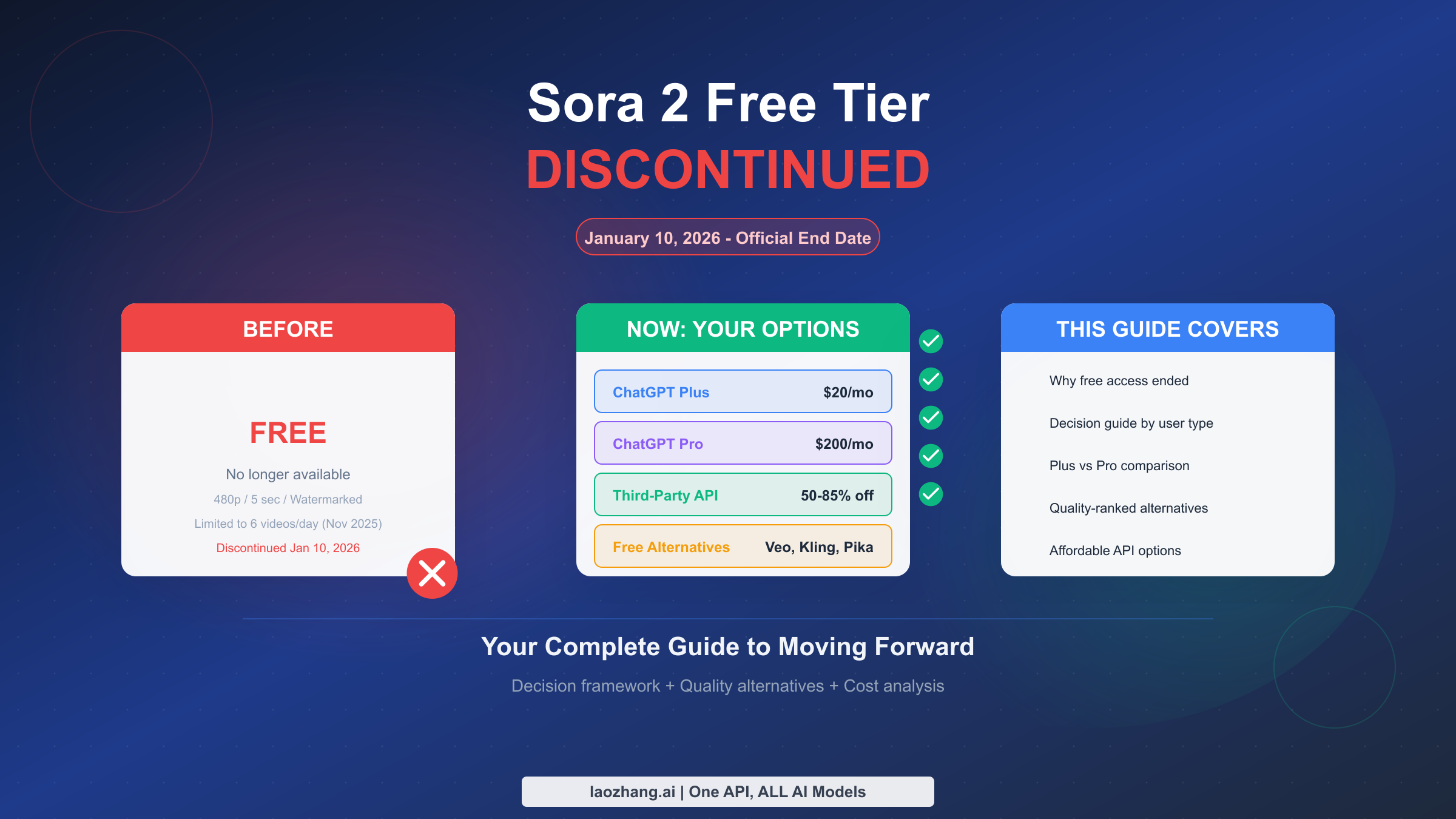
If you recently tried to access Sora 2 for free and saw the frustrating "We're under heavy load" error, you're not alone—and it's not actually a server issue. OpenAI officially ended free access to Sora 2 on January 10, 2026, leaving millions of users searching for alternatives. This guide cuts through the confusion with a clear decision framework, honest quality comparisons, and practical next steps based on your specific needs and budget.
TL;DR
OpenAI discontinued Sora 2's free tier on January 10, 2026. Here's what you need to know:
- What happened: Free users can no longer generate videos or images through sora.com
- Why: OpenAI cited "unsustainable GPU demands" from the free tier
- Your options now:
- ChatGPT Plus ($20/mo): 1,000 credits for ~50 videos at 720p
- ChatGPT Pro ($200/mo): 10,000 credits, 1080p, no watermarks
- Third-party APIs: 50-85% cheaper than official pricing
- Free alternatives: Veo 3.1, Kling AI, Pika, Luma Dream Machine
- Best choice depends on: Your usage volume, quality requirements, and budget
Read on for the complete breakdown and decision guide.
What Happened to Sora 2's Free Access?
On January 10, 2026, at 4:00 AM, OpenAI quietly flipped a switch that affected millions of users worldwide. The free tier of Sora 2—the AI video generator that had captured imaginations since its December 2024 launch—was officially discontinued.
If you've tried accessing sora.com recently as a free user, you've likely encountered the "We're under heavy load" message. While it sounds like a temporary server issue, it's actually an intentional access restriction. OpenAI confirmed in their Help Center that "ChatGPT Free, Enterprise, and Edu accounts are not eligible for Sora access."
The timeline of free access erosion happened gradually. When Sora 2 launched in December 2024, OpenAI offered generous free limits, stating users could "freely explore its capabilities." By November 2025, free users found themselves limited to just 6 video generations per day, down from 30 at launch. Bill Peebles, head of Sora at OpenAI, tweeted that their "GPUs are melting" while announcing the reduced limits. Then came January 10, 2026—the complete cutoff.
What made this particularly frustrating for users was the lack of clear communication. There was no advance warning email, no countdown, no "last chance to save your projects" notice. Users simply woke up one day to find their access gone. The "heavy load" error message added insult to injury by implying a temporary technical issue rather than a permanent policy change.
For those who built workflows around free Sora 2 access, created content calendars expecting its availability, or simply enjoyed experimenting with AI video generation, this abrupt ending felt like a betrayal of the initial "explore freely" promise.
Why OpenAI Ended Free Sora 2 Access
Understanding why this happened doesn't excuse the poor communication, but it does provide important context for what's likely coming across the AI industry.
The fundamental issue is GPU economics. Video generation is extraordinarily compute-intensive compared to text or even image generation. When OpenAI's DevDay 2025 rolled around, the company acknowledged that free unlimited video access was simply "unsustainable" given the GPU demands. Every 10-second video generation requires significant computational resources that cost real money—resources that weren't being offset by the free tier.
This isn't unique to OpenAI. Around the same time Sora cut its free tier, Google also reduced free access to Gemini 3 Pro. The pattern suggests we're entering a new era where the "free AI for everyone" honeymoon period is ending across the industry. Companies that initially used generous free tiers as growth strategies are now facing the reality that GPUs don't run on goodwill.
From a business perspective, OpenAI's move makes sense. They demonstrated the technology, built excitement and demand, then converted that demand into a paid product. It's the classic freemium-to-premium playbook. But the execution—the sudden cutoff, the misleading error messages, the lack of migration path for users—left a bitter taste that damaged trust.
The silver lining, if there is one, is that this pressure has accelerated competition. Alternatives like Veo 3.1 and Kling AI have improved rapidly, partially because they're competing for the users OpenAI just pushed out the door.
What Are Your Options Now? A Decision Guide
With free access gone, you have four main paths forward. The right choice depends entirely on your specific situation—how often you create videos, what quality you need, and what you're willing to spend. Let me break this down by user type.
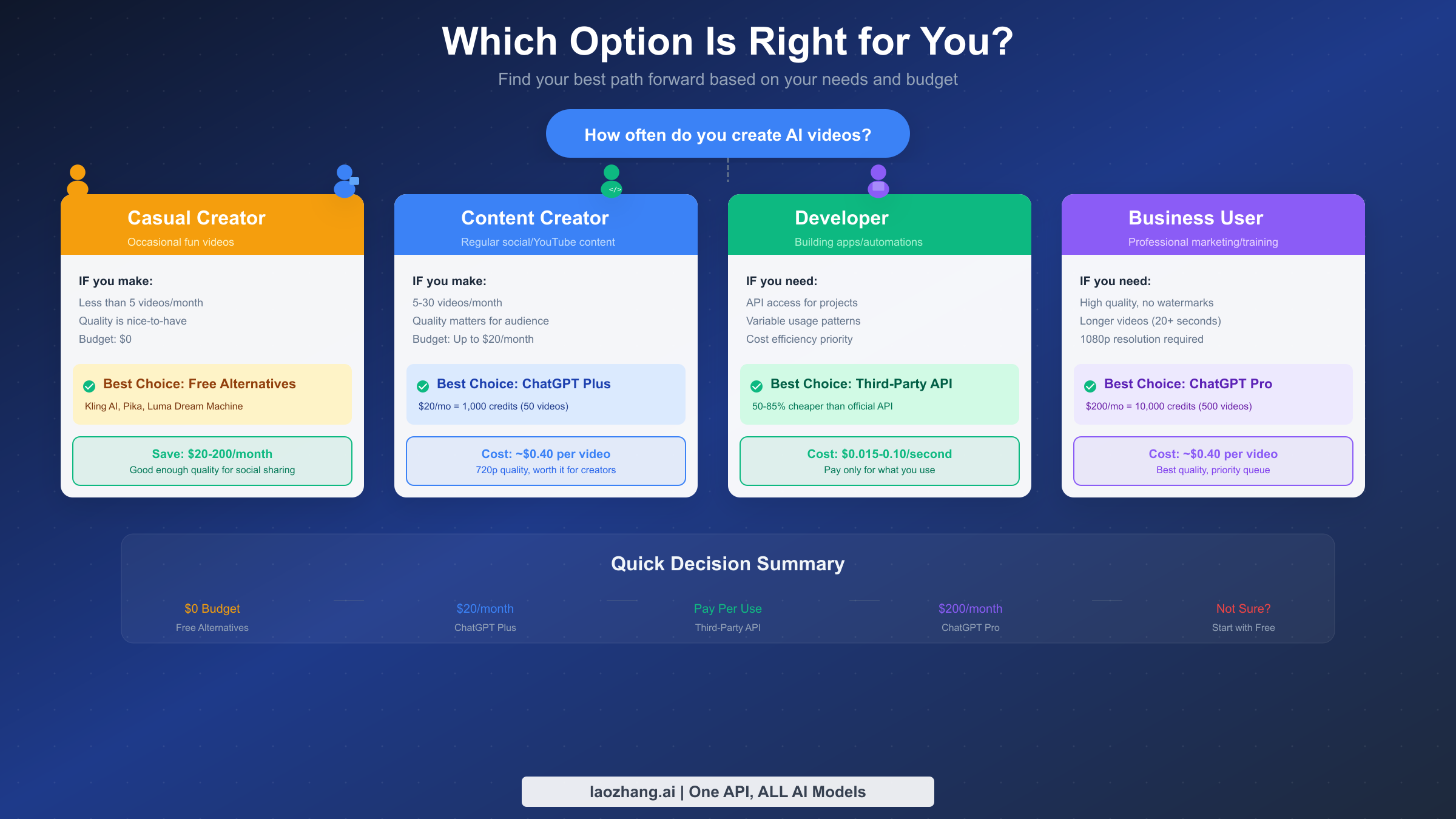
If you're a casual creator making fewer than 5 videos per month for fun or social media, paying $20+ monthly doesn't make sense. Your best path is exploring free alternatives like Kling AI (which offers a free tier with monthly credits) or Pika 2.2 (generous free plan, very beginner-friendly). You'll sacrifice some quality compared to Sora 2, but for casual social sharing, most viewers won't notice the difference. The money you save can go toward other creative tools or simply stay in your pocket.
If you're a content creator producing 5-30 videos monthly for YouTube, TikTok, or professional social media, ChatGPT Plus at $20/month becomes genuinely worth considering. You get 1,000 credits monthly, which translates to roughly 50 videos at 720p resolution. That's about $0.40 per video—competitive with most alternatives when you factor in Sora 2's quality advantage. The watermark is a downside, but many creators work around it or accept it as the cost of accessible AI video.
If you're a developer building applications or automations that need video generation, skip the subscriptions entirely and go straight to API access. Third-party providers offer Sora 2 API access at $0.015-0.10 per second—that's 50-85% cheaper than OpenAI's official API pricing. You pay only for what you use, which is ideal for variable workloads. For reliable third-party access, platforms like laozhang.ai offer Sora 2 API at competitive rates with documented uptime guarantees.
If you're a business user needing professional-quality videos without watermarks, at 1080p resolution, with longer durations up to 20 seconds, ChatGPT Pro at $200/month is your answer. The 10,000 monthly credits support around 500 videos, and you get priority queue access that matters when deadlines are tight. The cost per video (~$0.40) is actually the same as Plus, but you're paying for premium features.
The decision tree is straightforward: No budget? Free alternatives. Occasional use? Plus. Variable/technical needs? API. Professional quality? Pro.
Official Paid Options: Plus vs Pro Detailed Breakdown
Let's dig deeper into what you actually get with OpenAI's paid tiers, because the devil is in the details.
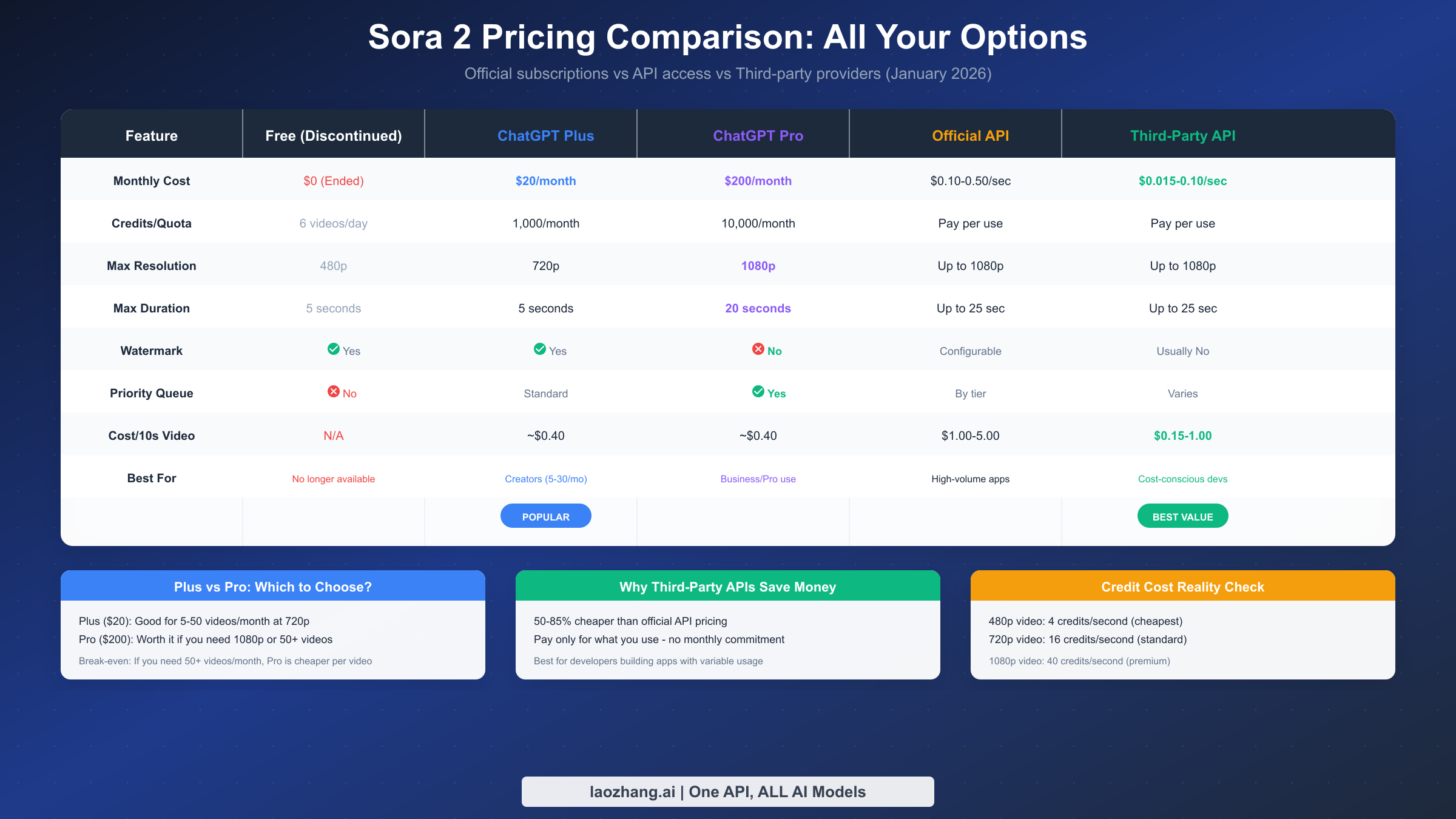
ChatGPT Plus ($20/month) includes Sora 2 access at no additional cost—it's bundled with your subscription. You receive 1,000 credits monthly that reset on your billing date with no rollover. At 720p resolution, a 5-second video costs approximately 80 credits (16 credits/second), so your 1,000 credits yield about 12-15 priority videos monthly at that resolution. Drop to 480p and you can stretch to roughly 50 videos (4 credits/second).
The credit math is important to understand. For detailed ChatGPT Plus Sora limits, resolution dramatically affects consumption. At 480p, you're spending 20-40 credits per short video. At 720p, expect 80-160 credits. This means your actual video count varies significantly based on your quality settings.
ChatGPT Pro ($200/month) is the premium tier, offering 10,000 credits monthly—10x the Plus allocation. But the real value isn't just volume. Pro unlocks 1080p resolution, videos up to 20 seconds (versus 5 for Plus), watermark-free downloads, and priority queue access. When you're producing client work or professional content, these features justify the price jump.
The break-even analysis works like this: If you need more than 50-60 videos monthly at decent quality, Pro's cost-per-video becomes competitive with Plus. If you need watermark-free output for any reason, Pro is your only option within OpenAI's ecosystem. For complete Sora 2 API pricing and quota details, the official tiers offer predictable costs but less flexibility than API access.
Upgrading from Plus to Pro is straightforward—it's a plan change in your OpenAI account settings. Your credits don't stack; you simply start with Pro's 10,000 allocation. If you're mid-billing-cycle, OpenAI prorates the difference.
Credit management tips that experienced users swear by: Always prototype at 480p first before generating your final high-quality version. Use the "relaxed mode" (slower queue, but doesn't count against priority credits) for non-urgent work. Batch your generation sessions to make deliberate use of your monthly allocation rather than impulsive experimentation that burns through credits.
Best Sora 2 Alternatives (Quality-Ranked for 2026)
If you're not ready to pay OpenAI, or you want options outside their ecosystem entirely, here's my honest assessment of the alternatives. I've ranked these by output quality compared to Sora 2 Pro, with practical notes on what each excels at.
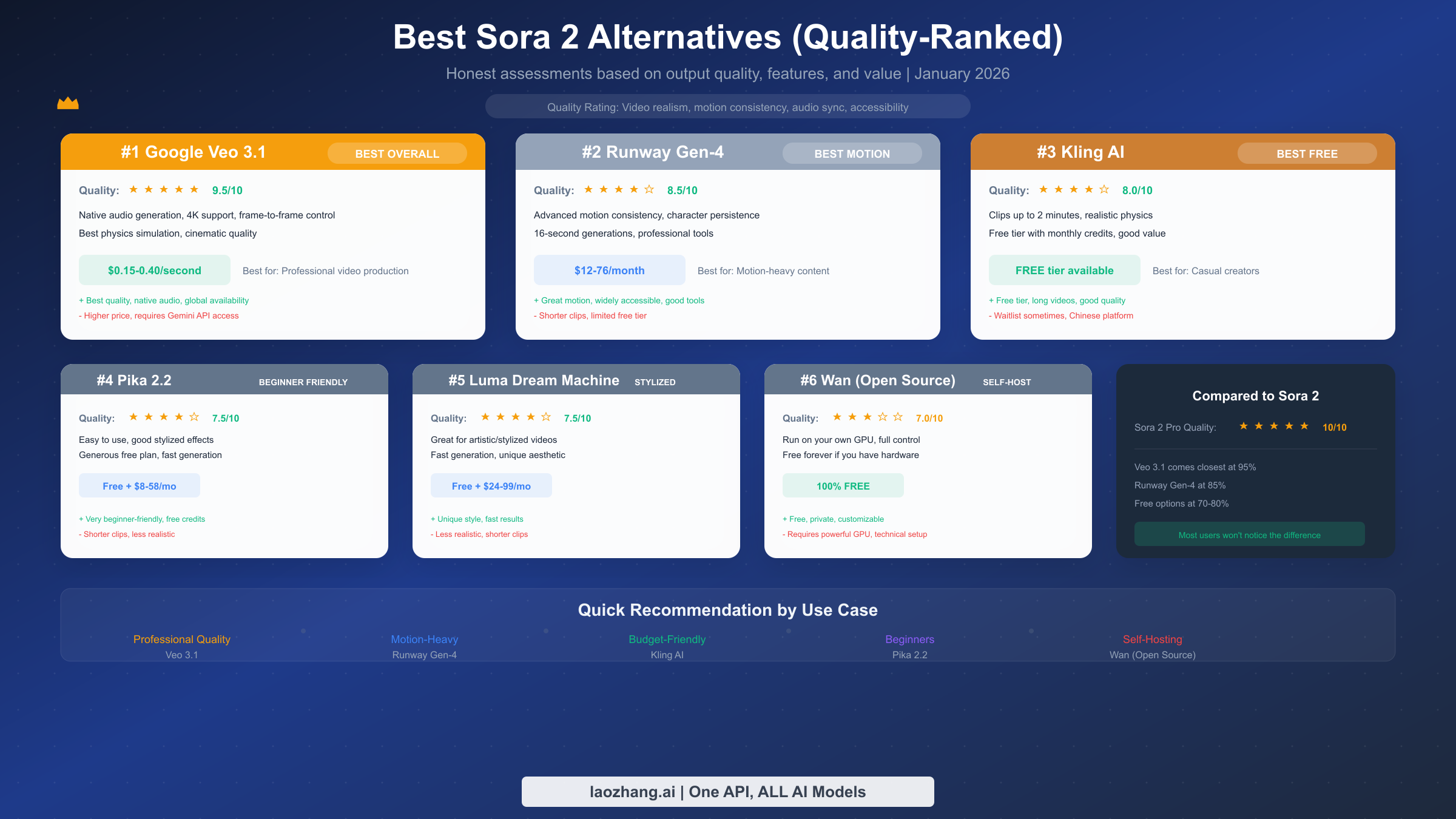
#1: Google Veo 3.1 (9.5/10 quality) — This is the closest thing to Sora 2 Pro available today. Veo 3.1 offers native audio generation (Sora requires separate audio work), 4K support, and exceptional physics simulation. The first-and-last-frame control feature lets you define exact start and end states, which is incredibly useful for precise creative control. Available globally through Gemini API, pricing runs $0.15-0.40 per second—more expensive than third-party Sora access but with some unique capabilities. For a complete breakdown, see our Sora 2 vs Veo 3 comparison. Best for professional video production where quality is non-negotiable.
#2: Runway Gen-4 (8.5/10 quality) — The go-to choice for motion-heavy content. Runway's character consistency across frames and advanced physics simulation produce remarkably smooth videos. The 16-second maximum generation is shorter than Sora Pro's 20 seconds, but the motion quality often compensates. Pricing ranges from $12-76 monthly depending on tier. Their browser-based interface makes it accessible without technical setup. Best for content requiring complex movement or character persistence.
#3: Kling AI (8.0/10 quality) — The best free option available. Kling offers videos up to 2 minutes (far exceeding Sora's limits), realistic physics, and a genuine free tier with monthly credit refreshes. The catch? It's a Chinese platform, which may raise concerns for some users, and there's occasionally a waitlist. But for budget-conscious creators, the quality-to-cost ratio is unbeatable. Best for casual creators who prioritize length and cost over maximum quality.
#4: Pika 2.2 (7.5/10 quality) — Perfect for beginners. Pika's interface is the most approachable of any AI video tool I've tested, with generous free credits and fast generation times. The output leans more stylized than realistic, which works great for certain creative directions but less so for photorealistic needs. Pricing runs free to $58/month depending on usage. Best for newcomers to AI video who want low friction.
#5: Luma Dream Machine (7.5/10 quality) — When you want distinctive artistic videos rather than realism. Luma has carved out a niche for stylized, almost painterly video generation that's unlike anything else available. Fast generation times and a genuine free tier make it accessible. Best for creators with artistic visions that benefit from stylization.
#6: Wan (Open Source, 7.0/10 quality) — The fully free option if you have hardware. Wan runs on consumer GPUs (you need at least a decent graphics card), generating 480-720p video with text-to-video, image-to-video, and editing capabilities. Zero ongoing cost, complete privacy, full customization. The tradeoff is technical setup and lower quality compared to cloud services. Best for developers who want control and have GPU resources.
For comprehensive comparisons including pricing and features, check out our AI video models comparison guide.
API Access: The Developer's Path to Affordable Sora 2
If you're technically inclined or building applications, API access offers the most flexibility and often the best economics.
Official OpenAI Sora 2 API pricing breaks down by quality tier. The Standard model runs $0.10/second at 720p, meaning a 10-second video costs $1.00. The Pro model jumps to $0.30/second for 720p or $0.50/second for 1080p. At these rates, a 10-second 1080p video runs $5.00—which adds up quickly for any meaningful volume.
Third-party API providers have filled the gap with significant savings. Platforms offering unofficial Sora 2 access typically charge $0.015-0.10 per second—representing 50-85% savings compared to OpenAI's direct pricing. For example, a 10-second standard video might cost just $0.15-0.20 through a third-party provider versus $1.00 official.
When evaluating third-party providers, prioritize these factors. Uptime reliability: Check their status pages and user reports. Pricing transparency: Hidden fees or unclear per-second rates are red flags. Payment methods: Legitimate providers accept standard payment options. Documentation quality: Good providers have clear API docs and examples. Support responsiveness: Test their support before committing budget.
Platforms like laozhang.ai offer aggregated access to multiple video models including Sora 2 at competitive rates. The advantage of such platforms is flexibility—you can compare outputs from different models without maintaining multiple provider relationships.
For developers seeking the cheapest Sora 2 API access, third-party routes consistently outperform official pricing. Just balance cost savings against reliability requirements for your specific use case.
Red flags to avoid when selecting a third-party provider include: prices that seem too good to be true (they usually are), lack of clear terms of service, cryptocurrency-only payment requirements, no verifiable track record, and promises of "unlimited" access. Legitimate providers are transparent about their limitations and pricing structure.
Here's a basic example of how API access typically works:
pythonimport requests


response = requests.post(
    "https://api.provider.com/v1/video/generate",
    headers={"Authorization": "Bearer YOUR_API_KEY"},
    json={
        "model": "sora-2-standard",
        "prompt": "A cat playing piano in a jazz club",
        "duration": 10,
        "resolution": "720p"
    }
)

video_url = response.json()["video_url"]
For more methods including free Sora 2 API access options, explore our dedicated guides.
Frequently Asked Questions
Is Sora 2 completely free anymore?
No. As of January 10, 2026, OpenAI discontinued all free access to Sora 2. The "We're under heavy load" error message that free users see is actually an access restriction, not a temporary server issue. You now need either ChatGPT Plus ($20/month) or Pro ($200/month) subscription for access.
When exactly did Sora 2 free access end?
The free tier was officially discontinued on January 10, 2026, at 4:00 AM. Prior to this, free access had been progressively limited—dropping from 30 generations per day at launch (December 2024) to just 6 per day in November 2025.
Can I still use Sora 2 without paying anything?
Not directly through OpenAI. However, you have alternatives. Third-party API providers offer pay-per-use access without subscription commitment. Some providers offer trial credits. Free alternatives like Kling AI and Pika provide similar capabilities. Open-source options like Wan run on your own hardware.
Is ChatGPT Plus ($20/month) enough for Sora 2?
For most content creators making 5-30 videos monthly, yes. Plus provides 1,000 credits monthly, translating to roughly 50 videos at 480p or 12-15 at 720p. The main limitations are 720p maximum resolution, watermarked outputs, and 5-second maximum duration. If these constraints work for your needs, Plus offers good value.
What countries have Sora 2 access?
Sora 2 is currently available in the United States and Canada through the iOS app and sora.com website. OpenAI states they "hope to expand quickly to other countries," but no timeline has been confirmed. Users outside these regions need to use VPN solutions or third-party API providers for access.
Are third-party Sora 2 APIs safe to use?
Reputable providers are generally safe. Look for transparent pricing, clear documentation, standard payment methods, and verifiable track records. Avoid providers with prices that seem impossibly low, cryptocurrency-only payments, or no terms of service. Start with small purchases to test reliability before committing significant budget.
What's the best free alternative to Sora 2?
For most users, Kling AI offers the best combination of quality, features, and free access. It provides videos up to 2 minutes long with realistic physics simulation and a genuine free tier. Pika 2.2 is the most beginner-friendly option with generous free credits. If you have GPU hardware, Wan (open source) provides unlimited free generation with full privacy.
Conclusion: Making Your Best Choice
The end of Sora 2's free tier marks a shift in the AI video landscape—from "try everything free" to "pay for what you value." While that transition felt abrupt and poorly communicated, the good news is you have genuine options.
If you're a casual creator focused on occasional fun projects, explore Kling AI or Pika's free tiers. You'll get 70-80% of Sora 2's quality at zero cost. Don't let the loss of free Sora access stop your creative experimentation.
If you're a regular content creator where quality matters for your audience, ChatGPT Plus at $20/month offers reasonable value. Calculate whether your monthly video needs justify the cost, and consider it an investment in your content quality.
If you're a developer or need variable access, third-party APIs provide the flexibility and cost savings that make sense for technical workflows. Platforms like laozhang.ai aggregate multiple video models at competitive rates.
If you're a professional needing the best quality without compromises, ChatGPT Pro's $200/month delivers 1080p, no watermarks, and priority access.
The AI video generation space is evolving rapidly. What feels like a setback today—losing free Sora access—is accelerating competition that will ultimately benefit creators. Veo 3.1 is already matching Sora's quality in many scenarios. Open-source models are improving monthly. The future likely holds more options at better prices.
For now, choose the path that matches your actual needs, not your theoretical ones. Start with free alternatives to see if they meet your requirements before committing to subscriptions. Test third-party APIs with small amounts before relying on them. And remember that the best tool is the one you actually use consistently—not necessarily the one with the highest specs.
Your creative vision matters more than your video generation platform. Find what works for your workflow and budget, then focus on making great content.