
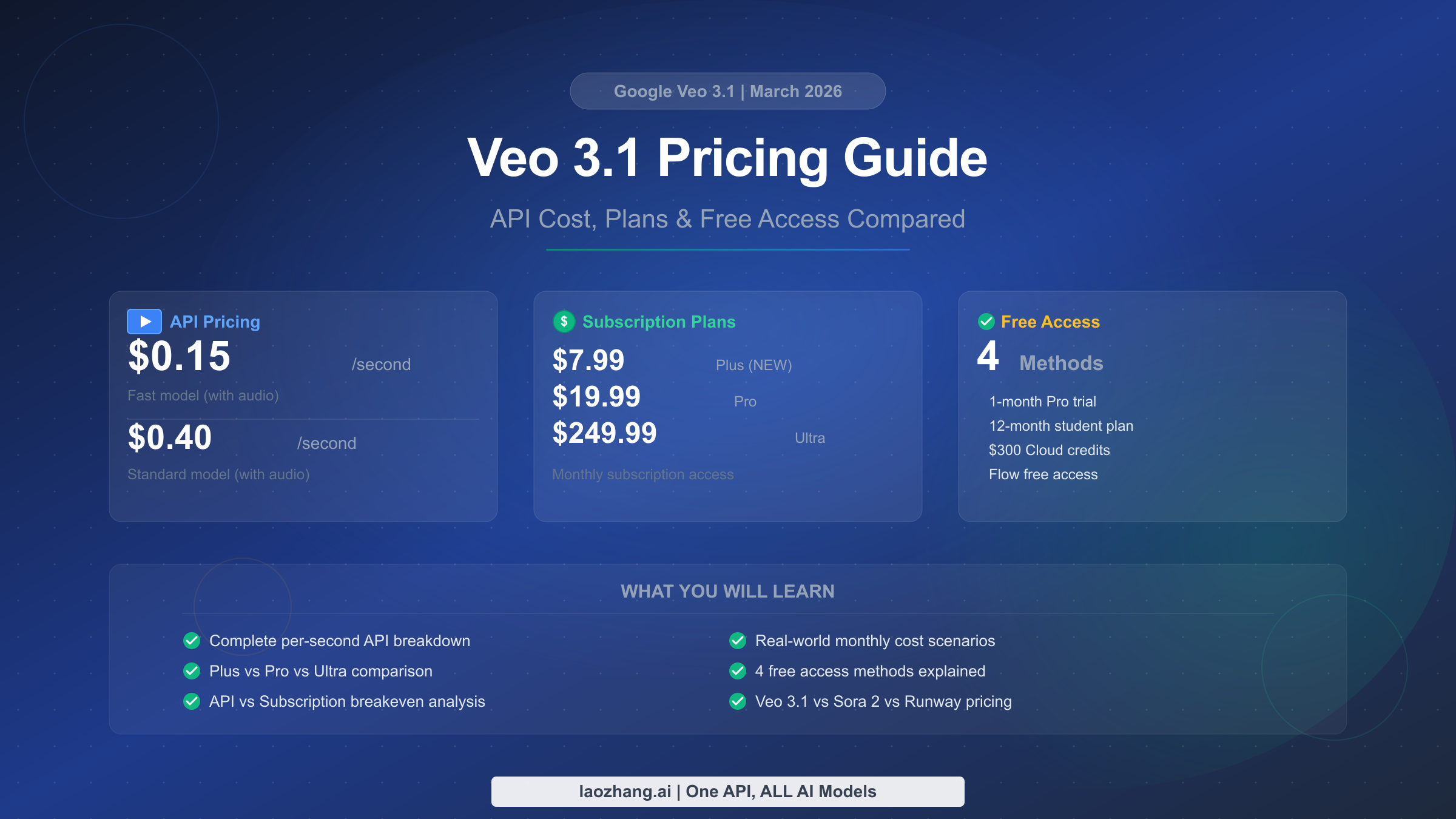
Veo 3.1 pricing in March 2026 starts at $0.15 per second for the Fast API model and $0.40 per second for Standard quality, both including audio generation (Google official pricing, verified March 2, 2026). Subscription access ranges from $7.99/month (Google AI Plus with Veo 3.1 Fast) to $249.99/month (Google AI Ultra with full Veo 3.1). Four free access methods exist: a 1-month Pro trial, 12-month student plan, $300 Google Cloud credits, and Flow access. This guide breaks down every pricing layer so you can determine exactly which option saves you the most money.
What Is Veo 3.1 and Why Its Pricing Structure Matters
Google's Veo 3.1 represents the most advanced AI video generation model available to consumers and developers as of early 2026, but understanding what you'll actually pay requires navigating a surprisingly complex pricing landscape. Unlike simpler AI tools that charge a flat monthly fee, Veo 3.1 offers multiple access pathways—each with distinct cost structures, quality tiers, and usage limits—that can result in dramatically different monthly bills depending on how you use it.
The pricing complexity stems from Google's multi-platform strategy. Veo 3.1 is simultaneously available through the Gemini API (pay-per-second), three subscription tiers within Google AI plans (monthly flat rate with credit-based usage), and several free access routes. The model itself comes in two quality variants—Standard and Fast—each with different per-second rates and output characteristics. Standard delivers higher visual quality and more detailed motion, while Fast prioritizes speed and cost efficiency while still producing impressive results at both 720p and 1080p resolutions with integrated audio generation.
What makes this particularly confusing for newcomers is that Google recently introduced the Google AI Plus plan at $7.99 per month, creating a three-tier subscription structure where previously only Pro and Ultra existed. Most pricing guides published before February 2026 completely miss this entry-level option, leaving potential users unaware that they can access Veo 3.1 Fast without committing to the $19.99 Pro plan. Understanding the full pricing picture matters because the difference between the cheapest and most expensive way to generate the same video can be over 10x—and the "right" choice depends entirely on your specific usage volume, quality requirements, and whether you need API integration or just the web-based Flow interface.
Throughout this guide, every price figure is sourced directly from Google's official pages and verified using browser-based data extraction on March 2, 2026. Where third-party access options exist, we clearly distinguish them from official Google pricing. By the end, you'll have a concrete decision framework—not just raw numbers—to determine your optimal Veo 3.1 pricing path.
Veo 3.1 API Pricing: Complete Per-Second Breakdown
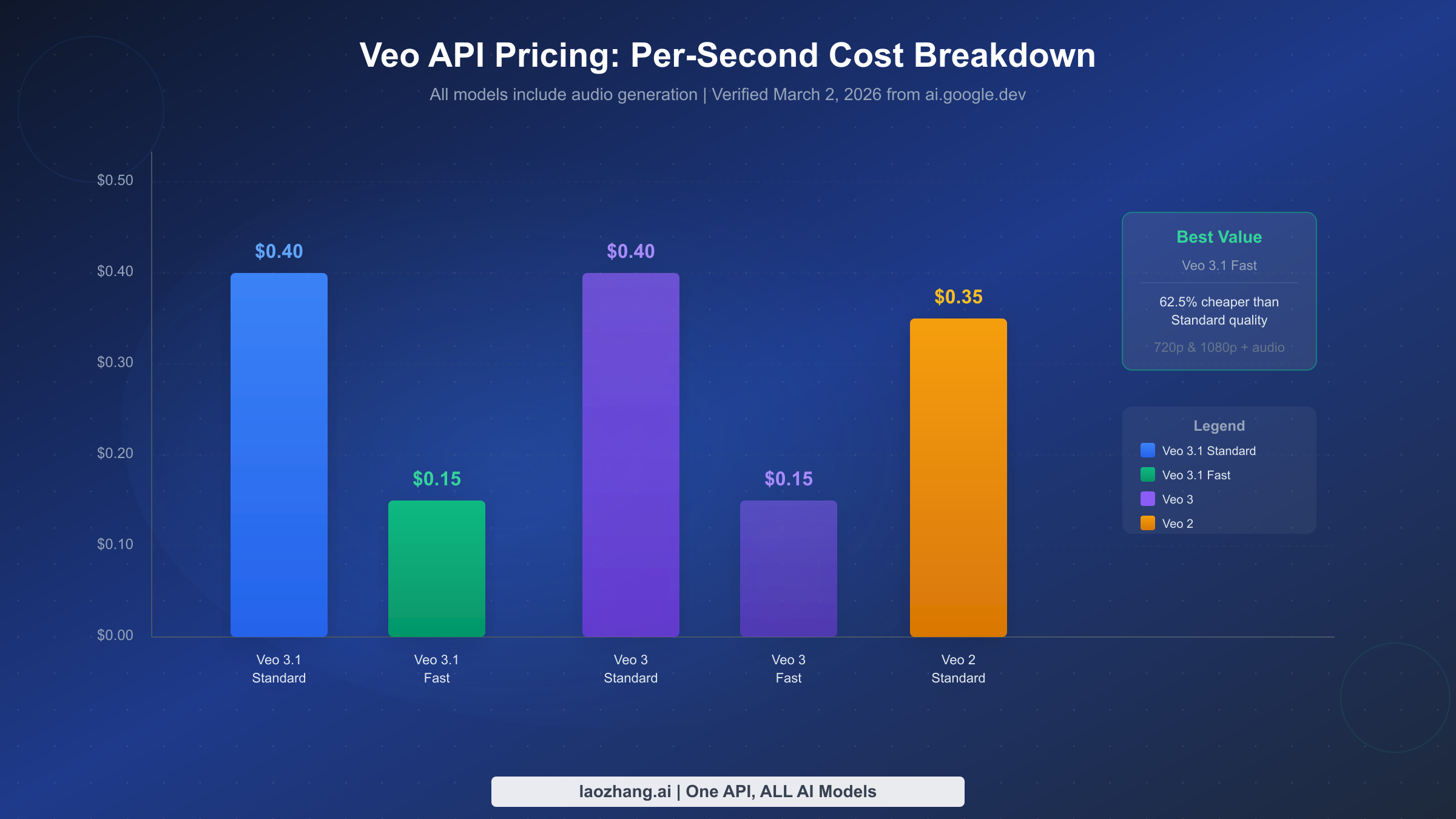
The Gemini API is the most granular way to pay for Veo 3.1, charging you per second of generated video. This model works best for developers integrating video generation into applications or for power users who need precise cost control. According to Google's official API pricing page (verified March 2, 2026), the current rates are as follows.
Veo 3.1 Standard costs $0.40 per second and delivers the highest quality output with detailed motion, superior color accuracy, and cinematic-grade audio synchronization. Both 720p and 1080p resolutions are supported, and audio generation is included in the per-second rate with no additional charges. The model ID for API calls is veo-3.1-generate-preview. For a typical 8-second video, you're looking at $3.20 per generation—a figure that adds up quickly at higher volumes but delivers output quality that competes with professional stock footage.
Veo 3.1 Fast runs at $0.15 per second, making it 62.5% cheaper than Standard while still producing remarkably capable results. The same resolution options (720p and 1080p) apply, and audio generation remains included. The model ID is veo-3.1-fast-generate-preview. An 8-second video costs just $1.20, making Fast the go-to choice for iterative workflows where you generate multiple variations before selecting the best one. Many creators find that Fast quality is indistinguishable from Standard for social media content and short-form videos, reserving Standard only for hero content that demands maximum visual fidelity.
For context, the older Veo 3 models carry identical pricing—$0.40/second for Standard and $0.15/second for Fast—while Veo 2 sits at $0.35/second. This means upgrading from Veo 2 to Veo 3.1 Fast actually saves money ($0.15 vs $0.35 per second) while delivering a significant generational quality improvement. It's one of the rare cases in AI where the newest model is also the cheapest option. If you want a more detailed breakdown of per-second costs across all generation lengths, check out our detailed per-second pricing calculator.
One critical detail that many pricing guides overlook: Veo 3.1 has no free API tier. Unlike Gemini text models that offer generous free quotas, every Veo 3.1 API call is billed from the first second. Google Cloud's $300 new-user credit can offset initial costs, but there is no permanent free tier for video generation via the API. For a complete breakdown of API rate limits and quotas, including requests per minute and daily caps, see our dedicated guide.
Google AI Plans: Plus vs. Pro vs. Ultra for Veo 3.1
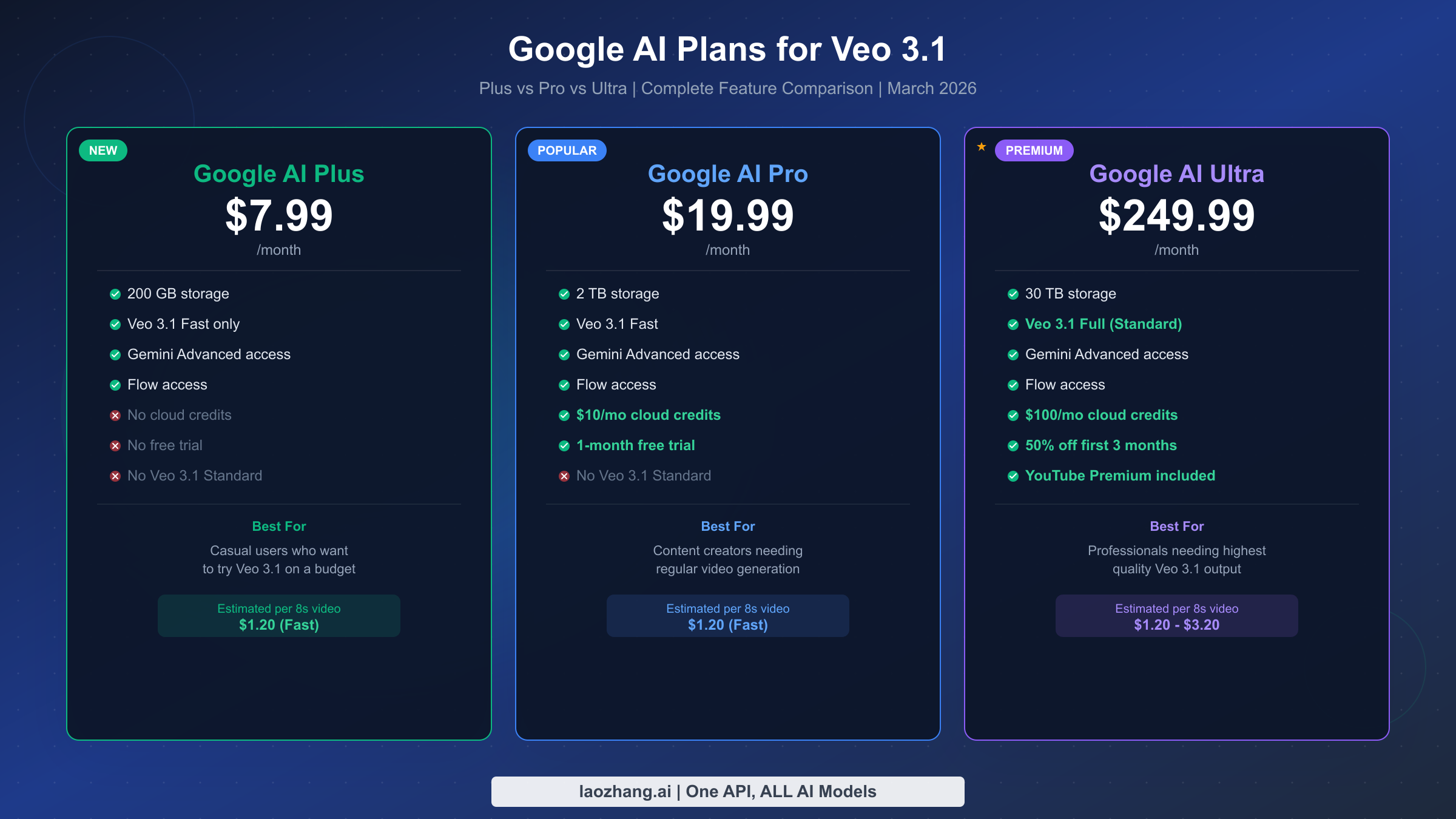
Google's subscription-based access to Veo 3.1 comes through three distinct plans, each offering different levels of video generation capability alongside other Google AI features. The information below comes from Google's official AI plans page and was verified on March 2, 2026. This is the first comprehensive comparison that includes the newly launched Google AI Plus tier, which most existing guides don't cover.
Google AI Plus ($7.99/month) is the newest entry-level tier and represents the cheapest subscription path to Veo 3.1. Launched in early 2026, it includes 200 GB of Google One storage, access to Gemini Advanced, and—critically—Veo 3.1 Fast generation through both Flow (Google's creative studio interface) and the subscription's included AI features. The limitation is clear: Plus only grants access to the Fast quality tier, not Standard. There's no free trial for Plus, and no monthly cloud credits are included. For hobbyists generating a handful of videos per month, Plus eliminates the need to manage per-second API billing entirely, offering predictable costs for casual use.
Google AI Pro ($19.99/month) has been the most popular choice since its introduction, and for good reason. It includes 2 TB of storage, Veo 3.1 Fast access (same as Plus), and Gemini Advanced with higher usage limits. The two significant advantages over Plus are: first, a 1-month free trial that lets you evaluate Veo 3.1 without any commitment; and second, $10 per month in Google Cloud credits that can be applied toward API usage, effectively reducing the net subscription cost to $9.99 for users who also leverage the API. Pro remains the sweet spot for content creators who produce videos regularly but don't need maximum quality.
Google AI Ultra ($249.99/month) is the premium tier targeted at professional creators and production teams. It stands alone as the only subscription plan that includes full Veo 3.1 access—meaning both Standard and Fast quality tiers. Ultra comes with 30 TB of storage, $100 per month in Google Cloud credits (which can fund substantial API usage), and currently offers 50% off the first three months for new subscribers. Additionally, YouTube Premium is bundled in 40+ countries. For professionals who need Veo 3.1 Standard quality output, Ultra is the only subscription path—the $100 monthly cloud credits effectively reduce the Veo-specific cost if you actively use them for API generation.
The distinction between Plus/Pro (Fast only) and Ultra (Standard + Fast) is the single most important factor in choosing a subscription plan. If Veo 3.1 Fast quality meets your needs—and for many social media, marketing, and educational video use cases it absolutely does—then paying a 12x premium for Ultra solely for Standard quality access is hard to justify. Understanding this access difference before subscribing saves many users from overspending. The decision tree is straightforward: try the free Pro trial first, evaluate whether Fast quality satisfies your requirements, and only upgrade to Ultra if you genuinely need Standard quality output for professional production work.
API vs. Subscription: Which Saves You More?
This is the analysis no other Veo 3.1 pricing guide provides—a concrete breakeven calculation that tells you exactly when the API becomes cheaper than a subscription, and vice versa. The answer depends on two variables: how many videos you generate per month and which quality tier you need.
For Veo 3.1 Fast users, the math works out as follows. The cheapest subscription with Fast access is Google AI Plus at $7.99/month. Through the API, each 8-second Fast video costs $1.20 (8 seconds multiplied by $0.15/second). Dividing the subscription cost by the per-video API cost gives us the breakeven point: $7.99 divided by $1.20 equals approximately 6.7 videos per month. If you generate fewer than 7 eight-second videos monthly, the API is cheaper. If you generate more than 7, the Plus subscription saves money because it includes unlimited generations within its fair-use limits. With Pro ($19.99/month), the breakeven is roughly 17 videos—but Pro includes $10 in cloud credits, so the effective breakeven is closer to 8-9 videos when accounting for the credits you can redirect to other Google services.
For Veo 3.1 Standard users, only the Ultra plan ($249.99/month) provides subscription access. Each 8-second Standard video costs $3.20 via API (8 seconds multiplied by $0.40/second). The raw breakeven is $249.99 divided by $3.20, which equals approximately 78 videos per month. However, Ultra includes $100 in monthly cloud credits that can be spent on API calls, effectively subsidizing approximately 31 additional Standard videos (or 83 Fast videos) per month. When you factor in the credits, the breakeven drops to roughly 47 Standard videos per month—still a high bar that only professional production teams would consistently exceed.
The practical takeaway is surprisingly clear. Most individual creators and small teams should use the API for Standard quality (paying only for what they generate) while subscribing to Plus or Pro for convenient Fast-quality access through the Flow interface. The API-plus-subscription hybrid approach is often the most cost-effective: use your Pro subscription's $10 monthly credits plus direct API billing for Standard-quality hero content, while relying on the subscription's included Fast access for everyday quick generations. This hybrid strategy is particularly effective because it decouples your "experimentation budget" (unlimited Fast via subscription) from your "production budget" (precision-billed Standard via API).
Real-World Cost Scenarios: What You'll Actually Pay
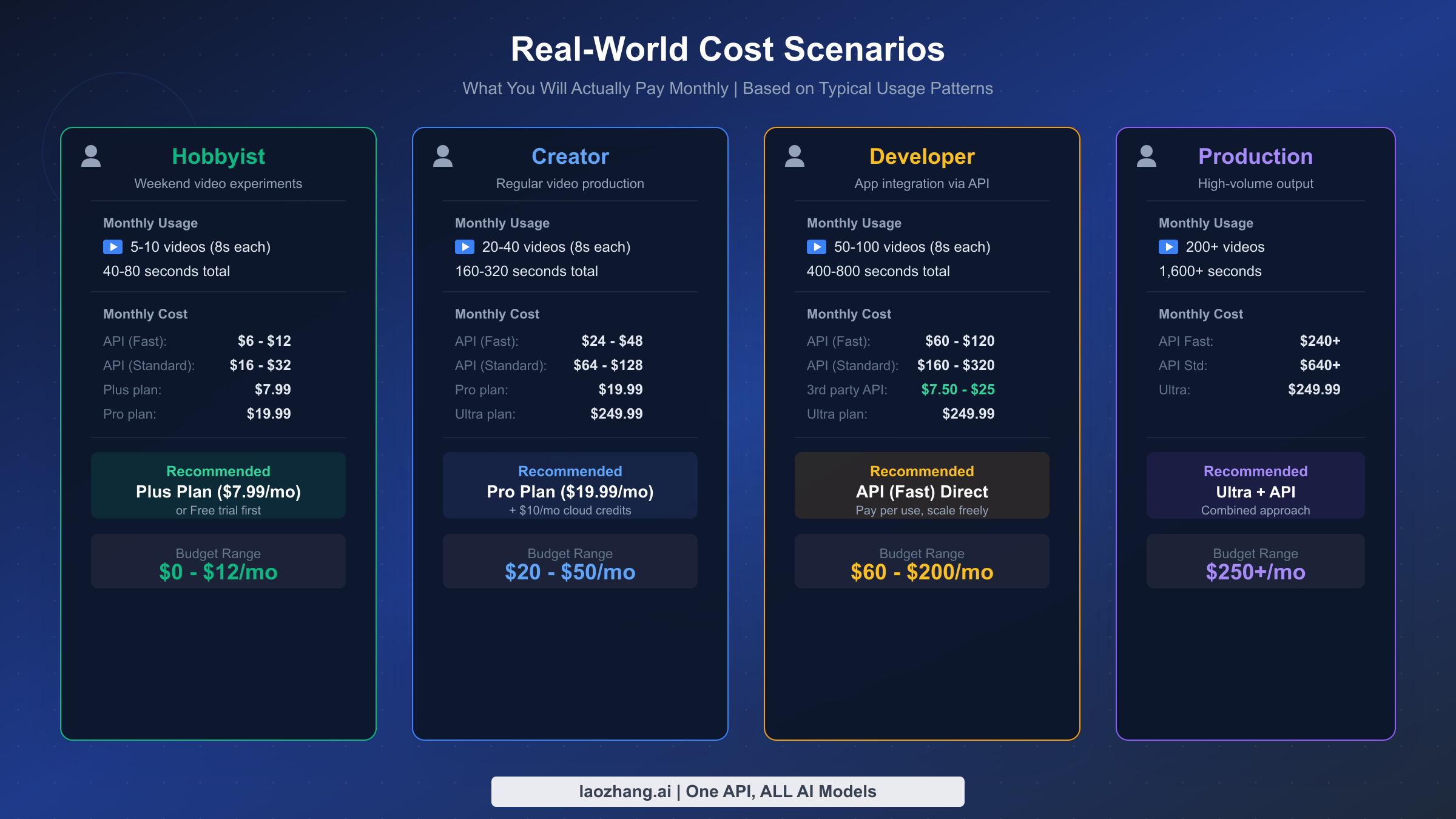
Abstract pricing tables are useful, but what most people really want to know is "how much will I spend per month given my actual workflow?" The scenarios below are based on typical usage patterns we've observed across different user types, with all calculations using the verified March 2026 pricing data.
The Hobbyist ($0–$12/month) generates 5 to 10 short videos per month, mostly for personal social media posts or creative experiments. At this volume, the most cost-effective approach is to start with the 1-month free Pro trial to evaluate Veo 3.1 quality, then either continue with the Plus plan at $7.99/month or switch to pay-as-you-go API billing at $6 to $12/month (5-10 videos at $1.20 each using Fast). The student plan offers an even better option: 12 months of free Pro access for verified .edu email holders, effectively making Veo 3.1 a zero-cost tool for the first year. Many hobbyists find they can stay entirely within free or near-free options by combining the Pro trial with Google Cloud's $300 new-user credit. For a complete roadmap to free access, see our complete free credits guide.
The Content Creator ($20–$50/month) produces 20 to 40 videos per month for YouTube intros, TikTok content, or client social media management. At this volume, the Pro subscription ($19.99/month) is almost always the best choice. The included Flow access handles most Fast-quality needs without tracking per-second costs, and the $10 monthly cloud credit provides a cushion for occasional API-based Standard quality generations. A content creator generating 30 eight-second Fast videos through the API would pay $36/month—nearly double the Pro subscription cost. The subscription's value becomes even clearer when you account for the psychological benefit of predictable monthly billing versus variable API charges that scale with creative output.
The Developer ($60–$200/month) integrates Veo 3.1 into applications and generates 50 to 100 videos per month, primarily through the API. Subscription plans offer limited value here because developers need programmatic API access rather than the Flow web interface. The API is the only viable option, and monthly costs range from $60 (50 Fast videos at $1.20 each) to $320 (100 Standard videos at $3.20 each). Most developers optimize costs by defaulting to Fast quality for preview and draft generations, only switching to Standard for final output—a strategy that typically reduces costs by 40-60% compared to using Standard exclusively. For developers seeking cheapest Veo 3.1 API access options, third-party aggregated API gateways can further reduce per-request costs.
The Production Team ($250+/month) generates 200+ videos monthly for advertising agencies, media companies, or AI-powered video platforms. At this scale, the Ultra subscription ($249.99/month) becomes viable, especially with its $100 monthly cloud credit that effectively subsidizes 83 Fast or 31 Standard API generations. Production teams typically combine Ultra subscription (for team-wide Flow access and Standard quality) with heavy API usage (for automated batch generation). The Ultra plan's 50% discount for the first three months provides significant savings during the ramp-up period: $125/month for three months instead of $250, saving $375 total. At production volume, even small per-second optimizations compound significantly—using Fast for 70% of generations instead of Standard can save thousands annually.
How to Access Veo 3.1 for Free (4 Proven Methods)
Paying for Veo 3.1 is optional—at least initially. Google provides several legitimate free access paths that, when combined strategically, can provide months of zero-cost video generation. Every method described below has been verified as active in March 2026.
Method 1: Google AI Pro Free Trial (1 month) is the most straightforward entry point. Every new user can activate a 1-month free trial of Google AI Pro, which includes Veo 3.1 Fast access through Flow, Gemini Advanced, and 2 TB of storage. No credit card is required for the trial in most regions, and you can generate as many Fast-quality videos as you want during the trial period (within fair-use limits). The trial is available at one.google.com and automatically converts to the $19.99/month paid plan unless you cancel before the trial ends. This is the recommended first step for everyone—it lets you evaluate Veo 3.1 quality with zero financial risk.
Method 2: Student Plan (12 months free) extends your free access to a full year. Google verifies student status through SheerID, accepting valid .edu email addresses from accredited institutions worldwide. Once verified, you receive Google AI Pro at no cost for 12 consecutive months—including Veo 3.1 Fast access, Gemini Advanced, 2 TB of storage, and $10/month in cloud credits. The student plan represents the highest total free value at approximately $240 (12 months of Pro) plus $120 in cloud credits over the year. If you have a valid student email, this should be your primary access method. The application process typically takes 24-48 hours for verification.
Method 3: Google Cloud Free Credits ($300) works differently from the subscription methods—it gives you API access rather than Flow access. New Google Cloud users receive $300 in free credits valid for 90 days, which can be applied toward Veo 3.1 API calls through the Gemini API. At $0.15/second (Fast), $300 translates to 2,000 seconds of video generation, or approximately 250 eight-second videos. At $0.40/second (Standard), you get about 93 eight-second Standard-quality videos. This method is ideal for developers who need API access rather than the Flow interface, and it can be combined with method 1 or 2 to run subscription and API access simultaneously at zero cost.
Method 4: Flow Free Access provides limited Veo 3.1 access through Google's creative studio interface without any subscription. Flow offers a daily generation quota for free-tier users, though the limits are significantly more restrictive than paid plans. The free Flow tier gives you enough generations to evaluate quality and experiment with prompts, but isn't sufficient for regular content production. Access Flow at flow.google.com with any Google account. The combination strategy is powerful: use Flow's free tier for experimentation, the Pro trial for your first month of serious use, and then decide whether to continue with Plus ($7.99/month), Pro ($19.99/month), or switch to API-only billing based on your actual usage patterns during the trial period.
Veo 3.1 vs. Sora 2 vs. Runway: Price Comparison
Choosing the right AI video generator isn't just about one platform's pricing—it's about how Veo 3.1 compares against its direct competitors on a standardized cost basis. The table below normalizes pricing across platforms to a common metric: cost per 8-second video, the most common generation length across all three services.
| Feature | Veo 3.1 (Google) | Sora 2 (OpenAI) | Runway Gen-3 Alpha |
|---|---|---|---|
| Fast/Basic per 8s | $1.20 | $1.20-$1.60 | $2.00 |
| Standard/HD per 8s | $3.20 | $2.40-$4.00 | $4.00 |
| Cheapest subscription | $7.99/mo (Plus) | $20/mo (Plus) | $12/mo (Standard) |
| Full-quality subscription | $249.99/mo (Ultra) | $200/mo (Pro) | $76/mo (Unlimited) |
| Free trial | 1 month Pro | Limited free tier | 125 credits |
| Audio included | Yes (all tiers) | No (separate) | No |
| Max resolution | 1080p | 1080p | 1080p (Turbo: 4K) |
The comparison reveals several important dynamics. Veo 3.1 Fast offers the lowest per-video cost at the entry level, matching or beating Sora 2's cheapest option while including audio generation—a feature that Sora 2 and Runway charge extra for or don't support natively. When you factor in audio, Veo 3.1's effective cost advantage widens by $0.50-$1.00 per video for users who need sound.
At the subscription level, Google AI Plus at $7.99/month undercuts every competitor's entry-level plan. OpenAI's cheapest Sora access requires the $20/month ChatGPT Plus subscription, while Runway's Standard plan starts at $12/month with limited credits. For users who just want to experiment with AI video generation at the lowest possible monthly cost, Google's Plus plan is the clear winner. For a deeper dive into the Google versus OpenAI comparison, our in-depth Sora 2 vs Veo 3.1 comparison covers quality, speed, and feature differences beyond pricing.
At the high end, Runway offers the most competitive unlimited plan at $76/month, while Google's Ultra ($249.99) and OpenAI's Pro ($200) target users who need maximum quality and priority access. The premium pricing for Ultra is partially justified by the $100/month cloud credits and YouTube Premium bundle, but users who only need video generation may find Runway's pricing more palatable. The right choice ultimately depends on your quality requirements, volume, and whether you value the broader Google ecosystem integration (cloud credits, YouTube, Google One storage) that comes bundled with the Google AI plans.
5 Strategies to Optimize Your Veo 3.1 Costs
Smart Veo 3.1 users can reduce their effective costs by 30-60% through deliberate optimization strategies. These aren't theoretical suggestions—they're practical approaches based on how the pricing structure actually works and where the savings compound.
Strategy 1: Default to Fast, Upgrade Selectively. The single most impactful cost reduction is using Veo 3.1 Fast ($0.15/second) as your default quality tier and only switching to Standard ($0.40/second) for final, public-facing content. In a typical workflow where you generate 5 drafts before selecting one final video, using Fast for all 5 drafts and Standard only for the final cut costs $6.00 + $3.20 = $9.20 per final video. Using Standard for all 6 generations would cost $19.20—more than double. Over 20 monthly production cycles, this strategy saves $200/month. Most creators discover that Fast quality is perfectly adequate for 60-80% of their published content, further reducing the percentage of Standard-quality generations needed.
Strategy 2: Leverage Subscription Cloud Credits. Both Pro ($10/month) and Ultra ($100/month) include Google Cloud credits that most users never apply toward Veo API calls. These credits work for Gemini API billing, meaning Pro subscribers effectively get 83 seconds of Fast generation or 25 seconds of Standard generation included beyond their subscription's Flow access. Ultra subscribers get a much more substantial credit that covers approximately 666 Fast seconds or 250 Standard seconds—enough for 83 Fast videos or 31 Standard videos per month at no additional cost beyond the subscription fee. Setting up billing to prioritize credit usage over direct payment is a one-time configuration that pays for itself every month.
Strategy 3: Use Third-Party API Gateways for High Volume. For developers and businesses generating more than 100 videos per month, third-party API aggregators can offer significant savings over direct Google API billing. For stable Veo 3.1 API access, laozhang.ai offers async endpoints with no charge on failures, starting at $0.15/request for the fast model and $0.25/request for standard quality. The async API design means no charges on failures—whether content moderation fails or generation times out, you won't be charged. This contrasts with direct API access where charges apply immediately upon request submission. Documentation is available at docs.laozhang.ai. At production volume, the per-request pricing model (versus per-second) can result in meaningful cost differences depending on average video length.
Strategy 4: Batch Similar Generations. Veo 3.1's pricing is purely per-second with no per-request overhead, but there's an indirect optimization in batching. When you generate multiple thematically similar videos in a single session, you develop increasingly effective prompts, leading to fewer failed or unsatisfactory generations. Experienced users report that prompt refinement within a batch session reduces their "waste ratio" (unusable generations divided by total generations) from 40% to under 15%. On 100 monthly Fast videos, reducing waste from 40% to 15% saves 25 videos worth of cost—$30/month or $360/year.
Strategy 5: Stack Free Access Methods During Onboarding. New users have a unique cost advantage window. Start with the 1-month Pro free trial for immediate Flow access. Simultaneously, apply for Google Cloud's $300 free credits for API experimentation. If eligible, activate the student plan to extend free Pro access to 12 months. During this combined free period, establish your actual usage patterns before committing to any paid plan. Many users discover during the free period that their usage is lower than expected, allowing them to start with Plus ($7.99/month) instead of Pro ($19.99/month)—a savings of $144/year that wouldn't have been apparent without the data from the free trial period.
Frequently Asked Questions
Is Google Veo 3.1 free to use?
Veo 3.1 is not entirely free, but Google provides four legitimate free access methods. The most accessible is the 1-month Google AI Pro free trial, which includes Veo 3.1 Fast quality generation. Students with verified .edu email addresses can access Google AI Pro free for 12 months through Google's student plan. New Google Cloud users receive $300 in free credits applicable to Veo 3.1 API calls, enough for approximately 250 eight-second Fast videos. Additionally, Google Flow offers limited free daily generations. The API itself has no permanent free tier—every generation is billed from the first second (Google AI Studio, verified March 2, 2026).
How much does a single Veo 3.1 video cost?
A single 8-second Veo 3.1 video costs $1.20 using the Fast model ($0.15/second times 8 seconds) or $3.20 using the Standard model ($0.40/second times 8 seconds). Both prices include audio generation at no extra charge. Through subscription plans, the per-video cost is effectively lower for high-volume users: a Plus subscriber generating 20 videos/month pays an effective $0.40/video, while a Pro subscriber at the same volume pays roughly $1.00/video. The exact cost depends on your access method and monthly generation volume.
What is the cheapest way to use Veo 3.1?
The absolute cheapest way is to combine free access methods: start with the Pro free trial (1 month), then activate the student plan if eligible (12 months free), and use Google Cloud's $300 free credits for API access. For ongoing paid use, Google AI Plus at $7.99/month is the cheapest subscription providing Veo 3.1 Fast access. For API-only usage at low volume (under 7 videos/month), pay-as-you-go at $0.15/second is cheaper than any subscription. Third-party API gateways can further reduce per-video costs for high-volume developers.
Does Google AI Plus include Veo 3.1?
Yes, the new Google AI Plus plan ($7.99/month) includes Veo 3.1 Fast access through both Flow and Gemini's AI features. However, Plus only provides Fast quality—Standard quality Veo 3.1 generation requires the Ultra plan ($249.99/month). Plus does not include cloud credits or a free trial. For most casual users and social media creators, Fast quality is sufficient, making Plus the most cost-effective subscription option for Veo 3.1 access (Google AI Plans page, verified March 2, 2026).
How does Veo 3.1 pricing compare to Sora 2?
At the entry level, Veo 3.1 Fast ($1.20 per 8-second video) is comparable to Sora 2's basic tier, but Veo 3.1 includes audio generation while Sora 2 does not—giving Veo an effective cost advantage for users who need sound. Google AI Plus ($7.99/month) significantly undercuts OpenAI's ChatGPT Plus ($20/month) as the cheapest subscription path to AI video generation. At the premium tier, OpenAI Pro ($200/month) is cheaper than Google AI Ultra ($249.99/month), though Ultra includes $100/month in cloud credits and YouTube Premium. The best value depends on your specific needs: Veo 3.1 wins on entry-level pricing and audio inclusion, while Sora 2 may offer better value at the premium subscription tier.