
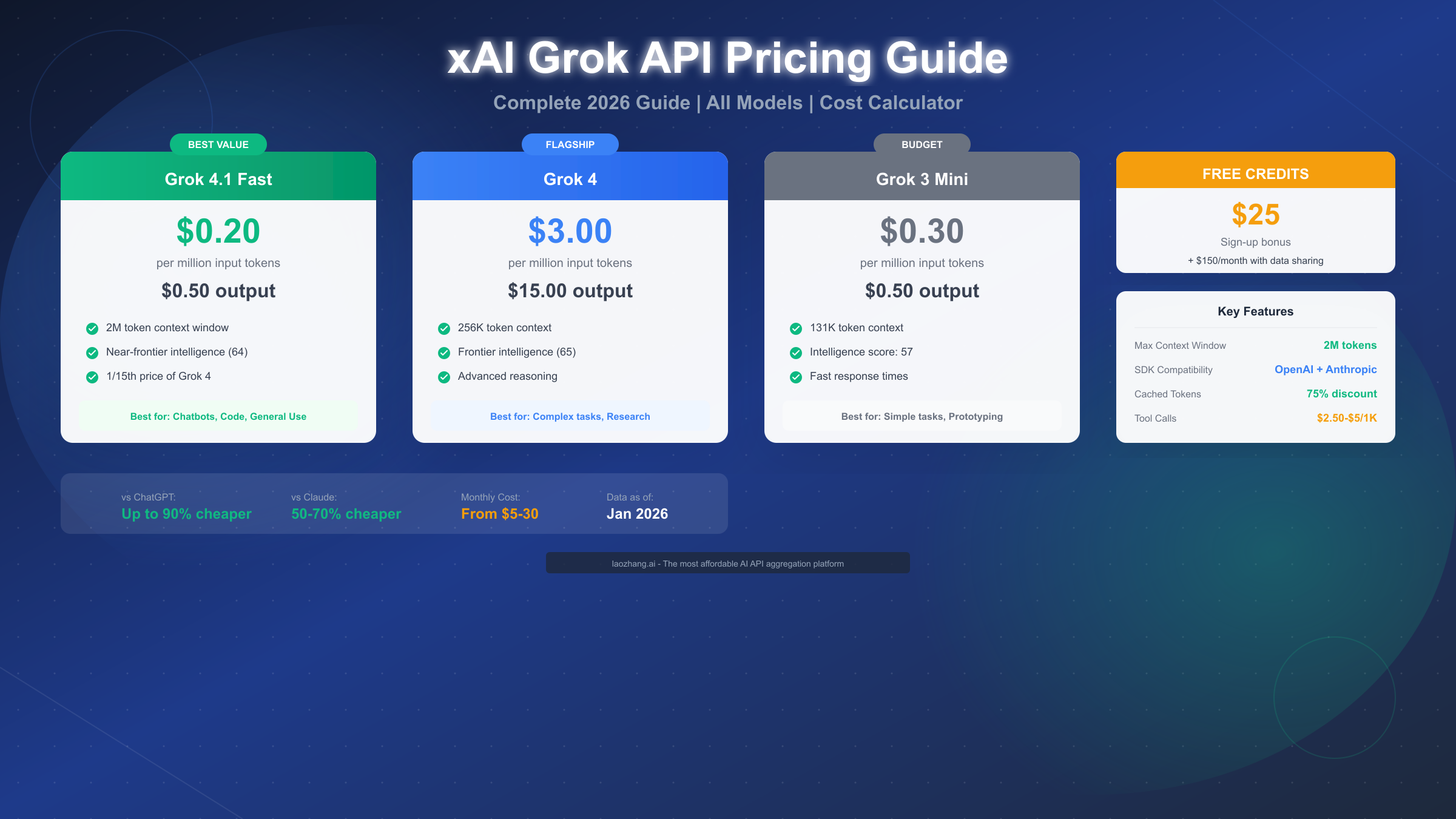
xAI's Grok API pricing starts at $0.20 per million input tokens for the budget-friendly Grok 4.1 Fast model and goes up to $3/$15 per million for the flagship Grok 4. As of January 2026, new users receive $25 in free promotional credits upon signup, with an additional $150/month available through the data sharing program. Grok offers the industry's largest context window at 2 million tokens, making it a compelling alternative to OpenAI's GPT-4o and Anthropic's Claude for developers seeking both performance and value.
Whether you're evaluating Grok for a new project, comparing it against your current AI provider, or looking to optimize existing costs, this guide covers everything you need to make an informed decision. We'll break down exact pricing for every model, show you how to claim free credits step-by-step, compare costs with competitors, and reveal optimization strategies that can cut your bill by more than half.
What is Grok API? Quick Overview
Grok API is the programmatic interface to xAI's family of large language models, enabling developers to integrate advanced AI capabilities directly into their applications. Unlike the Grok chatbot available through X (formerly Twitter), the API provides raw access to the underlying models with customizable parameters, streaming responses, and enterprise-grade reliability.
xAI launched Grok in November 2023, but the API only became broadly available in late 2024. Since then, the model family has expanded significantly, with Grok 4 representing the current flagship and Grok 4.1 Fast offering an optimized balance of speed and cost. The API maintains compatibility with OpenAI's SDK format, meaning developers can often switch with minimal code changes.
What sets Grok apart from competitors includes several distinctive capabilities. The models have access to real-time data through X integration, providing current information that models trained on static datasets cannot match. Grok 4.1 Fast supports a 2 million token context window, the largest in the industry, enabling processing of entire codebases or document collections in a single request. The models also demonstrate strong performance in reasoning tasks, with Grok 4 achieving 92.7% on the LMSYS Chatbot Arena benchmark.
For developers, the practical value comes down to three factors: pricing competitiveness, unique capabilities like real-time data, and ease of integration. The following sections address each of these in detail.
Complete Grok API Pricing Table (January 2026)
Understanding Grok's pricing structure requires looking at multiple dimensions: base token costs, context considerations, and tool pricing. Here's the complete breakdown based on official xAI documentation as of January 2026.
Standard Token Pricing
| Model | Input (per 1M tokens) | Output (per 1M tokens) | Context Window | Best For |
|---|---|---|---|---|
| Grok 4.1 Fast | $0.20 | $0.50 | 2M tokens | High-volume production |
| Grok 4 | $3.00 | $15.00 | 256K tokens | Complex reasoning |
| Grok 3 | $2.00 | $10.00 | 128K tokens | General tasks |
| Grok 3 Mini | $0.10 | $0.30 | 128K tokens | Simple tasks |
Cached Token Pricing
xAI offers significant discounts for cached tokens, which occur when you reuse the same prompt prefix across multiple requests. This is particularly valuable for applications with consistent system prompts.
| Model | Cached Input (per 1M) | Savings vs Standard |
|---|---|---|
| Grok 4.1 Fast | $0.10 | 50% |
| Grok 4 | $0.75 | 75% |
| Grok 3 | $0.50 | 75% |
Tool and Feature Pricing
Beyond basic token costs, certain features incur additional charges:
| Feature | Pricing | Notes |
|---|---|---|
| Tool Invocation | $2.50-5.00 per 1K calls | Varies by tool complexity |
| Web Search | Per source charged | Based on sources retrieved |
| Image Input | Included in token count | No additional charge |
| Function Calling | Standard token rates | No additional charge |
The tool pricing deserves attention because it can significantly impact costs for applications that rely heavily on external integrations. A chatbot making frequent web searches will see substantially higher bills than one performing text-only tasks.
Cost Per 1K Tokens (For Quick Reference)
For those accustomed to thinking in smaller units:
| Model | Input (per 1K) | Output (per 1K) |
|---|---|---|
| Grok 4.1 Fast | $0.0002 | $0.0005 |
| Grok 4 | $0.003 | $0.015 |
| Grok 3 Mini | $0.0001 | $0.0003 |
How to Get Free Grok API Credits ($25 + $150/month)
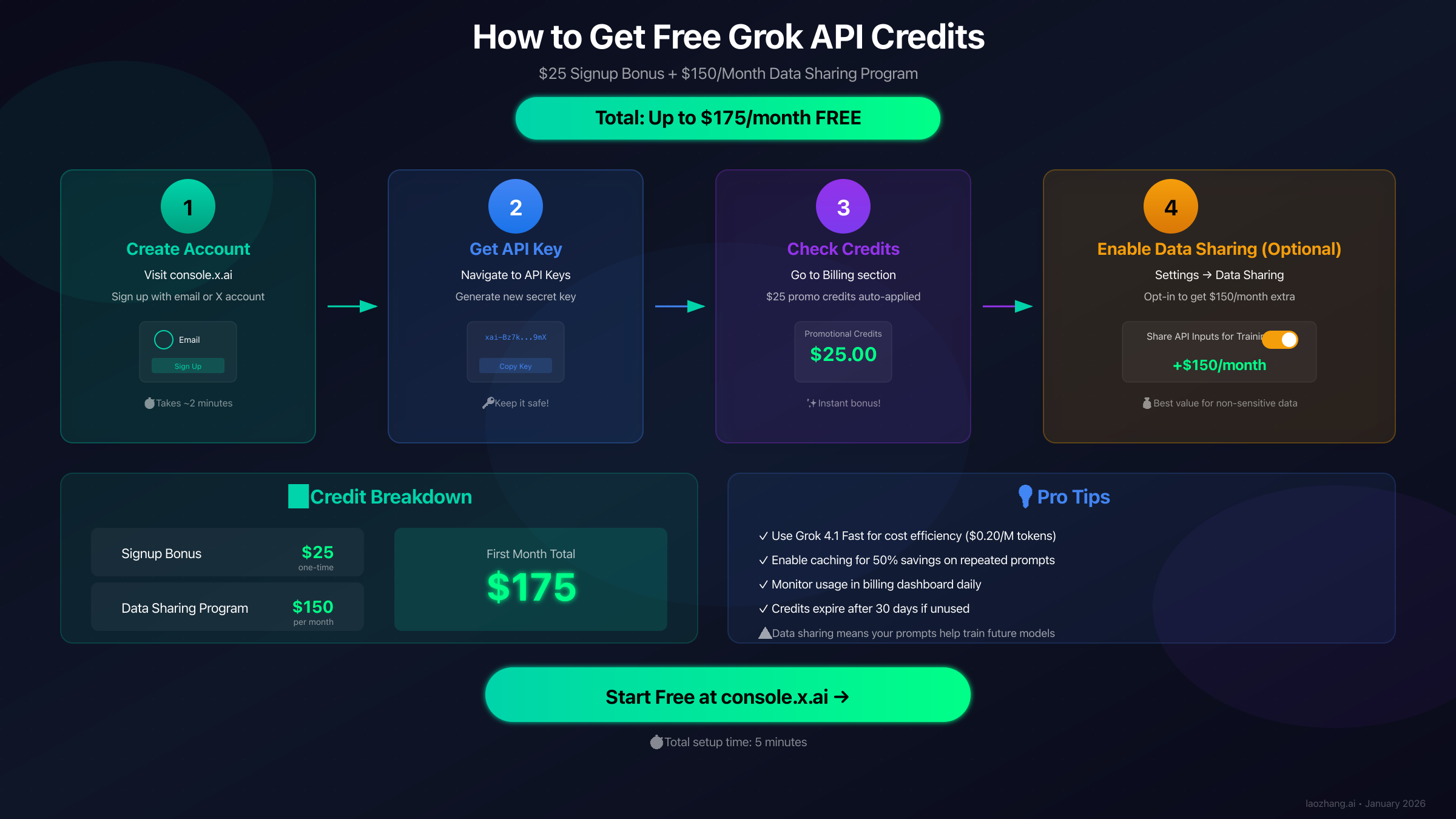
One of Grok API's most compelling advantages is the generous free credit program. New users can access up to $175 in credits their first month, providing substantial runway for evaluation and development.
Step 1: Create Your xAI Account
Navigate to console.x.ai and click "Sign Up." You can authenticate using either your email address or your X account. Using your X account provides automatic verification and faster onboarding, but either method grants full API access.
After completing registration, you'll land on the dashboard where your account status and credit balance display prominently. New accounts automatically receive $25 in promotional credits within minutes of registration.
Step 2: Generate Your API Key
From the dashboard, navigate to the "API Keys" section in the left sidebar. Click "Create New Key" and provide a descriptive name for your key. The system generates a secret key starting with "xai-" followed by a random string.
Copy this key immediately and store it securely. xAI follows security best practices by displaying the full key only once. If you lose it, you'll need to generate a new one. Never commit API keys to version control or share them in public code repositories.
Step 3: Verify Your Credits
Return to the "Billing" section to confirm your promotional credits. You should see:
- Promotional Credits: $25.00
- Expires: 30 days from registration
These credits apply to all API usage without restrictions on model selection. You can use them for Grok 4 at $3/$15 per million tokens or maximize their value with Grok 4.1 Fast at $0.20/$0.50.
Step 4: Enable Data Sharing (Optional, +$150/month)
Here's where the real value unlocks. xAI offers an additional $150 per month in API credits through their data sharing program. To enable it:
- Navigate to Settings > Data Sharing
- Toggle "Share API Inputs for Model Training" to ON
- Review and accept the terms
- Credits appear within 24 hours
The data sharing program allows xAI to use your API interactions (prompts and responses) to improve future model versions. For non-sensitive applications like development testing, educational tools, or public-facing chatbots, this trade-off provides exceptional value. Your $175 monthly credit balance can support significant production usage.
However, if your application processes proprietary code, confidential business data, or personal information, keep data sharing disabled. The $25 initial credit still provides meaningful evaluation capacity, and you can always enable sharing later.
For teams exploring multiple AI providers, consider that free access to Grok 4 API through various methods can further extend your testing budget.
Credit Usage Tips
Maximize your free credits with these strategies:
-
Start with Grok 4.1 Fast: At $0.20 per million input tokens, $175 in credits translates to approximately 875 million input tokens. That's enough for extensive production testing.
-
Use caching: Consistent system prompts benefit from 50-75% cache discounts. Design your application to maximize prompt reuse.
-
Monitor daily: The billing dashboard shows real-time usage. Set up alerts at 50% and 80% thresholds to avoid surprises.
-
Credits expire: Promotional credits have a 30-day expiration. Data sharing credits refresh monthly. Plan your usage accordingly.
Grok vs ChatGPT vs Claude: API Pricing Comparison
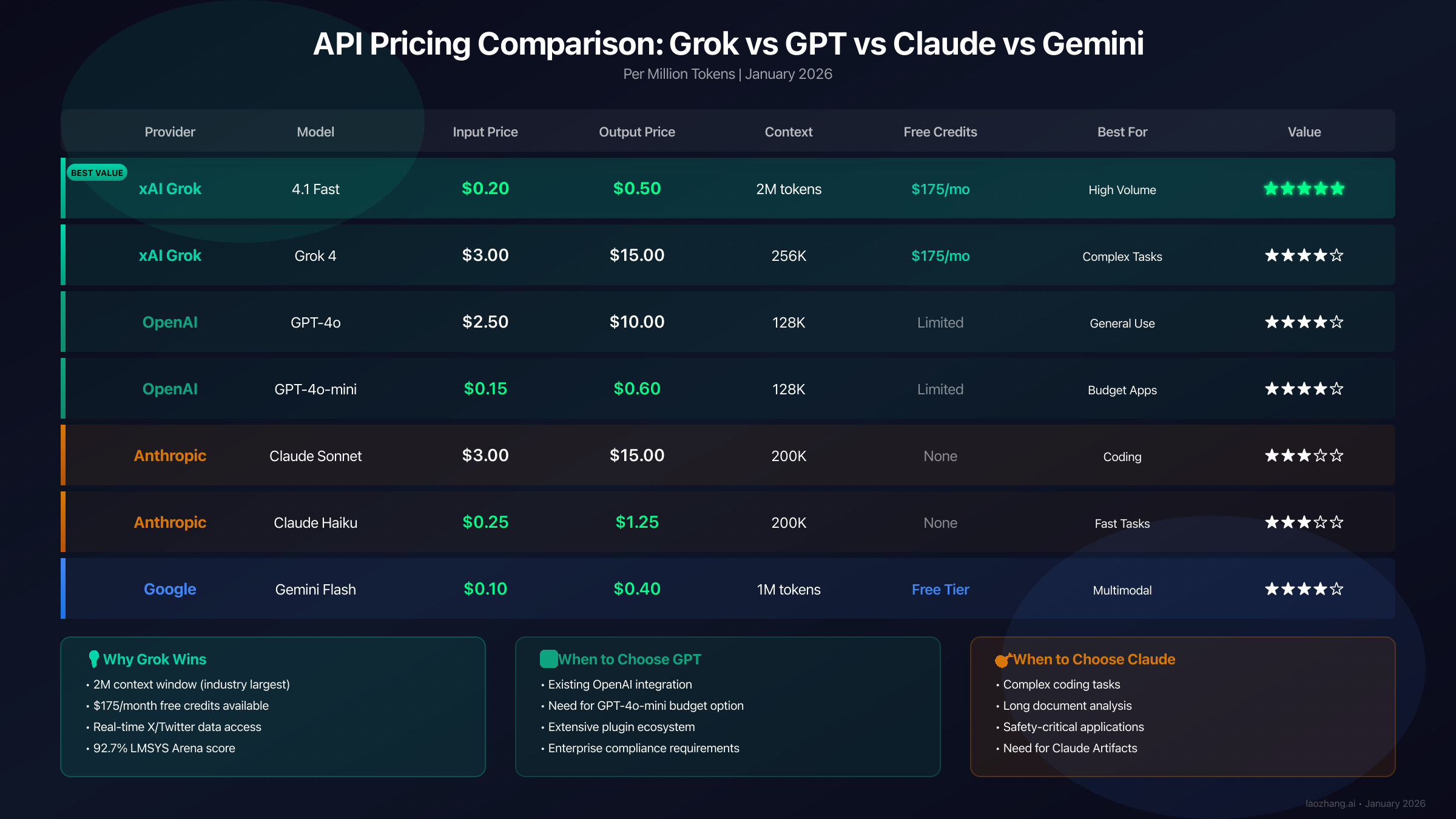
Choosing between AI providers requires understanding how pricing translates to real-world costs. This comparison uses January 2026 pricing from official documentation.
Flagship Model Comparison
| Provider | Model | Input/1M | Output/1M | Context | Free Credits |
|---|---|---|---|---|---|
| xAI | Grok 4 | $3.00 | $15.00 | 256K | $175/mo |
| OpenAI | GPT-4o | $2.50 | $10.00 | 128K | Limited |
| Anthropic | Claude Sonnet | $3.00 | $15.00 | 200K | None |
| Gemini 1.5 Pro | $1.25 | $5.00 | 2M | Free tier |
At the flagship tier, Grok 4 and Claude Sonnet share identical pricing, while GPT-4o offers slightly lower costs. However, raw token pricing tells only part of the story.
Budget Model Comparison
| Provider | Model | Input/1M | Output/1M | Context | Value |
|---|---|---|---|---|---|
| xAI | Grok 4.1 Fast | $0.20 | $0.50 | 2M | Excellent |
| OpenAI | GPT-4o-mini | $0.15 | $0.60 | 128K | Good |
| Anthropic | Claude Haiku | $0.25 | $1.25 | 200K | Moderate |
| Gemini 2.0 Flash | $0.10 | $0.40 | 1M | Excellent |
Grok 4.1 Fast delivers exceptional value at the budget tier. While Gemini Flash offers lower per-token costs, Grok's 2M context window and $175/month free credits tip the overall value proposition in its favor for many use cases.
For detailed analysis of competitor pricing, see our guides on Claude API pricing structure, GPT-4o API pricing, and Gemini API pricing options.
When to Choose Each Provider
Choose Grok when:
- You need real-time data integration (X/Twitter content)
- Your application requires massive context windows (2M tokens)
- Free credits significantly impact your budget
- You're building applications for X platform integration
Choose GPT-4o when:
- You have existing OpenAI integration to maintain
- Plugin ecosystem access matters
- Enterprise compliance requires established providers
- You need GPT-4o-mini's specific price point
Choose Claude when:
- Complex coding tasks are primary use case
- Safety and alignment are critical concerns
- You need Claude Artifacts functionality
- Long document analysis with nuanced understanding
Choose Gemini when:
- Multimodal capabilities (video, audio) are essential
- Google Cloud integration simplifies infrastructure
- Free tier limits cover your usage
- Cost minimization is the absolute priority
Total Cost of Ownership
Beyond per-token pricing, consider these factors:
| Factor | Grok | OpenAI | Claude | Gemini |
|---|---|---|---|---|
| Free Credits | $175/mo | Limited | None | Free tier |
| Rate Limits | Generous | Tier-based | Tier-based | Generous |
| Caching Discount | Up to 75% | Variable | Up to 90% | Limited |
| Min. Commitment | None | None | None | None |
For teams requiring flexibility across providers, services like laozhang.ai offer API aggregation with consistent pricing across models, eliminating the complexity of managing multiple accounts and billing relationships.
Real-World Cost Examples: How Much Will You Pay?
Abstract pricing means little without concrete examples. Here's what actual production workloads cost across different scenarios.
Scenario 1: Customer Support Chatbot
A mid-size e-commerce company processes 10,000 customer conversations daily. Each conversation averages 8 exchanges, with 500 input tokens and 400 output tokens per exchange.
Daily token usage:
- Input: 10,000 × 8 × 500 = 40,000,000 tokens
- Output: 10,000 × 8 × 400 = 32,000,000 tokens
Monthly cost with Grok 4.1 Fast:
- Input: 40M × 30 × $0.20/M = $240
- Output: 32M × 30 × $0.50/M = $480
- Total: $720/month
With $150/month data sharing credits, effective cost drops to $570/month.
Comparison with GPT-4o:
- Input: 40M × 30 × $2.50/M = $3,000
- Output: 32M × 30 × $10.00/M = $9,600
- Total: $12,600/month
Using Grok 4.1 Fast instead of GPT-4o saves $11,880/month or 94%.
Scenario 2: Code Review Assistant
A development team processes 50 pull requests daily, each averaging 15,000 input tokens (code context) and 3,000 output tokens (review comments).
Monthly token usage:
- Input: 50 × 15,000 × 30 = 22,500,000 tokens
- Output: 50 × 3,000 × 30 = 4,500,000 tokens
Cost comparison:
| Model | Input Cost | Output Cost | Total |
|---|---|---|---|
| Grok 4 | $67.50 | $67.50 | $135 |
| Grok 4.1 Fast | $4.50 | $2.25 | $6.75 |
| GPT-4o | $56.25 | $45.00 | $101.25 |
| Claude Sonnet | $67.50 | $67.50 | $135 |
For code review, Grok 4.1 Fast at $6.75/month offers remarkable value, though teams requiring the highest quality analysis might prefer Grok 4's reasoning capabilities at $135/month.
Scenario 3: Document Analysis Pipeline
A legal tech startup processes 200 contracts daily, each 25,000 tokens with 5,000 token summaries.
Monthly usage:
- Input: 200 × 25,000 × 30 = 150,000,000 tokens
- Output: 200 × 5,000 × 30 = 30,000,000 tokens
Monthly costs:
| Model | Cost | With Caching (50%) |
|---|---|---|
| Grok 4.1 Fast | $45 | $30 |
| Grok 4 | $900 | $487.50 |
| GPT-4o | $675 | Varies |
Document analysis benefits enormously from Grok 4.1 Fast's combination of low pricing and massive context window. Processing full contracts without chunking improves accuracy while keeping costs minimal.
Cost Calculator Formula
For your own estimates, use this formula:
Monthly Cost = (Input Tokens/1M × Input Rate + Output Tokens/1M × Output Rate) × 30
Effective Cost = Monthly Cost - Free Credits - Caching Savings
Hidden Costs: Tools, Search, and Context Pricing
Token pricing headlines don't capture the full cost picture. Several factors can significantly increase your actual bill.
Tool Invocation Costs
When your application uses Grok's built-in tools (web search, code execution, etc.), additional charges apply beyond standard token costs.
| Tool Type | Cost per 1K Calls | Example Use Case |
|---|---|---|
| Web Search | $5.00 | Real-time data retrieval |
| Code Execution | $2.50 | Running generated code |
| File Analysis | $3.00 | Processing uploaded documents |
A chatbot that searches the web for every query could add $5 per 1,000 queries. At scale, this compounds quickly. Consider whether your use case actually requires real-time data or whether cached/trained knowledge suffices.
Large Context Pricing
While Grok 4.1 Fast supports 2M token contexts, extremely long contexts may incur premium pricing. As of January 2026:
- Standard context (up to 128K): Base rates
- Extended context (128K-2M): May incur 25% premium on some tiers
Check current documentation for your specific use case, as this pricing evolves.
Reasoning Token Costs
Advanced reasoning features (like chain-of-thought processing) generate additional internal tokens that count toward your usage. A query that looks like 100 input tokens might actually consume 500+ tokens when reasoning is enabled.
Monitor your actual token consumption versus expected usage. If you see significant discrepancies, reasoning tokens are likely the cause.
Rate Limit Considerations
While not a direct cost, rate limits affect your effective access:
| Tier | Requests/min | Tokens/min |
|---|---|---|
| Free tier | 60 | 100K |
| Standard | 600 | 1M |
| Enterprise | Custom | Custom |
Hitting rate limits doesn't cost money, but it does cost time and potentially users. Budget for higher tiers if your application requires consistent throughput.
Infrastructure Costs
Don't forget the costs outside xAI's billing:
- Prompt storage: Caching benefits require storing prompt templates
- Response logging: Compliance or debugging may require storing outputs
- Network egress: High-volume API calls incur bandwidth costs
- Error handling: Failed requests consume tokens without producing results
A complete cost model includes these infrastructure considerations alongside API pricing.
Which Grok Model Should You Choose?
Selecting the right model requires balancing capability against cost. Here's a decision framework based on common use cases.
Model Capability Overview
| Capability | Grok 4 | Grok 4.1 Fast | Grok 3 | Grok 3 Mini |
|---|---|---|---|---|
| Complex Reasoning | Excellent | Good | Good | Basic |
| Code Generation | Excellent | Excellent | Good | Moderate |
| Long Context | 256K | 2M | 128K | 128K |
| Speed | Standard | Very Fast | Fast | Fastest |
| Cost | High | Very Low | Medium | Lowest |
Use Case Recommendations
Customer Support Chatbots
- Recommended: Grok 4.1 Fast
- Reasoning: High volume, moderate complexity, cost-sensitive
- Alternative: Grok 3 Mini for simpler FAQ-style interactions
Code Review & Generation
- Recommended: Grok 4.1 Fast for routine tasks, Grok 4 for complex architecture
- Reasoning: Code quality correlates with reasoning capability
- Alternative: Consider Claude Sonnet for safety-critical code
Document Analysis
- Recommended: Grok 4.1 Fast (2M context is decisive advantage)
- Reasoning: Process entire documents without chunking
- Alternative: None offer comparable context at similar pricing
Research & Analysis
- Recommended: Grok 4
- Reasoning: Complex reasoning and synthesis tasks require top-tier capability
- Alternative: Consider blending Grok 4 for final synthesis with Grok 4.1 Fast for initial processing
Prototyping & Development
- Recommended: Grok 4.1 Fast with free credits
- Reasoning: Maximize iteration speed within free tier
- Alternative: Upgrade to Grok 4 once you've validated the approach
Decision Tree
-
Is cost the primary constraint?
- Yes: Grok 4.1 Fast or Grok 3 Mini
- No: Continue to step 2
-
Do you need >256K context?
- Yes: Grok 4.1 Fast (only option with 2M)
- No: Continue to step 3
-
Does your task require complex reasoning?
- Yes: Grok 4
- No: Grok 4.1 Fast
-
Is response speed critical?
- Yes: Grok 4.1 Fast or Grok 3 Mini
- No: Choose based on quality requirements
Model Mixing Strategy
Most production applications benefit from using multiple models:
- Routing layer: Grok 3 Mini for intent classification (cheapest)
- Standard queries: Grok 4.1 Fast for 80% of requests
- Complex tasks: Grok 4 for the 20% requiring deep reasoning
This approach typically reduces costs by 40-60% compared to using Grok 4 exclusively while maintaining quality where it matters.
Cost Optimization: Save 50%+ on Your Grok API Bill
Beyond model selection, several techniques can dramatically reduce your Grok API costs.
Prompt Caching
xAI's caching mechanism offers 50-75% discounts on repeated prompt prefixes. To maximize cache hits:
- Standardize system prompts: Use identical system messages across requests
- Front-load static content: Place unchanging context at the prompt beginning
- Batch similar requests: Process related queries together to maintain cache warmth
Example savings for a chatbot with 2,000 token system prompt:
- Without caching: 2,000 × $0.20/1M = $0.0004 per request
- With caching: 2,000 × $0.10/1M = $0.0002 per request
- 50% savings on system prompt tokens
Token Optimization
Reduce token consumption without sacrificing quality:
Input optimization:
- Remove unnecessary whitespace and formatting
- Use abbreviations in non-user-facing prompts
- Compress examples (fewer, more targeted examples)
- Truncate context to relevant portions
Output optimization:
- Specify maximum response lengths
- Request structured outputs (JSON uses fewer tokens)
- Use stop sequences to prevent rambling
A well-optimized prompt often uses 30-50% fewer tokens than an unoptimized version.
Batch Processing
For non-real-time workloads, batch API calls:
python# Instead of:
for item in items:
    response = call_grok(item)

# Use:
batch_prompt = format_batch(items)  # Combine into single request
responses = call_grok(batch_prompt)
Batching reduces:
- Per-request overhead
- Rate limit pressure
- System prompt duplication
Response Caching
Cache responses for common queries:
pythoncache = {}

def get_response(query):
    cache_key = hash(query)
    if cache_key in cache:
        return cache[cache_key]  # Free!

    response = call_grok(query)
    cache[cache_key] = response
    return response
For applications with repetitive queries (FAQ bots, standard analyses), response caching can reduce API calls by 60-80%.
API Aggregation Services
For teams using multiple AI providers or seeking additional cost savings, API aggregation platforms provide streamlined access. Services like laozhang.ai offer access starting at just $5 with pricing around 84% of official rates, multi-model aggregation without rate limit hassles, and convenient model switching without managing multiple accounts.
This approach particularly benefits teams that:
- Use multiple AI providers (Grok, OpenAI, Claude)
- Want simplified billing across providers
- Need higher rate limits than individual accounts offer
- Prefer pay-as-you-go over monthly minimums
Cost Monitoring Best Practices
Implement these monitoring practices:
- Daily usage alerts: Set thresholds at 25%, 50%, 75%, 90% of budget
- Per-feature tracking: Identify which features drive costs
- Cost per outcome: Track /token
- Regular audits: Review weekly for optimization opportunities
Optimization Checklist
- Caching enabled and verified
- System prompts standardized
- Token counts monitored
- Batch processing where applicable
- Response caching for common queries
- Rate limits understood and planned for
- Cost alerts configured
- Model selection matches task complexity
FAQ: Common Grok API Pricing Questions
How much does Grok API cost per token?
Grok API pricing varies by model. Grok 4.1 Fast costs $0.20 per million input tokens and $0.50 per million output tokens. Grok 4 costs $3.00 per million input and $15.00 per million output. These translate to $0.0002 and $0.003 per 1K tokens respectively.
Is there a free tier for Grok API?
Yes. New users receive $25 in promotional credits upon signup. Additionally, opting into the data sharing program provides $150/month in ongoing credits, totaling $175 in the first month. These credits work with all Grok models.
How does Grok pricing compare to ChatGPT?
Grok 4.1 Fast ($0.20/$0.50 per million) is significantly cheaper than GPT-4o ($2.50/$10.00 per million) for comparable quality. Grok 4 ($3.00/$15.00) prices similarly to GPT-4 Turbo. Grok's generous free credits ($175/month vs. limited free tier) provide additional value.
What is the largest context window available?
Grok 4.1 Fast offers a 2 million token context window, the largest in the industry. This enables processing approximately 1.5 million words or entire codebases in a single request. Grok 4 supports 256K tokens.
Do tool calls cost extra?
Yes. Tool invocations (web search, code execution) incur additional charges of $2.50-$5.00 per 1,000 calls depending on tool type. These charges apply on top of standard token costs.
How do I claim the $150/month free credits?
Navigate to Settings > Data Sharing in the xAI console and enable "Share API Inputs for Model Training." Credits appear within 24 hours and refresh monthly. This program allows xAI to use your API interactions for model improvement.
Can I use Grok API without an X Premium subscription?
Yes. Unlike the Grok chatbot, API access does not require X Premium. You only need an xAI account (free to create) and API credits (purchased or promotional).
What happens when my free credits expire?
Promotional credits expire 30 days after account creation. Unused credits do not carry over. Data sharing credits ($150/month) refresh monthly and do not accumulate. Add a payment method before expiration to avoid service interruption.
Is there a minimum purchase or commitment?
No. xAI offers pure pay-as-you-go pricing with no minimum commitment, no monthly fees, and no upfront costs beyond the free credits.
How do cached tokens work?
When you send requests with identical prompt prefixes, subsequent requests benefit from cache discounts of 50-75% on those tokens. Caches persist for approximately 5 minutes. Design your prompts to maximize repeated prefixes.
Conclusion: Getting Started with Grok API
xAI's Grok API delivers compelling value for developers seeking production-ready AI capabilities. The combination of competitive pricing (as low as $0.20/M tokens), generous free credits ($175/month), and unique features (2M context, real-time data) positions Grok as a serious contender against established players.
For cost-conscious applications, Grok 4.1 Fast offers perhaps the best value in the current AI API market. For tasks requiring maximum reasoning capability, Grok 4 matches premium competitors while xAI's free credit program softens the cost impact.
Getting started takes five minutes:
- Create an account at console.x.ai
- Generate your API key
- Enable data sharing for $150/month bonus credits
- Start building with Grok 4.1 Fast to maximize your free tier
- Upgrade to Grok 4 for complex tasks as needed
The AI API landscape evolves rapidly, with pricing and capabilities shifting quarterly. Bookmark this guide for updates, and monitor xAI's official documentation at docs.x.ai for the latest information.
Additional Resources:
Whether you're building your first AI-powered feature or migrating from another provider, Grok API offers the tools, pricing, and support to succeed. Start with the free credits, validate your use case, and scale with confidence.