
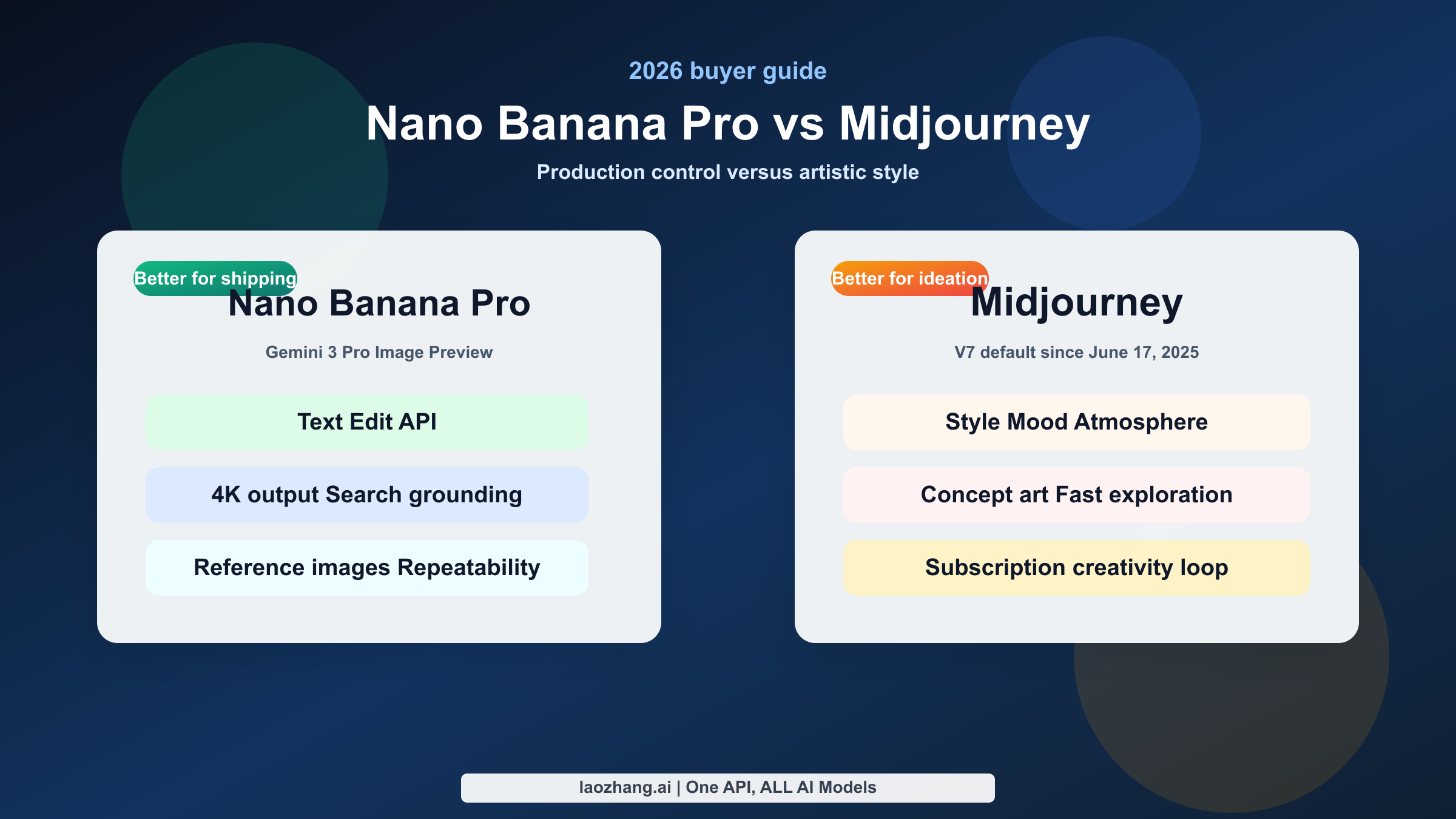
As of March 18, 2026, Nano Banana Pro is the better choice for production-grade images, readable text, editing, and API-driven workflows, while Midjourney is still the better choice for pure artistic style, visual ideation, and mood-first concept work. That is the short answer most comparison pages bury under 2,000 words of vague praise.
The harder part is that many readers are not really comparing one clean Google product to one clean Midjourney product. They are comparing a shifting Gemini image stack, where app access and API access behave differently, against a Midjourney product that now has a stronger web editor but still revolves around subscription plans rather than a default public API. If you do not separate those surfaces, the pricing and workflow comparison becomes misleading fast.
This guide fixes that. It uses current official Google and Midjourney sources, labels what is API pricing versus subscription pricing, and turns the comparison into a real buying decision for marketers, founders, and developers. If you need deeper background first, our guides to whether Nano Banana Pro is really Gemini 3 Pro Image, Nano Banana 2 vs Nano Banana Pro, and the current Midjourney API situation are good companion reads.
TL;DR
If you want one answer without the nuance, pick Nano Banana Pro when the output has to ship inside a workflow and pick Midjourney when the image itself is the creative exploration. Nano Banana Pro maps more naturally to product banners, infographic-like compositions, editable marketing assets, and API pipelines. Midjourney still wins when you want unexpected compositions, stronger taste baked into the model, and a subscription you can live inside for hours of visual exploration.
| Your priority | Better pick | Why it wins in 2026 |
|---|---|---|
| Readable text inside images | Nano Banana Pro | Google's current image docs explicitly position Gemini image models for advanced text rendering, which is still a weak spot in most Midjourney-heavy workflows. |
| Controlled editing and revisions | Nano Banana Pro | Gemini image workflows are stronger when you need reference images, grounded edits, and repeatable asset updates instead of one-shot aesthetic discovery. |
| Artistic style and mood | Midjourney | Midjourney V7 still produces the most consistently cinematic and taste-driven outputs for concept art, posters, and exploratory visual work. |
| API-first production | Nano Banana Pro | Google offers official API surfaces through AI Studio and Vertex AI, while Midjourney's latest official update still talks about investigating an Enterprise API rather than shipping a standard public one. |
| Fast creative exploration | Midjourney | Midjourney's subscription model and web-first creation flow are better when you want to keep iterating visually without thinking about per-image cost. |
| E-commerce, UI mockups, or ad creatives with copy | Nano Banana Pro | Text, layout fidelity, image editing, and 4K output matter more than painterly style in these jobs. |
| Private client work | Depends | Midjourney requires the Pro or Mega tier for Stealth Mode, while Gemini is easier to fit into API or enterprise-style workflows. The better answer depends on whether you need web privacy or server-side control. |
The biggest trap in this market is cost math. Nano Banana Pro is normally a pay-per-image decision. Midjourney is normally a subscription-and-GPU-time decision. When a comparison page tells you one is "cheaper" without saying which billing model it is talking about, it is skipping the part that actually changes the buying decision.
What "Gemini Image" Actually Means in 2026
When people search for "Gemini image vs Midjourney," they are often mixing together at least three different Google surfaces. The cheapest official API image model is Gemini 2.5 Flash Image, which Google's pricing page currently lists at $0.039 per image standard and $0.0195 in Batch for images up to 1024x1024. The higher-end model behind the current "Nano Banana Pro" branding is Gemini 3 Pro Image Preview, which Google currently prices at $0.134 for 1K or 2K output and $0.24 for 4K, with Batch output at $0.067 and $0.12 respectively. The broader Gemini app then adds another layer of confusion because users can access image generation through app plans with quota behavior that does not feel like clean API billing.
That naming confusion matters because comparison pages keep giving Midjourney one clean identity while giving Google a blurred one. If you are a consumer using the Gemini app, you are really comparing Midjourney against a quota-limited app experience with changing defaults and plan boundaries. If you are a team using Google's image-generation API docs and official pricing, you are comparing Midjourney against an API product with explicit model IDs, feature flags, and per-image economics.
Google's own product copy reinforces the split. In the March 2026 article on where to use Nano Banana Pro, Google says the model is available in the Gemini app, AI Mode in Search, NotebookLM, Workspace, Flow, Mixboard, Vertex AI, and AI Studio. The same page also says free-tier users have limits and that paid Google AI subscribers receive higher quotas. That means "Gemini image" is not one thing. It is a family of access routes with different cost, quota, and workflow implications.
The cleanest practical translation is this: if you are comparing Nano Banana Pro vs Midjourney, compare Gemini 3 Pro Image Preview plus its official access routes against Midjourney V7 plus its plan tiers and Editor. If you are comparing "Gemini image" in the broadest sense, you should still lead with Nano Banana Pro for serious work, then mention Gemini 2.5 Flash Image as the cheaper alternative when cost matters more than premium quality. For more detail on the Google side, our existing pages on Nano Banana Pro pricing and quotas and Nano Banana Pro maximum resolution go deeper.
Where Nano Banana Pro Beats Midjourney
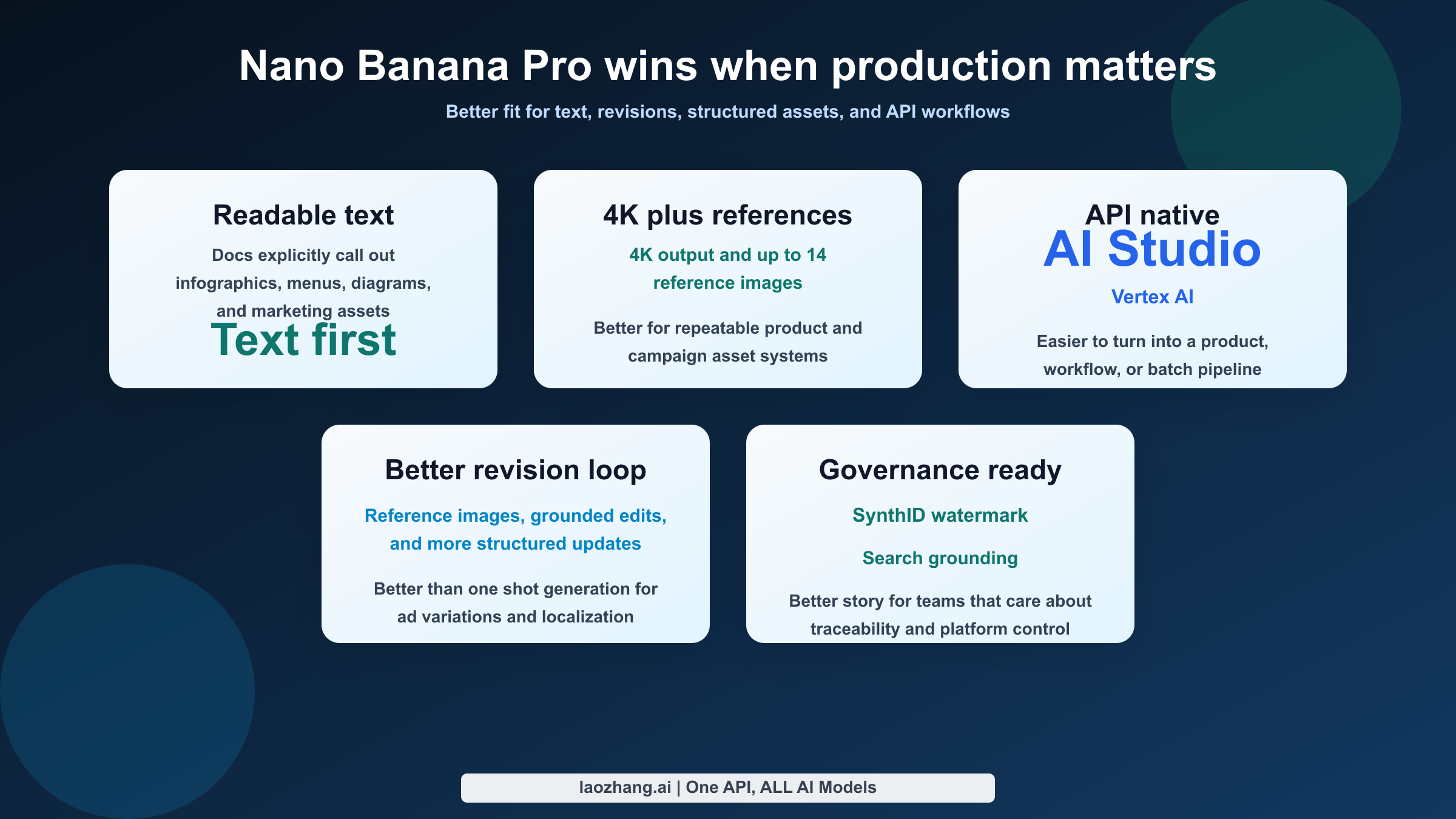
The strongest case for Nano Banana Pro is that it behaves more like a production image system than a pure visual sketchbook. Google's current documentation says Gemini image models support 1K, 2K, and 4K output, advanced text rendering, Search grounding, a default thinking process for harder compositions, and up to 14 reference images. That combination changes the jobs the model is naturally good at. Product banners, social ads with copy, in-image labels, infographic blocks, menu mockups, presentation assets, ecommerce composites, and other structured images are all closer to Nano Banana Pro's comfort zone than Midjourney's.
Text rendering is the most obvious example. Midjourney has improved prompt and image handling in V7, and the official Version page says the model now handles prompts with more precision and delivers better textures and coherence. But "better" is not the same as "reliable for text-heavy assets." The reason so many teams still treat Midjourney text as a risky last-mile problem is that the model's center of gravity is still aesthetic generation, not layout fidelity. By contrast, Google's current image docs explicitly call out advanced text rendering for infographics, menus, diagrams, and marketing assets. That is unusually direct first-party language, and it matches the kinds of jobs where Nano Banana Pro usually feels better in practice.
Editing is the second major advantage. Midjourney now has a real Editor, and it can edit both Midjourney images and users' own uploaded images with Remix, inpainting, Pan, and Zoom Out. That is a meaningful upgrade over the old "generate and pray" Midjourney workflow. But Nano Banana Pro still feels more at home in iterative asset work because the surrounding Gemini stack is built for reference images, grounded prompt changes, and more structured revisions. If a marketing team needs to keep the same hero product, update the price tag, switch the background color, and produce the same design in 3 aspect ratios, the Google route usually creates less downstream friction.
The third advantage is the API. This is the point many comparison pages underweight because it sounds technical, but it is one of the biggest reasons Gemini can replace Midjourney in actual business workflows. Google gives you official access through AI Studio and Vertex AI, while Midjourney's July 16, 2025 update still says it is "starting to investigate" an Enterprise API rather than offering a general public one. If you need image generation inside an app, a CMS pipeline, a batch marketing system, or a product workflow that runs on schedules and approvals, Nano Banana Pro is simply easier to operationalize.
The fourth advantage is higher-resolution output plus controllable cost. Google's pricing page currently lists Nano Banana Pro at $0.134 for 1K or 2K output and $0.24 for 4K, with Batch cutting those numbers to $0.067 and $0.12. That is not "cheap" in a vacuum, but it is transparent. You know what a 500-image or 5,000-image pipeline costs, and you can decide when to drop to Gemini 2.5 Flash Image at $0.039 or $0.0195 batch if the job does not deserve Pro pricing. Midjourney can be cheaper for heavy artistic exploration, but it is harder to model cleanly because the unit you buy is not a fixed image credit.
Finally, Nano Banana Pro is better when governance matters. Google's docs say all generated images include a SynthID watermark. That does not solve every provenance or compliance question, but it is a real platform-level feature. Combined with official enterprise-facing routes such as Vertex AI, it gives Nano Banana Pro a stronger story for teams that care about auditability, reproducibility, or platform governance. That matters less to a solo creator making moodboards and much more to an agency or product team shipping assets on behalf of clients.
Where Midjourney Still Beats Gemini Image
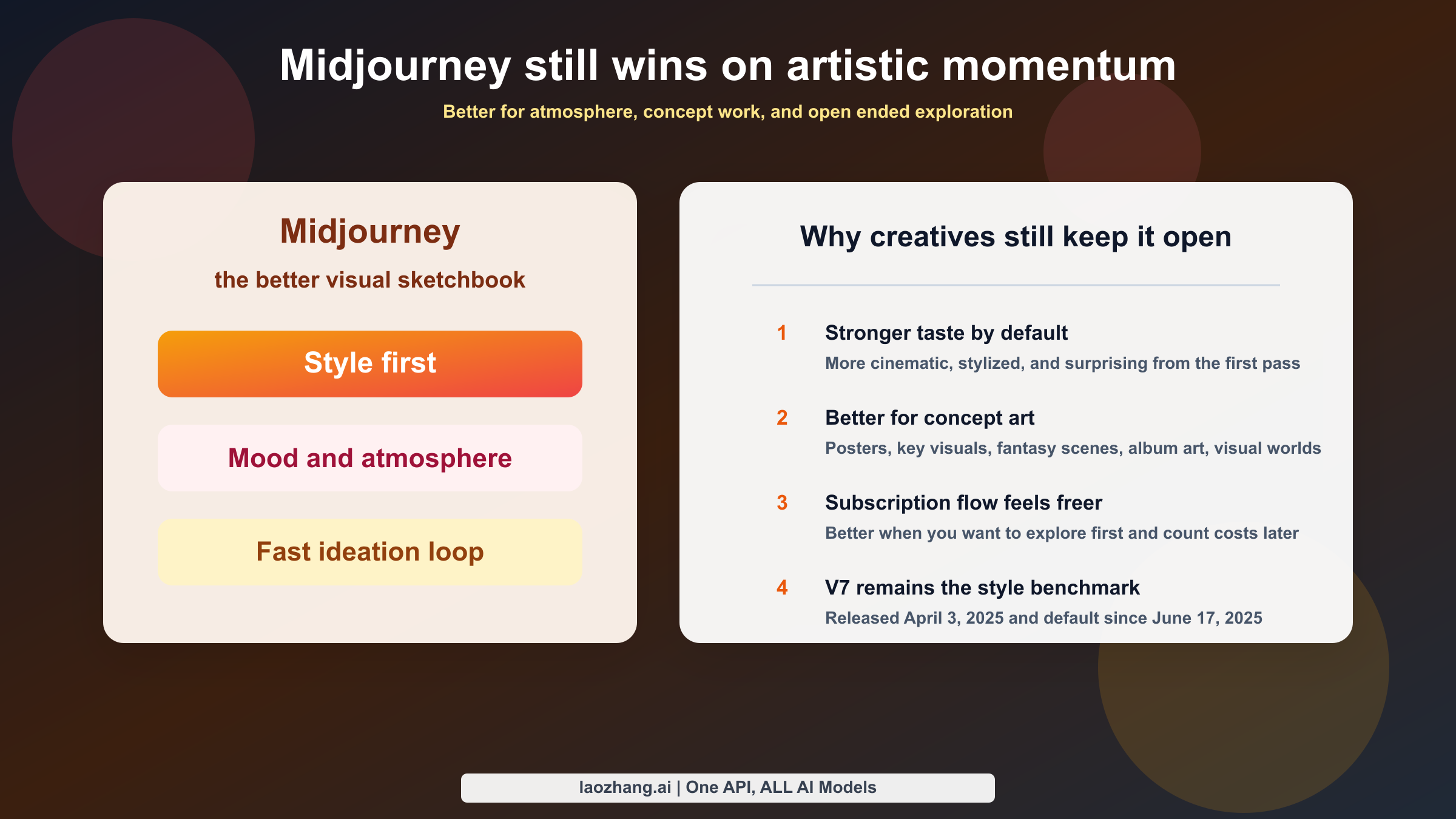
Midjourney is still the better tool when you care most about taste, atmosphere, and visual surprise. That sounds soft compared with a list of API features, but it is not a small difference. Many of the best Midjourney outputs feel pre-stylized in a good way: stronger camera language, better mood, more dramatic light, and more willingness to turn an acceptable prompt into an image that feels like a poster, key art frame, or visual concept rather than an obedient render.
This matters most in concept art, brand exploration, editorial illustration, speculative key visuals, and early creative discovery. If the job is "show me ten strong visual directions by lunch," Midjourney remains hard to beat. The model is still closer to a collaborative art director than a structured production system. You can get lucky with Nano Banana Pro in these contexts, and sometimes it will give you a cleaner, more realistic image, but Midjourney tends to generate the stronger "I want to keep looking at this" reaction.
Midjourney also wins on subscription psychology. The current official plans are $10, $30, $60, and $120 per month for Basic, Standard, Pro, and Mega. Standard and above get unlimited image generations in Relax Mode, while Pro and Mega get Stealth Mode. That means the creative user experience feels simpler once you are inside the right plan. You do not have to wonder whether this next burst of experimentation deserves $0.134, $0.24, or a batch queue. You can just keep exploring. For artists, designers, and founders doing broad visual ideation, that freedom is a genuine product advantage.
The current Midjourney flow is also more coherent than many Gemini-first users assume. V7 was released on April 3, 2025 and became the default on June 17, 2025. The model page says V7 improves prompt precision, textures, and coherence, and the web experience is much better than the old Discord-only stereotype. The Editor means Midjourney is no longer stuck as a pure first-pass generator. It still is not an API-first tool, but it is now a more complete creative workspace than the older comparisons suggest.
Privacy can also tilt toward Midjourney in specific cases, but only if you pay for it. Stealth Mode is available only on the Pro and Mega plans. If your team primarily works inside Midjourney's own environment and needs private image creation rather than server-side API control, that can be enough. The point is not that Midjourney is "more private" than Gemini across the board. The point is that privacy means different things in these two ecosystems. Midjourney sells private usage inside its creative environment. Google sells API and enterprise routes that can be integrated into broader systems. The better answer depends on which kind of control you need.
There is also a softer but still important advantage: community gravity. Midjourney prompts, styles, references, and visual expectations are already embedded in creative communities. If a team knows exactly what "Midjourney quality" means and has existing references, style boards, and internal prompt habits built around it, there is switching cost. Gemini may be better for the job on paper, but tools win partly by fitting the habits people already have.
Pricing, Privacy, and Workflow Math
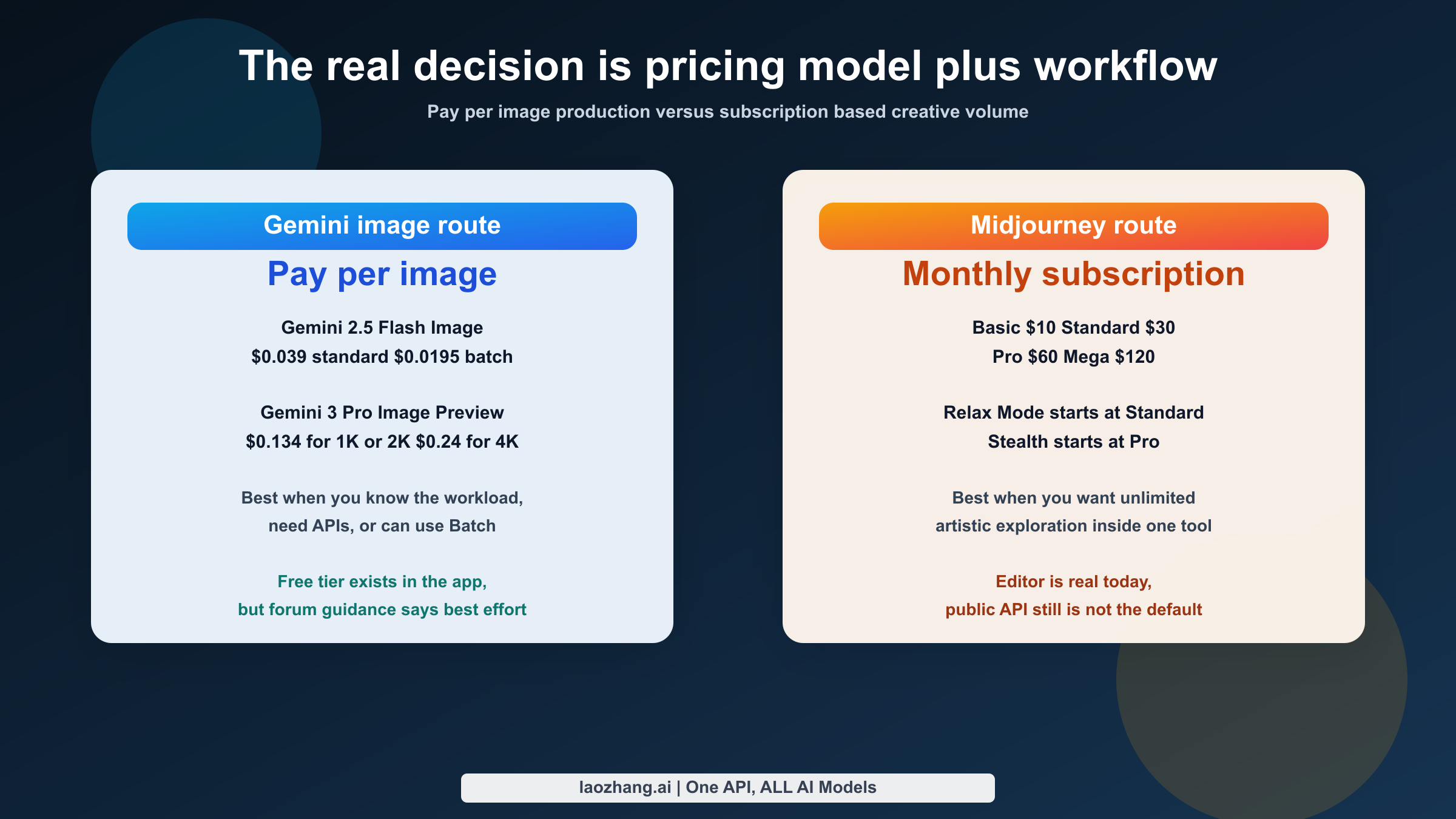
This is where most comparison pages become careless. They compare Midjourney's monthly plans with Google's per-image pricing and then declare a winner without explaining that the usage model itself is different. A better comparison is to ask which pricing logic fits your workflow.
| Metric | Nano Banana Pro / Gemini image stack | Midjourney |
|---|---|---|
| Primary billing model | Pay per image through official APIs or quota-based app usage | Monthly subscription plans |
| Lowest officially listed entry point | Gemini 2.5 Flash Image at $0.039 standard or $0.0195 batch | Basic plan at $10/month |
| Higher-end premium image pricing | Gemini 3 Pro Image Preview at $0.134 for 1K/2K and $0.24 for 4K | Pro plan at $60/month, Mega at $120/month |
| Batch economics | 50% discount on listed Batch prices | No equivalent pay-per-image batch pricing model |
| Best for | Predictable production workloads and API jobs | Open-ended artistic exploration inside a subscription |
| Private workflow story | Better fit for AI Studio, Vertex AI, and system integration | Stealth Mode starts at Pro |
| Free access story | App free tier exists but Google forum guidance makes clear free-tier availability is best effort and unstable | No true free plan; you subscribe when you want sustained use |
| Editing | Gemini image stack plus reference-based workflows | Midjourney Editor supports edits to Midjourney and personal images |
Now translate that into real operating choices. If you run a product or marketing team and you know you need 100, 500, or 2,000 images of a similar type each month, Gemini's pay-per-image model is easier to budget. You can estimate how much of that work deserves Pro pricing, how much can fall to 2.5 Flash Image, and how much can be moved to Batch for a 50% cut. That is not just a finance win. It is a planning win.
Midjourney is better when the output count is fuzzy but the exploration time is high. If a designer might generate 50 images one day, 300 another day, then throw most of them away while searching for mood, a fixed plan is mentally easier. The plan may or may not be cheaper in a strict spreadsheet sense, but the user experience feels cheaper because experimentation is not metered the same way.
Privacy changes the choice again. If your concern is "I do not want this client work visible in a public creative feed," Midjourney's answer is Stealth Mode on the Pro or Mega tier. If your concern is "I need this generation route to live inside a product or controlled server-side workflow," Gemini's official API access is more aligned with the job. These are different privacy problems, and the article should not pretend they are interchangeable.
There is also a reliability caveat on the Google side. An official Google forum thread from late 2025 says free-tier availability should be treated as best effort and unstable because capacity was being focused on high-demand models such as Gemini 3 Pro and Nano Banana Pro. That does not mean Gemini is unreliable overall. It means you should not build a serious comparison around the assumption that Google's free app access is a stable long-term replacement for paid tools.
Best Choice by Use Case
Once you stop looking for one universal winner, the decision becomes much simpler. The best choice depends on whether the job is mostly about taste, control, or systems fit.
| User or team | Better default | Why | When to override |
|---|---|---|---|
| Concept artist or creative director | Midjourney | Best mood, strongest style bias, easiest open-ended exploration | Override to Nano Banana Pro if the work needs legible text, brand-safe layouts, or structured revisions |
| Performance marketer | Nano Banana Pro | Better for text-heavy assets, product composites, and repeatable ad variations | Override to Midjourney for one-off hero visuals where style matters more than editability |
| E-commerce team | Nano Banana Pro | Better fit for controlled product shots, editable backgrounds, and API-driven bulk workflows | Override to Midjourney only for lifestyle or campaign imagery where art direction matters more than consistency |
| Solo founder making launch visuals | Depends | Midjourney is simpler for creative discovery; Gemini is better once the visual system starts repeating | Choose Midjourney first if you are still exploring, Gemini first if you already know the asset template |
| Developer building image features | Nano Banana Pro | Official API routes and clearer unit economics make it easier to ship | Override to Midjourney only if the product is a Midjourney-adjacent creative experience rather than a backend image service |
| Agency with private client work | Depends | Gemini is stronger for API control; Midjourney Pro or Mega can work if the team lives inside Midjourney's environment | The decision turns on workflow integration versus in-tool privacy |
For most businesses, the pattern is straightforward. Use Midjourney to explore, discover, and overperform visually when the image itself is the product. Use Nano Banana Pro to produce, revise, and scale once the image has to fit a repeatable workflow. That may sound like a split decision, but in practice it is exactly the answer buyers need.
If you are trying to choose one tool only, ask a harder question than "which model looks better?" Ask which tool you would rather use on the 40th asset, not the first. Midjourney often wins the first image. Nano Banana Pro more often wins the tenth, hundredth, or localized version of that image.
FAQ
Is Nano Banana Pro better than Midjourney overall?
Not overall. Nano Banana Pro is better for production workflows, text, editing, structured asset generation, and API use. Midjourney is better for artistic style, mood, concept exploration, and subscription-based visual ideation.
Is Gemini image the same as Nano Banana Pro?
Not exactly. "Gemini image" is a broad phrase covering multiple Google image surfaces. In this article, Nano Banana Pro refers to the higher-end Gemini image route mapped to Gemini 3 Pro Image Preview, while Gemini 2.5 Flash Image is the cheaper lower-cost option in the same broader family.
Which one is cheaper in 2026?
The honest answer is that they are cheaper in different ways. Midjourney can feel cheaper for heavy artistic exploration because you are paying for a monthly plan, not a fixed per-image meter. Gemini can be cheaper for production jobs because the pay-per-image model is explicit, Batch pricing cuts official rates by 50%, and you can step down to cheaper Google image models when Pro quality is unnecessary.
Which one is better for text in images?
Nano Banana Pro. Google's current docs explicitly position Gemini image models for advanced text rendering. Midjourney V7 is better than earlier versions, but it is still not the first choice for copy-heavy ads, UI mockups, menus, or infographic-style assets.
Can Midjourney replace an image API?
Not cleanly today. Midjourney's official July 2025 update says it was investigating an Enterprise API, but the product still is not sold like a default public image API. If your workflow depends on programmatic access, Gemini image routes are the safer official choice.
Which one is better for privacy?
It depends on the privacy problem. Midjourney Pro and Mega offer Stealth Mode for private usage inside Midjourney's environment. Gemini is easier to place inside AI Studio, Vertex AI, or other system-level workflows where server-side control matters more than a private creative feed.
Bottom Line
If you strip away the branding noise, the 2026 decision is simple. Nano Banana Pro is the better system for image work that has to survive editing, localization, text, governance, and API integration. Midjourney is the better system for image work that starts with taste, direction, and visual experimentation.
That is why the strongest recommendation is conditional rather than absolute. Creative teams often should not replace Midjourney at the top of the funnel. They should pair it with a Gemini image workflow that takes over once the image becomes an asset rather than an idea. But if you are choosing only one stack for serious business use, Nano Banana Pro is the safer default because it fails less often in the boring but expensive parts of production.
The best one-line rule is this: choose Midjourney when you want to discover the look, and choose Nano Banana Pro when you need to ship the asset.