
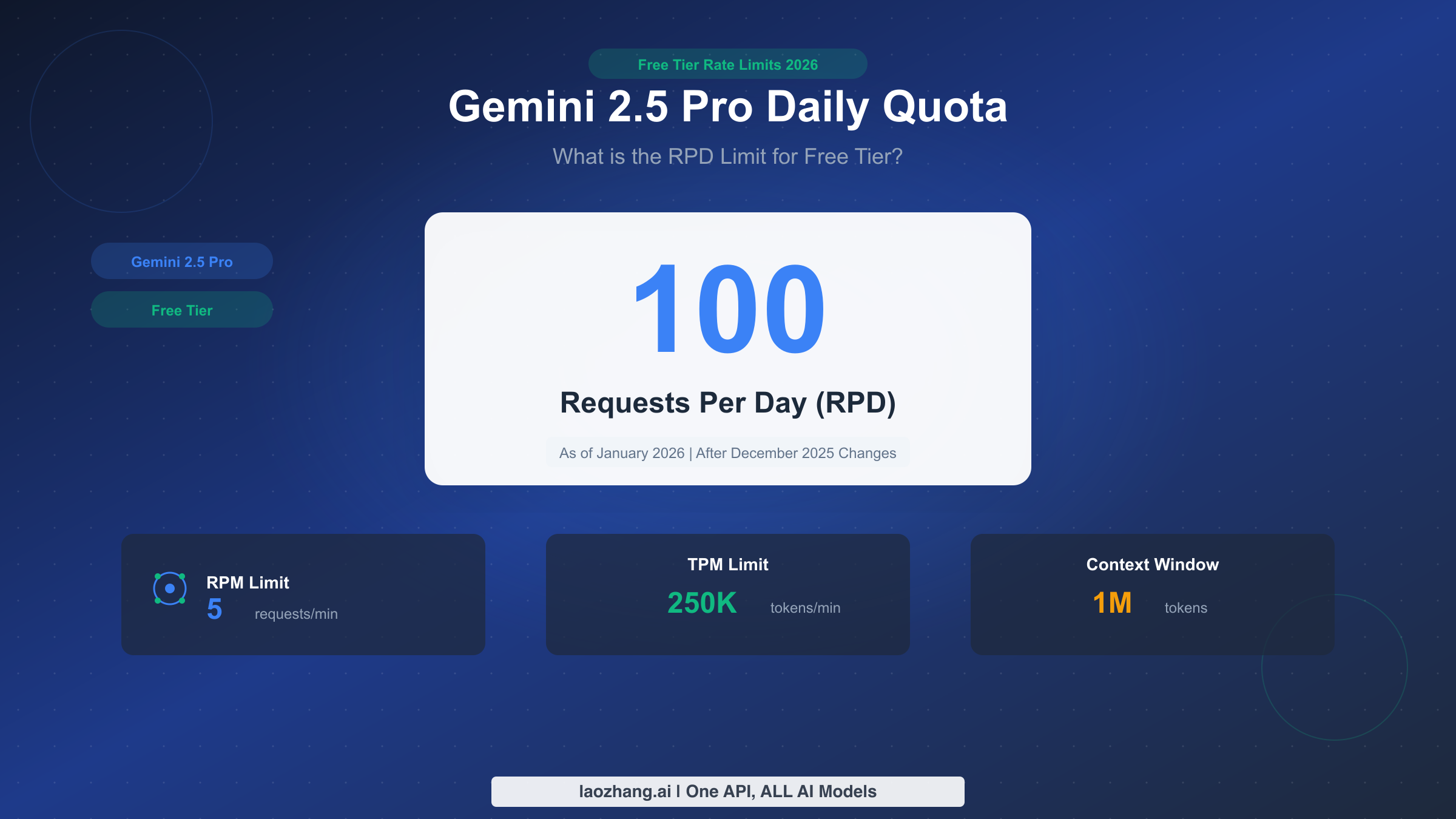
Gemini 2.5 Pro free tier allows 100 requests per day (RPD) as of January 2026. This limit, reduced significantly in December 2025, represents the maximum number of API calls you can make to the Gemini 2.5 Pro model within a 24-hour period without incurring charges. Understanding this limit and how it interacts with other rate constraints determines whether free tier access meets your project needs or whether upgrading makes sense for your situation.
TL;DR
The daily quota for Gemini 2.5 Pro free tier is 100 RPD (requests per day), resetting at midnight Pacific Time. This represents an 80% reduction from pre-December 2025 limits. You also face 5 RPM (requests per minute) and 250,000 TPM (tokens per minute) constraints. Flash models offer significantly higher quotas (500-1,000 RPD) if you need more daily requests. Upgrading to Tier 1 by enabling billing instantly increases your limit to 1,000 RPD with pay-as-you-go pricing.
Understanding Gemini 2.5 Pro's 100 RPD Limit
The 100 requests per day limit on Gemini 2.5 Pro free tier means exactly what it states: you can send up to 100 API calls to this model every 24 hours before receiving 429 rate limit errors. This quota applies at the project level rather than per API key, so creating additional keys within the same Google Cloud project does not multiply your available requests.
What RPD Means in Practical Terms
To understand whether 100 RPD suits your needs, consider how many API calls different use cases typically require. A single coding assistance session where you iteratively refine code might consume 5-15 requests depending on complexity. A document analysis task involving back-and-forth clarifications could use 3-8 requests. A chatbot interaction typically counts as one request per user message, though streaming responses count the same as non-streaming.
For context, 100 daily requests translates to roughly 10-15 substantive coding sessions, approximately 50 short conversational exchanges, or around 20 document analysis tasks with follow-up questions. If you're building a personal assistant tool that you use throughout the workday, you'll likely exhaust this quota by early afternoon with moderate usage. Projects involving batch processing or automated workflows hit this limit almost immediately.
The quota resets at midnight Pacific Time (PT), not based on when you started using the API. This reset timing matters for planning your usage patterns. If you're in a timezone where midnight PT falls during your working hours, you might strategically save complex tasks for after the reset to maximize effective daily capacity.
Practical Scenarios
Consider a developer building a code review tool. Each code snippet review might require 2-3 API calls for initial analysis, suggestions, and clarification. With 100 RPD, this developer can review approximately 30-50 code snippets daily before hitting limits. For personal project development, this capacity often suffices. For a team tool serving multiple users, it becomes inadequate within minutes of active use.
A content creator using Gemini 2.5 Pro for writing assistance faces similar constraints. Drafting a single blog post might consume 10-20 requests through ideation, outlining, drafting sections, and revision suggestions. Creating one substantial piece of content daily remains feasible, but producing multiple articles or supporting a content team requires paid tier access.
Complete Rate Limits Breakdown
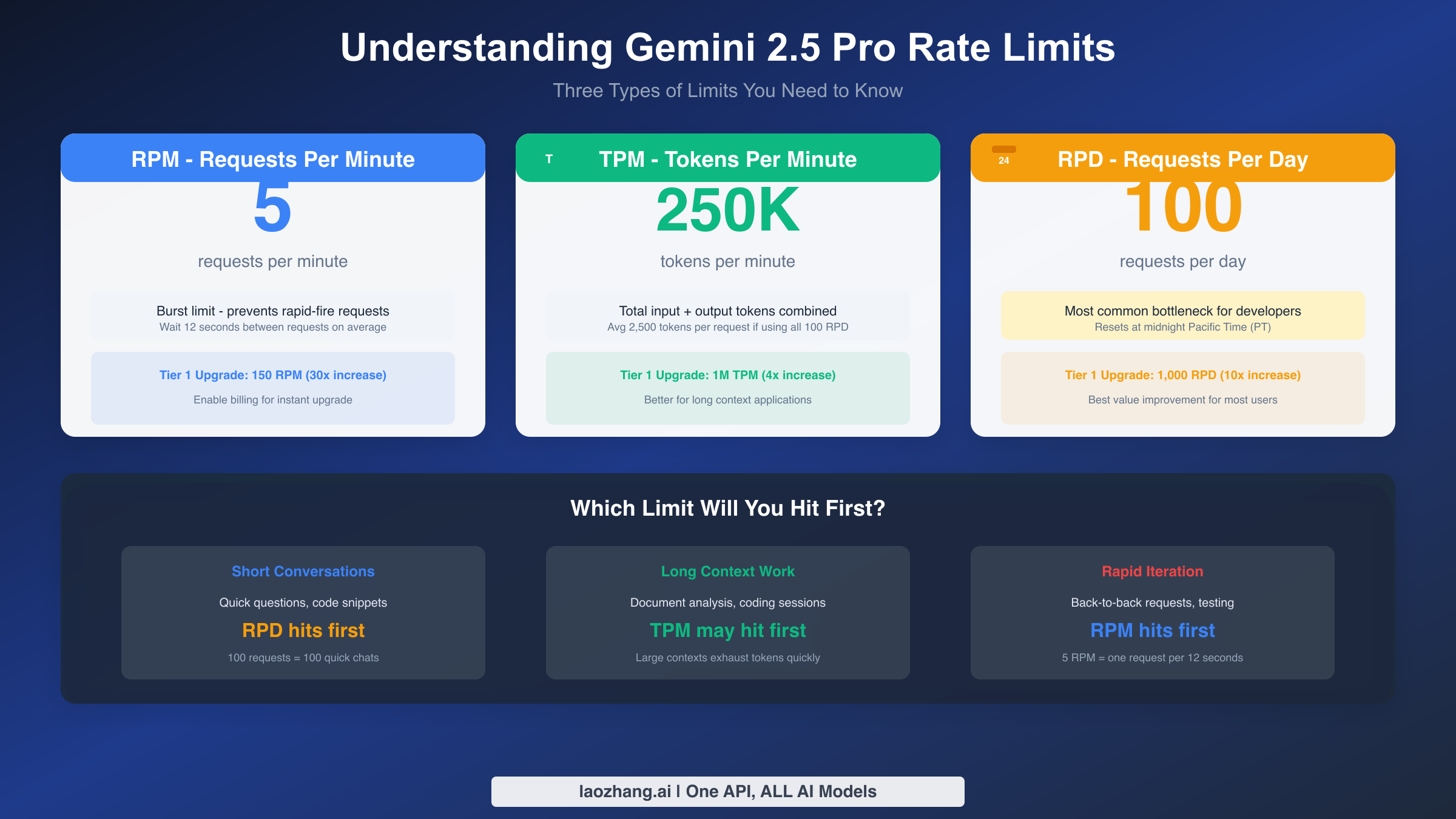
Understanding how RPD interacts with the other rate limits helps you predict which constraint you'll encounter first and plan accordingly. Gemini 2.5 Pro free tier imposes three distinct rate limits that operate independently.
All Three Limits Explained
RPM (Requests Per Minute): 5 - This burst limit prevents rapid-fire requests. With only 5 requests allowed per minute, you must wait at least 12 seconds between consecutive calls on average. This constraint primarily affects interactive applications where users might send multiple messages quickly and batch processing scripts that attempt to parallelize requests.
TPM (Tokens Per Minute): 250,000 - This limit caps the total tokens (input plus output) processed within any 60-second window. The 250,000 TPM allocation allows approximately 2,500 tokens per request if you're making all 100 daily requests. However, if you're using Gemini's 1 million token context window for large document analysis, a single request could consume a significant portion of your minute-level token budget.
RPD (Requests Per Day): 100 - As the daily quota, this limit typically becomes the binding constraint for most developers. While RPM and TPM limits affect moment-to-moment throughput, RPD determines your total daily capacity regardless of how carefully you spread your requests.
Which Limit Hits First?
The limit you encounter depends on your usage pattern. For short conversational interactions with quick questions and answers, you'll typically exhaust RPD long before approaching TPM limits. Each exchange might use only 500-1,000 tokens but counts as one full request against your daily quota.
Long-context work presents different dynamics. When analyzing large documents or maintaining extensive conversation history, TPM constraints become more relevant. A single request with 50,000 input tokens and 10,000 output tokens consumes 60,000 of your 250,000 minute-level token budget. Four such requests within one minute would exceed TPM limits even though you're well within RPM allowance.
Rapid iteration during development often triggers RPM limits. If you're testing prompts and making adjustments, the 5 RPM cap means you can only test 5 variations per minute. For serious prompt engineering work, this pace feels restrictively slow. For understanding how these limits work across different scenarios, our rate limit concepts guide provides deeper technical context.
Comparing Gemini Models Free Tier Limits
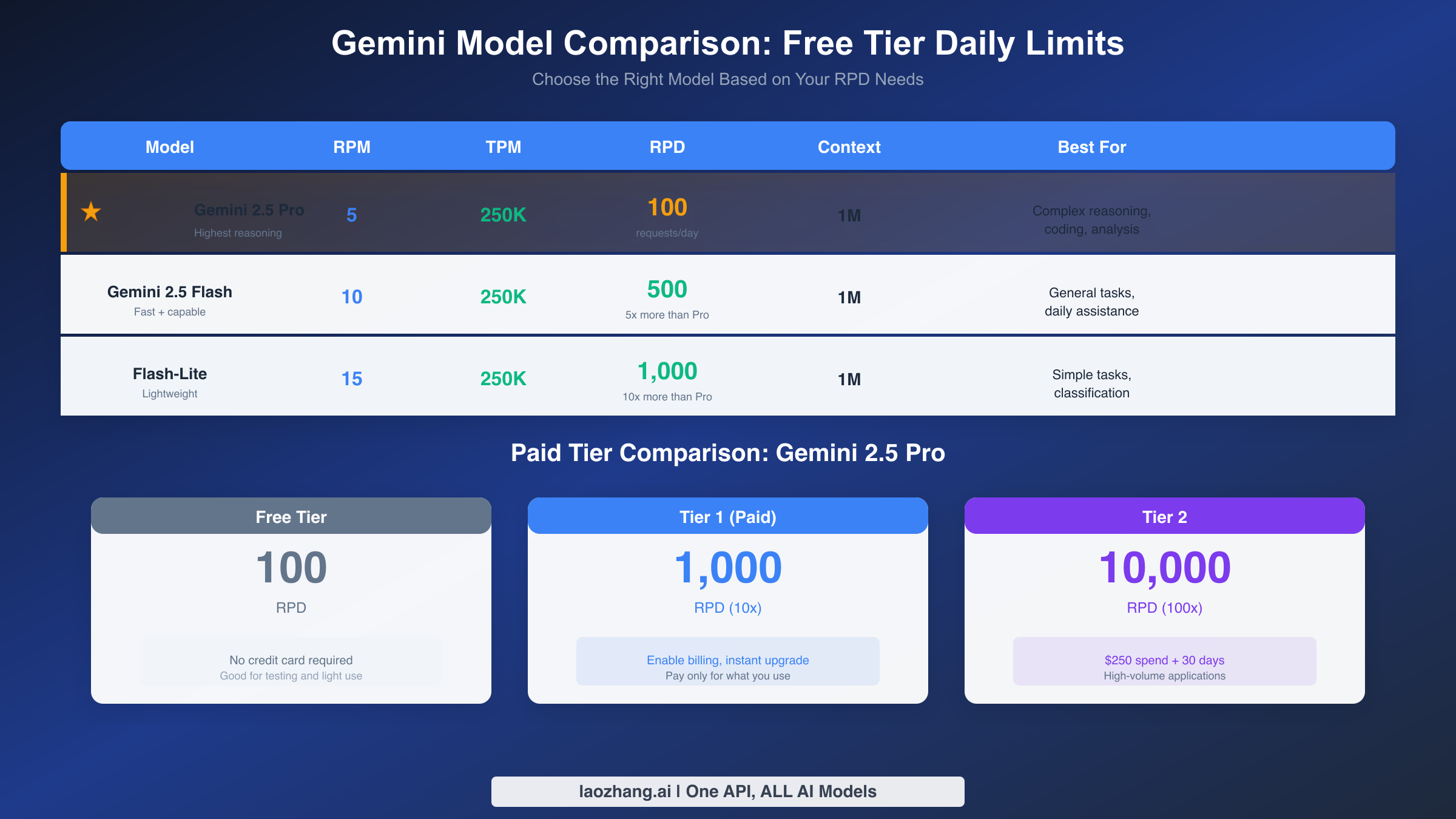
Choosing between Gemini models involves balancing capability against available quota. While Gemini 2.5 Pro offers the highest reasoning quality, its 100 RPD free tier limit is the most restrictive among current Gemini models.
Model-by-Model Comparison
| Model | RPM | TPM | RPD | Context | Best For |
|---|---|---|---|---|---|
| Gemini 2.5 Pro | 5 | 250K | 100 | 1M | Complex reasoning, coding |
| Gemini 2.5 Flash | 10 | 250K | 500 | 1M | General tasks, daily use |
| Gemini 2.5 Flash-Lite | 15 | 250K | 1,000 | 1M | Simple tasks, classification |
The difference in daily quotas is substantial. Flash offers 5x the daily requests compared to Pro, while Flash-Lite provides 10x. Both Flash variants also offer higher RPM limits, allowing faster burst usage during interactive sessions.
When to Use Each Model
Reserve Gemini 2.5 Pro requests for tasks where its superior reasoning capability genuinely matters: complex multi-step coding problems, nuanced analysis requiring deep understanding, and situations where output quality directly impacts outcomes. For everything else, Flash models provide excellent results with far more generous quotas.
Implementing a model routing strategy extends your effective capacity significantly. Simple classification tasks, straightforward Q&A, and routine content generation work well with Flash-Lite, consuming from your 1,000 RPD quota instead of the precious 100 Pro requests. This approach lets you handle 10x more daily interactions while preserving Pro access for genuinely complex tasks.
Many developers report that Gemini CLI automatically falls back to Flash when Pro quota is exhausted, demonstrating that Flash handles most tasks competently. "Usually 100 requests is enough for a day of work," as one Hacker News commenter noted, "and when the switch happens, Flash is surprisingly effective." For comprehensive comparison across all models, see our complete free tier rate limits guide.
December 2025 Changes Impact
The current 100 RPD limit represents a significant reduction from earlier quotas, implemented during a broader rate limit adjustment in December 2025. Understanding what changed provides context for the current constraints.
Before and After
Prior to December 6-7, 2025, Gemini 2.5 Pro free tier reportedly allowed approximately 500 requests per day. The December changes reduced this by 80% to the current 100 RPD limit. This wasn't an isolated adjustment; Google reduced quotas across most free tier models during the same period, with some models seeing even more dramatic cuts.
Google attributed these changes to "capacity and demand management," reallocating resources as they launched newer models and experienced increased API adoption. The changes weren't widely announced in advance, catching many developers off guard. Projects that had been running smoothly suddenly began hitting rate limits, prompting a wave of frustrated forum posts and GitHub issues.
The timing coincided with increasing focus on monetization as Gemini API matured. Free tier access remains available but with constraints that push serious usage toward paid tiers. For developers who were relying on higher free quotas for production workloads, the December changes forced difficult decisions about upgrading or restructuring applications.
Some developers reported that Gemini 2.5 Pro disappeared entirely from their free tier access for certain accounts, effectively reducing their Pro quota to zero. The inconsistent rollout across accounts added to confusion, with some users retaining access while others found Pro unavailable without billing enabled.
What to Do When You Hit the Limit
Encountering a 429 rate limit error mid-project is frustrating, but several strategies can help you continue working productively.
Immediate Options
Switch to Flash models: The most practical immediate workaround is redirecting requests to Gemini 2.5 Flash, which offers 500 RPD—five times your Pro quota. For many tasks, Flash provides comparable results. Update your model parameter from gemini-2.5-pro to gemini-2.5-flash and continue working. Most applications can handle this fallback gracefully with minimal code changes.
Wait for quota reset: If you specifically need Pro capabilities and have exhausted your daily allocation, the quota resets at midnight Pacific Time. Calculate when this falls in your timezone and plan critical Pro-dependent work for after the reset. This approach requires patience but costs nothing.
Check your actual usage: Before assuming you've hit RPD limits, verify which limit triggered the error. The 429 response includes a quota_limit field indicating whether RPM, TPM, or RPD caused the rejection. You might be hitting RPM limits from too-rapid requests rather than truly exhausting daily quota, in which case simply spacing requests further apart solves the problem.
Long-term Solutions
Implement intelligent caching: Many API calls repeat similar queries. Caching responses for common questions eliminates redundant requests. Even a simple 15-minute cache on frequently-asked content can reduce actual API usage by 30-50% in interactive applications.
Batch operations strategically: If your workflow involves processing multiple items, batch them into single requests where possible. Instead of sending three separate questions, combine them into one prompt with clear delineation. This approach trades token usage for request count, often favorably given that TPM limits are relatively generous compared to RPD.
Route intelligently by complexity: Build logic that evaluates request complexity before choosing which model handles it. Simple tasks go to Flash-Lite, moderate tasks to Flash, and only genuinely complex work uses Pro. This routing maximizes the value extracted from your limited Pro quota.
For applications requiring consistent access beyond free tier constraints, third-party API aggregators like laozhang.ai provide unified access to multiple AI providers, potentially distributing load across different quota pools while maintaining consistent interfaces.
When to Upgrade to Paid Tier
Free tier constraints, while workable for testing and light personal use, become limiting quickly for serious development. Understanding when upgrading makes economic sense helps you make the right decision for your situation.
Decision Criteria
Frequency of hitting limits: If you encounter rate limit errors more than 2-3 times per week during normal work, free tier probably doesn't match your usage patterns. The productivity loss from interrupted workflows often exceeds the minimal cost of paid access.
Project requirements: Applications serving multiple users or running automated processes exhaust 100 daily requests almost instantly. Even a small team of 5 developers sharing one project's free quota means each person gets effectively 20 requests per day—completely inadequate for active development.
Reliability needs: Free tier quotas can change without notice, as December 2025 demonstrated. If your project depends on consistent API access, paid tiers provide more stability and contractual assurances that free tier lacks.
Cost Analysis
Tier 1 access requires only enabling billing—there's no minimum spend or subscription fee. You pay per token used, with Gemini 2.5 Pro costing significantly less than comparable models from other providers. Light usage patterns where you're currently hitting 100 RPD limits might cost $1-5 monthly at pay-as-you-go rates, far less than the productivity value of uninterrupted access.
The upgrade provides immediate benefits beyond just increased RPD. Tier 1 offers 1,000 RPD (10x improvement), 150 RPM (30x improvement), and 1 million TPM (4x improvement). For detailed pricing and upgrade process, our pricing guide covers all tiers and models.
Upgrade Process
Upgrading to Tier 1 involves enabling billing on your Google Cloud project. Navigate to Google AI Studio, access your project settings, and link a billing account. The upgrade takes effect immediately upon successful payment method verification. Google may require a small prepayment that credits to your account for future usage.
After upgrading, verify your new limits in AI Studio's usage dashboard. Some developers report needing to switch model identifiers from experimental free-tier variants (like gemini-2.5-pro-exp-03-25) to paid variants (gemini-2.5-pro-preview-03-25) to fully access upgraded quotas. If limits don't appear to change after billing is enabled, check that you're using the correct model identifier.
For organizations needing even higher limits, Tier 2 requires $250 cumulative Google Cloud spending plus 30 days since first payment, providing 10,000 RPD. Enterprise arrangements can negotiate custom limits beyond published tiers. Our complete tier upgrade guide details requirements and processes for each tier level.
Conclusion
Gemini 2.5 Pro free tier provides 100 requests per day, sufficient for testing, learning, and light personal use but constraining for serious development work. The December 2025 quota reductions make strategic usage essential for maximizing free tier value.
Key takeaways for working within free tier limits include reserving Pro requests for genuinely complex tasks while routing simpler work to Flash models with their 5-10x higher quotas. Understanding that RPD resets at midnight Pacific Time helps you plan around the daily limit, and implementing caching and intelligent routing extends effective capacity significantly.
When free tier no longer meets your needs, Tier 1 upgrade provides 10x the daily quota with pay-as-you-go pricing and no minimum commitment. For most developers hitting the 100 RPD ceiling regularly, the minimal cost of paid access delivers substantial productivity improvements.
Your next step depends on your current situation. If you're consistently hitting limits, enable billing through Google AI Studio for immediate Tier 1 access. If you're working within constraints, implement model routing to make your 100 Pro requests last longer. Either way, understanding these limits helps you build effective applications with Gemini's capable models.