
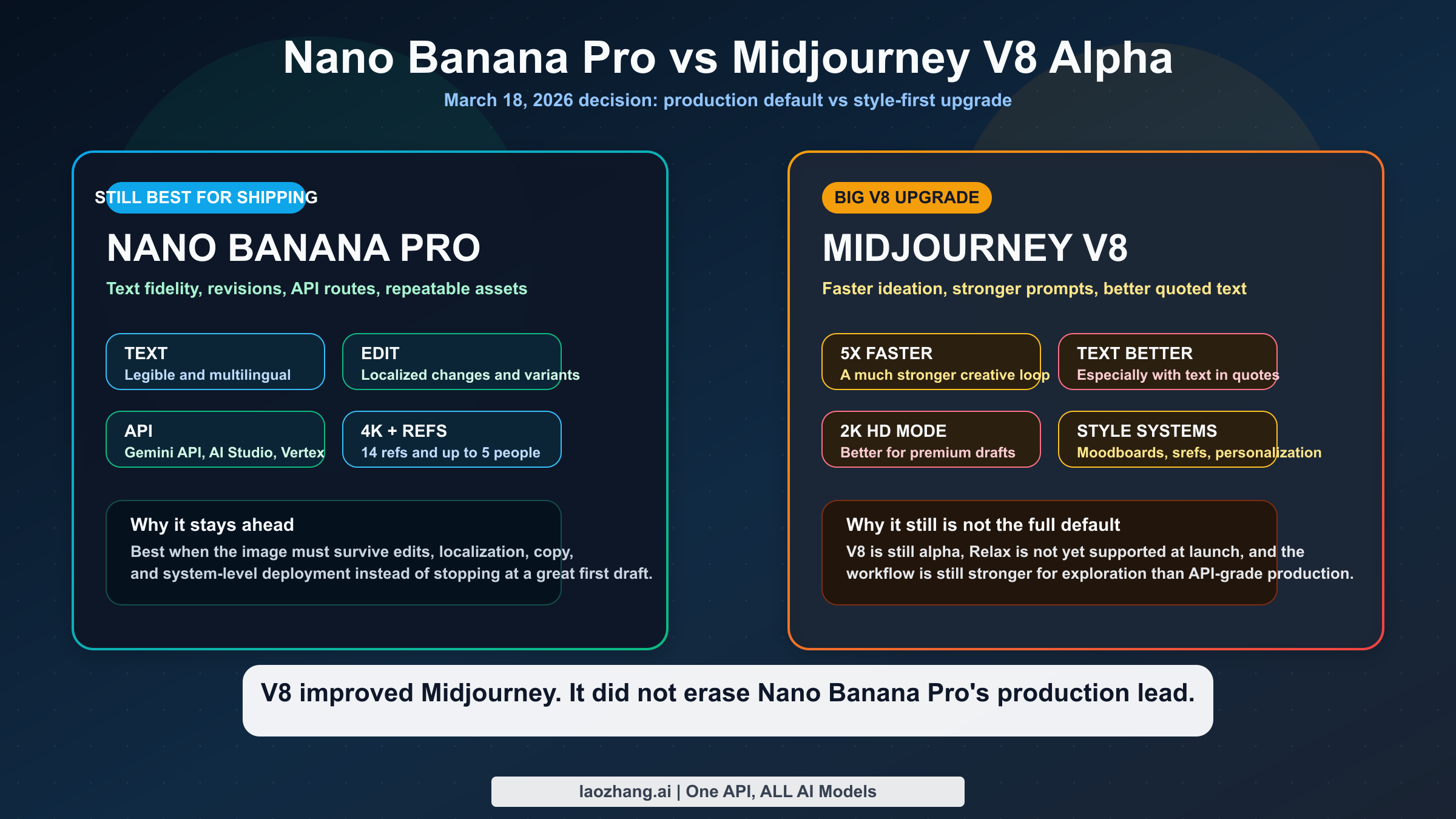
As of March 18, 2026, Midjourney V8 Alpha makes Midjourney more competitive on speed, prompt following, and in-image text, but Nano Banana Pro is still the safer default for controlled editing, multilingual text-heavy assets, and API-grade production workflows. That is the answer most pages still fail to give cleanly because they either pretend V8 changes everything or keep comparing Nano Banana Pro to old V7 assumptions.
The key nuance is the status. Midjourney officially announced V8 Alpha on March 17, 2026, not a finished V8 general release. In that post, Midjourney says V8 is roughly 5x faster, works better with detailed directions, improves text rendering when text is specified in quotes, and adds a native 2K --hd mode. Those are real upgrades. But the same post also says Relax is not yet supported at launch and that several premium V8 options currently cost 4x. That means the buyer question in 2026 is not just "Is V8 better?" It is "Is V8 better enough, and stable enough, to replace Nano Banana Pro for the kind of work I actually ship?"
This guide answers that with current official sources from Midjourney and Google, dated where the claims are volatile. If you want the broader non-V8 comparison first, see our main Nano Banana Pro vs Midjourney 2026 guide. If you need naming clarity on the Google side, Is Nano Banana Pro really Gemini 3 Pro Image? covers that background.
TL;DR
Midjourney V8 Alpha absolutely improves the Midjourney side of this comparison. It narrows the old speed gap, narrows the old text gap, and makes Midjourney a more serious option for structured prompting than many 2025 articles suggest. But it still does not turn Midjourney into the same kind of product as Nano Banana Pro. Google's side remains stronger when your image work has to survive editing, localization, brand consistency, automation, or repeated production cycles.
| Your priority | Better pick on March 18, 2026 | Why |
|---|---|---|
| Artistic exploration and mood-first concept work | Midjourney V8 Alpha | V8 keeps Midjourney's style advantage and adds faster iteration, stronger prompt following, and better text than earlier Midjourney versions. |
| Readable text inside the final asset | Nano Banana Pro | Google explicitly positions Nano Banana Pro as the best model for legible text in multiple languages, which is a stronger promise than Midjourney's improved quoted-text claim. |
| Controlled editing and asset revisions | Nano Banana Pro | Nano Banana Pro still fits reference-image and localized editing workflows better than Midjourney's editor-first creative environment. |
| Production API workflows | Nano Banana Pro | Google offers official API and Vertex AI routes. The latest first-party Midjourney API signal I could verify is still its July 16, 2025 Enterprise API investigation post. |
| Subscription-style visual exploration | Midjourney V8 Alpha | If you want to stay in one creative environment and generate heavily inside a monthly plan, Midjourney remains simpler psychologically. |
| Ecommerce, slides, posters, and ad creatives with copy | Nano Banana Pro | Text, structure, multilingual output, and controlled revisions matter more here than raw style bias. |
| Private client work inside Midjourney itself | Depends | Midjourney is open by default; Stealth starts at Pro. Google is stronger for system-level control, but the better answer depends on whether your privacy problem is web visibility or backend governance. |
The short version is this: Midjourney V8 Alpha is better than older Midjourney comparison pages suggest, but Nano Banana Pro is still better for work that has to become a repeatable asset instead of a beautiful first draft.
What Midjourney V8 Alpha Changes and What It Does Not
The most important update is simple: the query itself is now legitimate. Midjourney V8 is no longer rumor, leaked benchmark chatter, or a rating-party placeholder. Midjourney's own March 17, 2026 V8 Alpha post says the company is letting the community test an early version of the model on alpha.midjourney.com. That matters because a lot of 2026 comparison content still reads as if Midjourney is frozen at V7.
According to Midjourney's post, V8 Alpha is much better at following detailed directions, keeps the company's personalization and style-reference strengths, improves text rendering when text is given in quotes, and is roughly five times faster than before. The same post says V8 launches with multiple aspect ratios, --raw, --chaos, --weird, and a new native 2K --hd mode. Those are not small updates. If you dismissed Midjourney in late 2025 because it felt slower, harder to control, and too loose with detailed prompts, V8 Alpha makes that dismissal less defensible.
But V8 Alpha also arrives with limits that many blog posts hide. Midjourney explicitly says Relax is not supported at launch and that --hd, --q 4, style-reference jobs, and moodboard jobs are currently four times slower and cost four times more. In other words, the Midjourney side of the ledger improved, but some of the value assumptions around unlimited relaxed exploration and simple plan economics are temporarily less clean in Alpha.
That is why the article should not frame this as "Nano Banana Pro versus finished Midjourney V8." It is not. It is Nano Banana Pro versus Midjourney V8 Alpha on March 18, 2026. The stronger recommendation still has to account for product maturity, billing friction, and workflow fit.
There is another important distinction. Midjourney V8 Alpha improves Midjourney as Midjourney. It does not automatically turn Midjourney into a production API stack, a localization engine, or a safer platform for text-heavy marketing assets just because quoted text is better than before. That is the exact leap too many comparison pages make.
Where Nano Banana Pro Still Leads in 2026
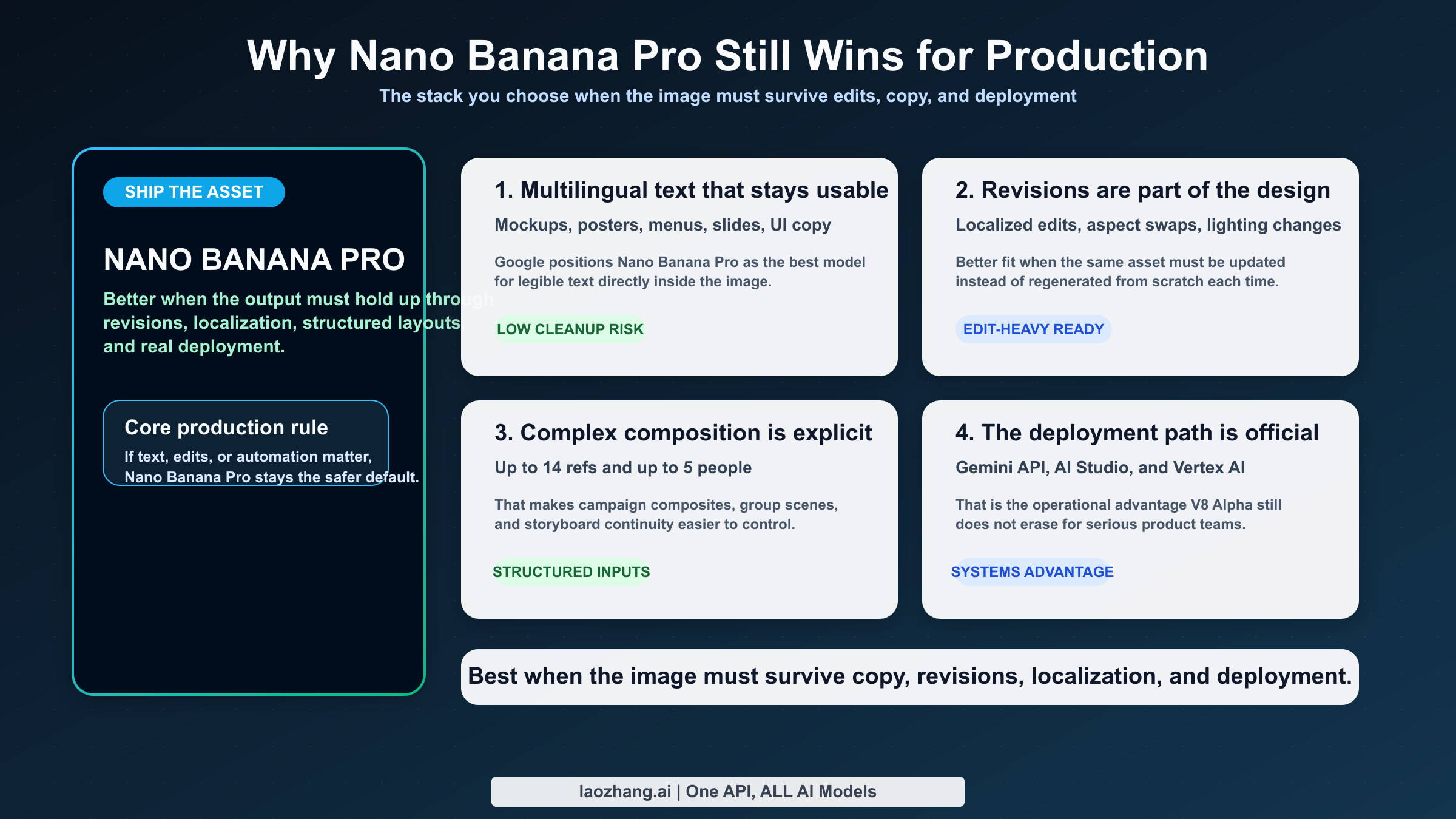
Nano Banana Pro still wins where image generation has to behave like design infrastructure instead of a creative sketchbook. Google's own Nano Banana Pro announcement is unusually explicit about this positioning. Google says the model is best for legible text directly in the image, supports multiple languages, offers 2K and 4K output, and can be used for infographics, mockups, posters, diagrams, and branded assets. That language matters because it matches exactly the kinds of jobs where many teams still hesitate to trust Midjourney.
Text is the easiest place to see the difference. Midjourney V8 Alpha says text rendering works better than ever when text is specified in quotes. That is a meaningful improvement and should be taken seriously. But Google's positioning is broader and stronger. Nano Banana Pro is not just claiming better single-line text treatment. Google is framing it as the best model for correctly rendered and legible text directly in images, including multilingual content. For ad creatives, event posters, product labels, slide graphics, and UI mockups, that difference is more than cosmetic. It changes whether the asset needs another cleanup pass or can go straight into a workflow.
Editing is the second major gap. Midjourney absolutely deserves more credit than older articles give it because the Midjourney Editor is real and can work with both Midjourney outputs and personal images. But Nano Banana Pro still feels more naturally built for controlled revisions. Google's announcement emphasizes localized editing, aspect-ratio adaptation, focus changes, lighting changes, and brand consistency across touchpoints. That matters when a team needs to keep the same product hero, translate the headline into Korean or Spanish, switch the background, then generate 1:1, 4:5, and 16:9 variants without losing the composition.
The reference-image story is stronger too. Google's image-generation documentation says Gemini 3 image models support up to 14 reference images, and for Gemini 3 Pro Image Preview specifically, up to 5 character-consistent people. That is a very practical production feature. It supports catalog work, campaign composites, group shots, storyboard continuity, and more controlled editing workflows. Midjourney can still create gorgeous scenes, but when you need several specific people, product elements, or brand cues to remain stable across rounds, Google's tooling is closer to what operators actually need.
The last big reason Nano Banana Pro still leads is API posture. Google's side is clean here. The model rolls out through the Gemini API and Google AI Studio, and enterprise users can build through Vertex AI. Midjourney's side is still murkier. The latest first-party API signal I could verify is Midjourney's July 16, 2025 Enterprise API Survey, where the company said it was starting to investigate opening an Enterprise API. I found no newer official post announcing a general public API during this March 18, 2026 review. That does not mean Midjourney will never offer one. It means production-minded buyers should not pretend the API decision is already solved.
This is the real reason Nano Banana Pro remains the better default for serious business use. It is not because Midjourney is weak. It is because Nano Banana Pro still creates fewer downstream problems for the boring but expensive parts of production: text fidelity, editing repeatability, localization, structured composition, and integration.
If you want to go deeper on the API branch of this choice, our Midjourney API guide explains the current access reality from a developer perspective, and our Nano Banana Pro pricing and quota guide breaks down the Google-side economics in more detail.
Where Midjourney V8 Alpha Closes the Gap or Wins
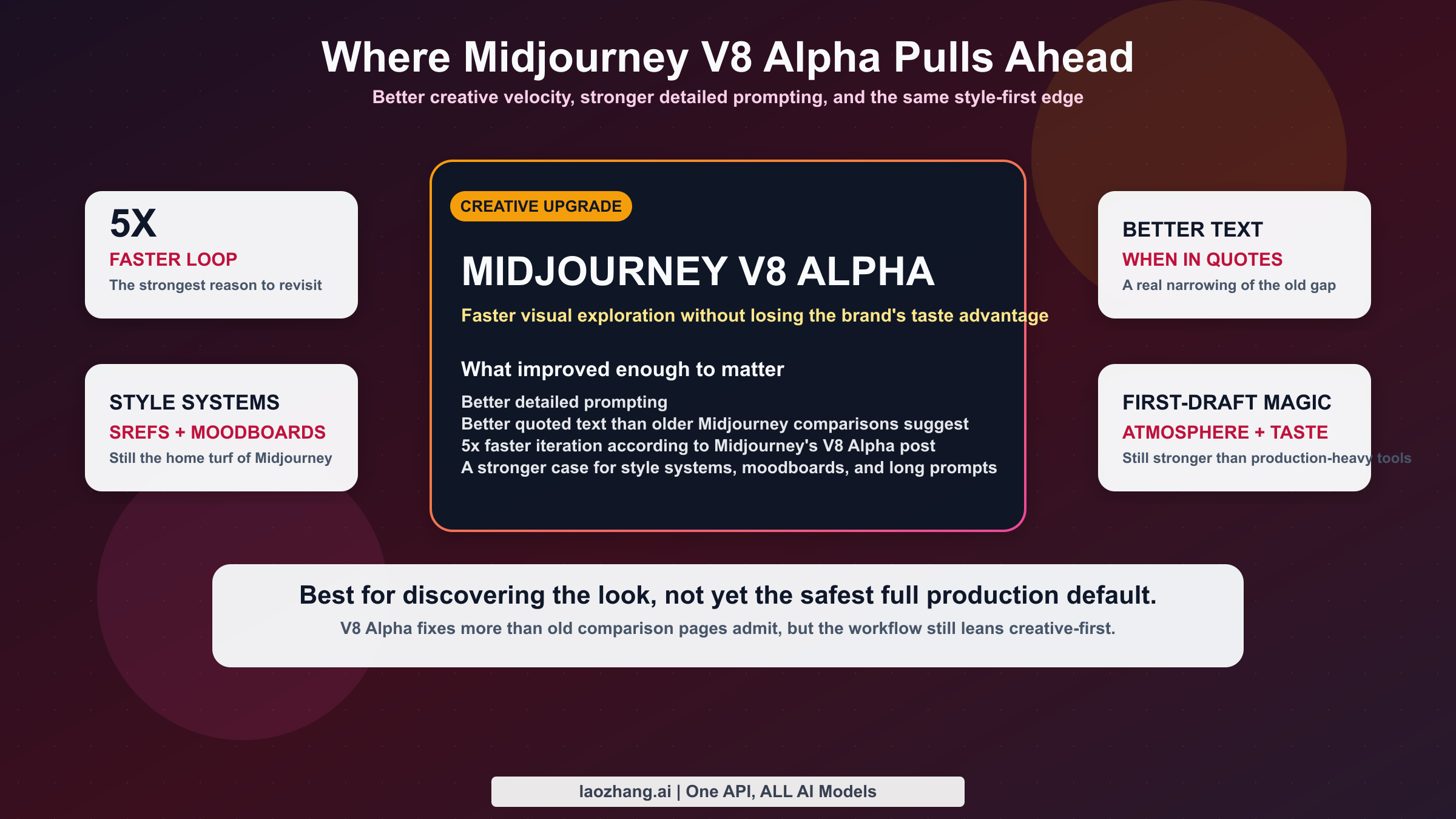
If you have not used Midjourney since the older V7 cycle, the fairest thing to say is that V8 Alpha makes the "Midjourney is all vibes and weak control" caricature harder to defend. Midjourney's own V8 Alpha post says the model is much better at following detailed directions, keeps its personalization, style-reference, and moodboard strengths, and improves text rendering. Combined with the speed claim, that points to a tool that is more operationally usable than many older comparison posts admit.
Where Midjourney still wins most clearly is aesthetic bias. Midjourney still tends to produce the more immediately cinematic, mood-rich, editorial-looking first pass. That advantage matters in concept art, campaign ideation, pitch decks, album art, fantasy scenes, high-drama poster concepts, and any early creative phase where "show me something striking" matters more than "keep this exact layout stable through six revision rounds."
V8 Alpha probably helps Midjourney in one area where Nano Banana Pro gained ground in late 2025: prompt specificity. Midjourney now says longer and more detailed prompting, plus personalization and style systems, are exactly where V8 shines. That means Midjourney is less dependent on happy accidents than it used to be. For a creative director or brand team that already knows how to work with style references and moodboards, this is a real upgrade.
Midjourney also remains easier to love if you think in terms of creative sessions rather than asset pipelines. Some people do not want to meter images one by one or think about whether this concept deserves 4K output. They want to sit in one visual environment, throw prompts around, compare grids, personalize the feed, and chase the image until it feels right. Midjourney remains unusually strong at that. V8 Alpha seems to make that loop faster and more controllable, which is exactly what many power users wanted.
It is also fair to say that Midjourney's text story is no longer a joke. If your only mental model of Midjourney text is broken labels and decorative gibberish, V8 Alpha has changed the argument. It still does not give Midjourney the same overall case as Nano Banana Pro for multilingual posters or product graphics with dense copy. But it probably gives Midjourney a much better chance on simpler text tasks, especially stylized short phrases and title-driven compositions.
So where does that leave the verdict? Midjourney V8 Alpha wins when the image itself is the creative exploration. Nano Banana Pro wins when the image has to become a stable, editable, multilingual business asset. The old split still holds, but V8 makes Midjourney's side stronger than older SERP pages suggest.
Pricing, Privacy, and Access Math
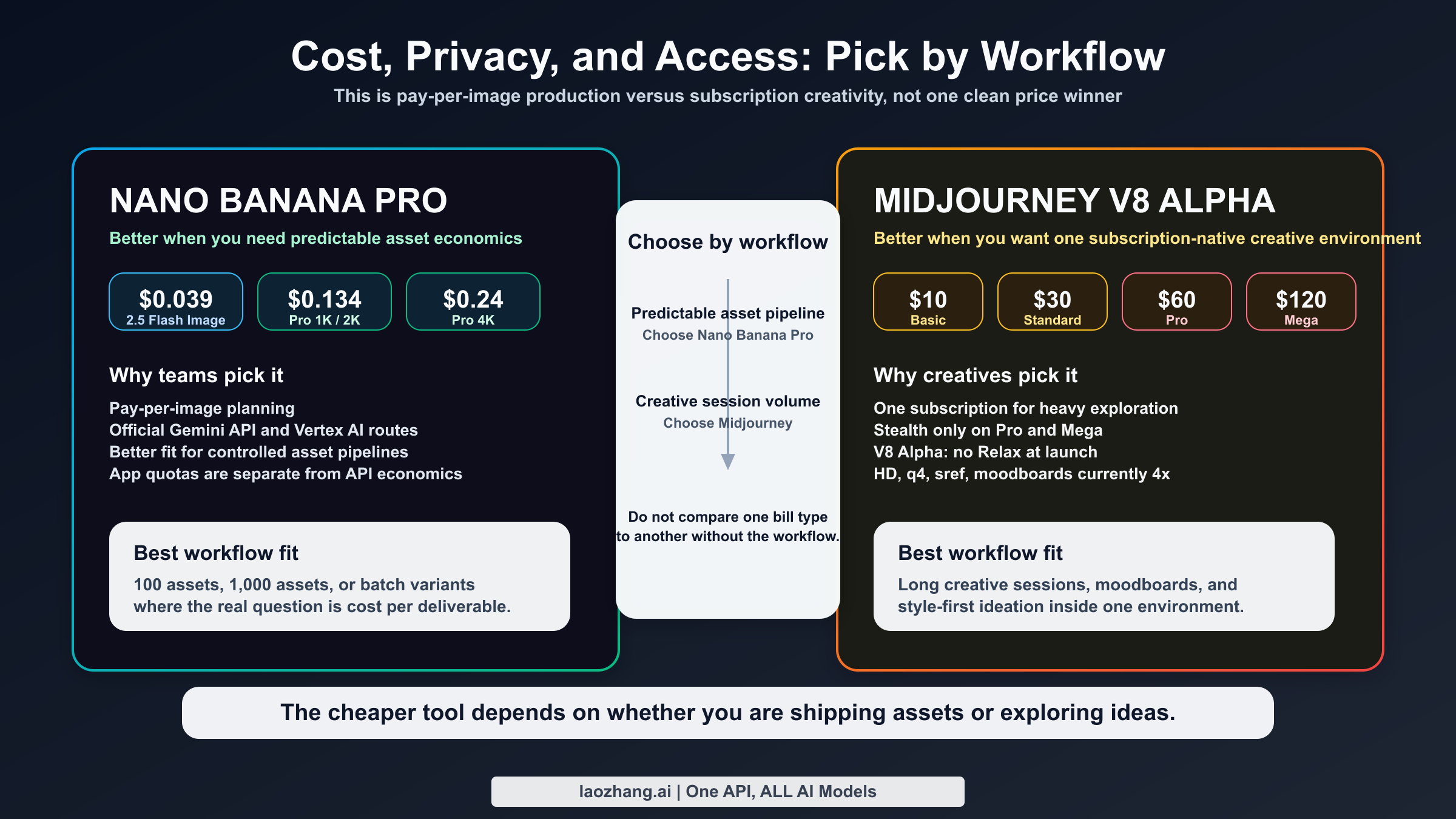
This is where many comparison articles become sloppy. They compare Midjourney's monthly plans against Google's per-image pricing and then declare a winner as if those are interchangeable numbers. They are not. They describe different user behavior.
Google's current pricing page lists Gemini 2.5 Flash Image at $0.039 standard and $0.0195 in Batch. The same page lists Gemini 3 Pro Image Preview, the model behind Nano Banana Pro, at $0.134 for 1K or 2K and $0.24 for 4K, with Batch prices of $0.067 and $0.12. Those numbers are clean. They let a team estimate the cost of 100, 1,000, or 10,000 outputs with reasonable precision.
Midjourney uses a different model. Its official plans page lists Basic $10, Standard $30, Pro $60, and Mega $120 per month. That feels cheaper for people who generate a lot without wanting to think about per-image billing. It feels less clear for teams trying to model cost per asset, cost per campaign, or cost per revision cycle. On top of that, the V8 Alpha launch post adds a temporary wrinkle: some premium V8 options currently cost 4x.
| Decision factor | Nano Banana Pro / Gemini side | Midjourney V8 Alpha side |
|---|---|---|
| Core billing model | Pay per image | Monthly subscription |
| Lowest current official entry point | Gemini 2.5 Flash Image at $0.039 standard | Basic at $10 per month |
| Premium image pricing | Gemini 3 Pro Image Preview at $0.134 for 1K/2K and $0.24 for 4K | Plan-based, not per-image by default |
| Best for budgeting | Forecastable production pipelines | Open-ended creative exploration |
| Privacy default | Better fit for controlled API and enterprise workflows | Open by default unless Stealth is enabled |
| Private creation option | System-level control via API / enterprise routes | Stealth only on Pro and Mega |
| Public API story | Official Gemini API and Vertex AI routes exist | Latest verified first-party API signal is still the July 16, 2025 Enterprise API investigation post |
| App or consumer caveat | Google app experience can differ from API economics and has quota logic | V8 is still alpha, and some premium V8 modes currently cost 4x |
Privacy is another place where the distinction matters. Midjourney's Keeping Your Creations Private page says Midjourney is open by default and that creations can be found on Explore. Stealth exists, but only for Pro and Mega. That is a valid answer if your privacy problem is "I do not want this visible on Midjourney's website." It is a different answer from Google's system-level route, where the question is usually "I need this generation inside an app, workflow, or enterprise environment."
Google also has its own caveat: the consumer app and the API product should not be treated as the same thing. Google's Nano Banana Pro announcement says free-tier users in the Gemini app get limited free quotas and then revert to the original Nano Banana model, while higher tiers get more quota. That is fine if you are mostly comparing app experience. It becomes misleading if you treat it as identical to Gemini API pricing or Vertex AI availability.
That distinction is also why readers keep mixing Nano Banana Pro with Nano Banana 2. The Gemini app surface can move faster than the underlying product story. If you need that naming split unpacked, our Nano Banana 2 vs Nano Banana Pro guide is the cleaner background read.
The practical rule is simple. If your workload is mostly exploratory and you want to create inside one subscription environment, Midjourney feels cleaner. If your workload is mostly repeatable and you need predictable cost per deliverable, Nano Banana Pro is easier to budget and easier to integrate.
Which One to Pick by Use Case
At this point, the smartest answer is not "which is better?" It is "which default will waste less time for my kind of work?"
| User or team | Better default today | Why | When to override |
|---|---|---|---|
| Concept artist or moodboard-heavy creative | Midjourney V8 Alpha | Best fit for style, atmosphere, and exploratory visual sessions | Override to Nano Banana Pro when the final asset needs precise text, editability, or repeatable localization |
| Performance marketer | Nano Banana Pro | Better for ad copy inside images, repeated variants, brand-safe revisions, and multilingual output | Override to Midjourney for hero concepts and campaign direction discovery |
| Ecommerce team | Nano Banana Pro | Stronger for product composites, reference-image consistency, and asset scaling | Override to Midjourney when the job is lifestyle imagery or top-of-funnel visual direction |
| Solo founder | Depends | Midjourney is great for finding the look; Nano Banana Pro is better once the template starts repeating | Pick Midjourney first if you are still exploring, Nano Banana Pro first if you already know the asset format |
| Developer building image features | Nano Banana Pro | Official API access and clearer pricing make it much easier to operationalize | Override only if your product is primarily a Midjourney-adjacent creative experience rather than an image backend |
| Agency handling private client work | Depends | Midjourney Pro or Mega can solve visibility inside Midjourney; Google is stronger for backend or enterprise-style control | The deciding factor is whether privacy means Stealth on web or controlled system integration |
If you need a one-line rule, use this: choose Midjourney V8 Alpha when you want to discover the visual direction, and choose Nano Banana Pro when you need to ship the direction as a dependable asset.
That recommendation is still more useful than a fake single winner because it maps to real behavior. Creative teams often should not fully replace Midjourney at the top of the funnel. But the moment the image becomes a deliverable with copy, revisions, localization, or system-level integration, Nano Banana Pro usually becomes the safer default.
FAQ
Is Midjourney V8 officially out now?
Yes, but only as an alpha right now. Midjourney officially announced V8 Alpha on March 17, 2026, not a finished public V8 release.
Does Midjourney V8 beat Nano Banana Pro now?
Not as a universal default. V8 Alpha improves Midjourney enough to make it more competitive for structured prompting and simple text tasks, but Nano Banana Pro still wins more often for editing, multilingual text-heavy assets, and production workflows.
Is Midjourney V8 better for text now?
It is better than earlier Midjourney comparisons suggest. Midjourney says quoted text works better than ever in V8 Alpha. But Nano Banana Pro is still the stronger pick when text readability is central to the final asset rather than a nice bonus.
Does Nano Banana Pro still have the API advantage?
Yes. Google offers official Gemini API, AI Studio, and Vertex AI routes. Midjourney's latest first-party API signal I could verify is still the July 16, 2025 Enterprise API Survey, so the API gap still matters.
Is Midjourney still open by default?
Yes. Midjourney's privacy docs say creations can be found on Explore by default. Stealth exists, but only for Pro and Mega subscribers.
Which one is actually cheaper in 2026?
It depends on how you work. Midjourney often feels cheaper for heavy creative exploration inside a subscription. Nano Banana Pro is easier to cost-model for production because Google's official pricing is per image and Batch pricing is explicit.
Should I replace Nano Banana Pro with Midjourney V8 Alpha for marketing work?
Usually not as a full replacement. V8 Alpha is more compelling for concepting and visual direction than before, but Nano Banana Pro is still the better default when marketing work requires text, brand consistency, revisions, and localization.
Bottom Line
Midjourney V8 Alpha changes this comparison enough that old V7-era verdicts are now incomplete. Midjourney is faster, more prompt-faithful, and more capable with text than many older articles admit. If your main job is ideation, atmosphere, and aesthetic exploration, V8 Alpha is now a stronger reason to stay in the Midjourney ecosystem.
But the part that matters most for serious buyers has not changed. Nano Banana Pro is still the better default when the image has to survive production. That means text-heavy creative, controlled editing, multilingual output, repeated asset variants, and API-grade workflows. Midjourney V8 Alpha is a meaningful upgrade. It is just not yet a full reversal.
The cleanest recommendation on March 18, 2026 is this: pick Midjourney V8 Alpha to discover the look, and pick Nano Banana Pro to ship the asset.