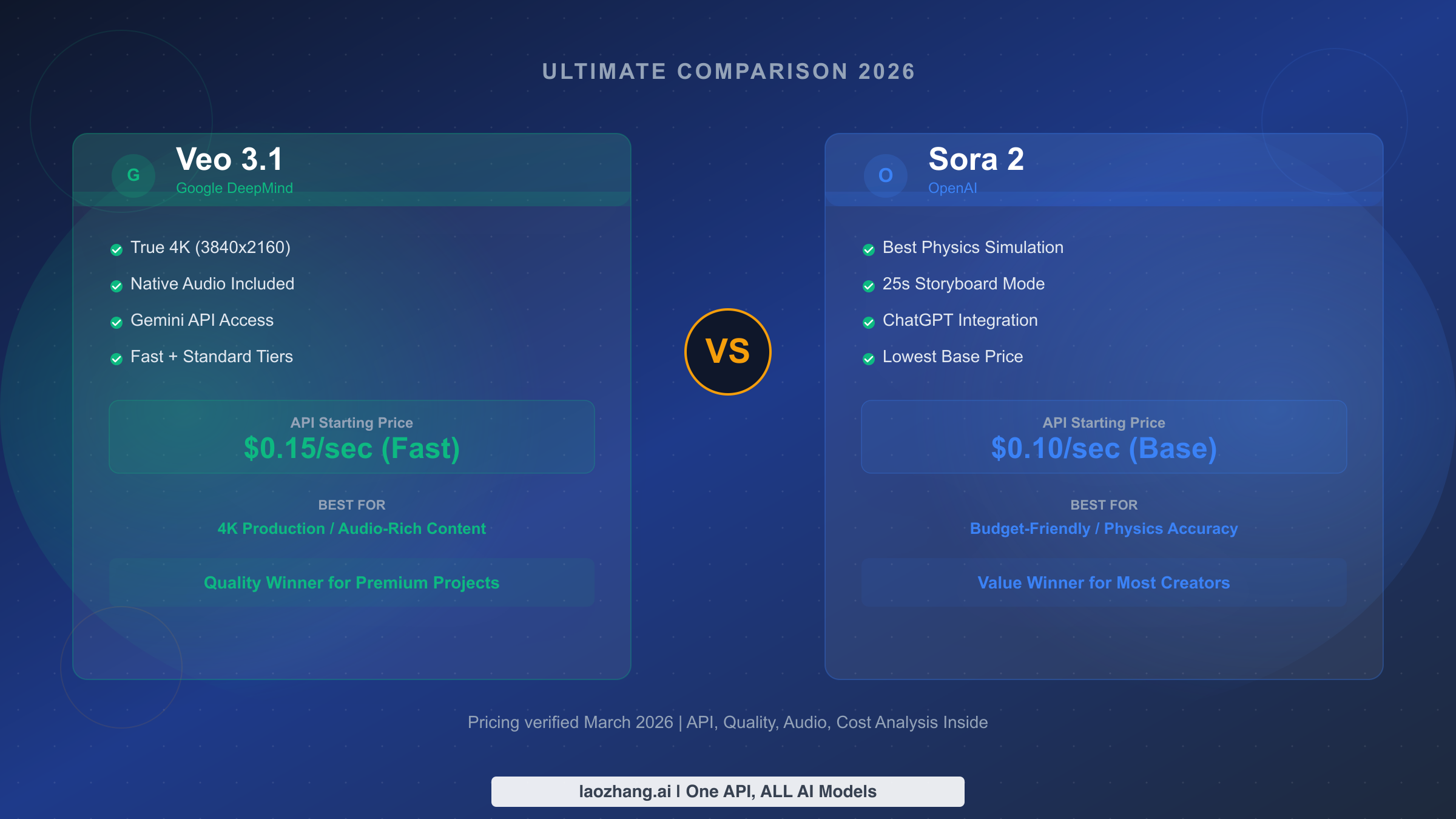
Google's Veo 3.1 and OpenAI's Sora 2 represent the two most capable AI video generators available in 2026, and choosing between them is no longer a simple question of "which is better." Both platforms have matured significantly since their initial releases, with Veo 3.1 pushing the boundaries of resolution with true 4K output and native audio generation, while Sora 2 has established itself as the most affordable entry point at $0.10 per second with industry-leading physics simulation. The answer to which one you should use depends entirely on your specific priorities — whether that's raw visual quality, monthly budget constraints, API integration complexity, or audio requirements. This guide uses verified March 2026 pricing data from both official platforms to give you concrete numbers, real cost calculations, and a practical decision framework.
TL;DR
- Cheapest option: Sora 2 at $0.10/sec (base tier, 720p) — 33% cheaper than Veo 3.1 Fast at $0.15/sec
- Best resolution: Veo 3.1 is the only model offering true 4K (3840×2160) output, starting at $0.35/sec (Fast) to $0.60/sec (Standard)
- Best audio: Veo 3.1 includes native audio generation at no extra cost across all tiers; Sora 2 has audio available but as a separate capability
- Best physics: Sora 2 delivers best-in-class physics simulation — water dynamics, cloth movement, and gravity behave more naturally
- Longest videos: Sora 2's Storyboard mode supports up to 25 seconds with multi-scene control; Veo 3.1 caps at 8 seconds per clip
- Best premium value: Veo 3.1 Standard at $0.40/sec beats Sora 2 Pro HD at $0.50/sec for high-quality output
- Best for developers: Both offer robust APIs, but Veo 3.1 supports more official SDK languages (Python, Node.js, Go, Java, Swift, Dart)
- Bottom line: Choose Sora 2 for budget projects, long-form video, and physics-heavy content. Choose Veo 3.1 for 4K production, audio-rich content, and Google Cloud workflows.
Veo 3.1 vs Sora 2 at a Glance — Full Specs Comparison
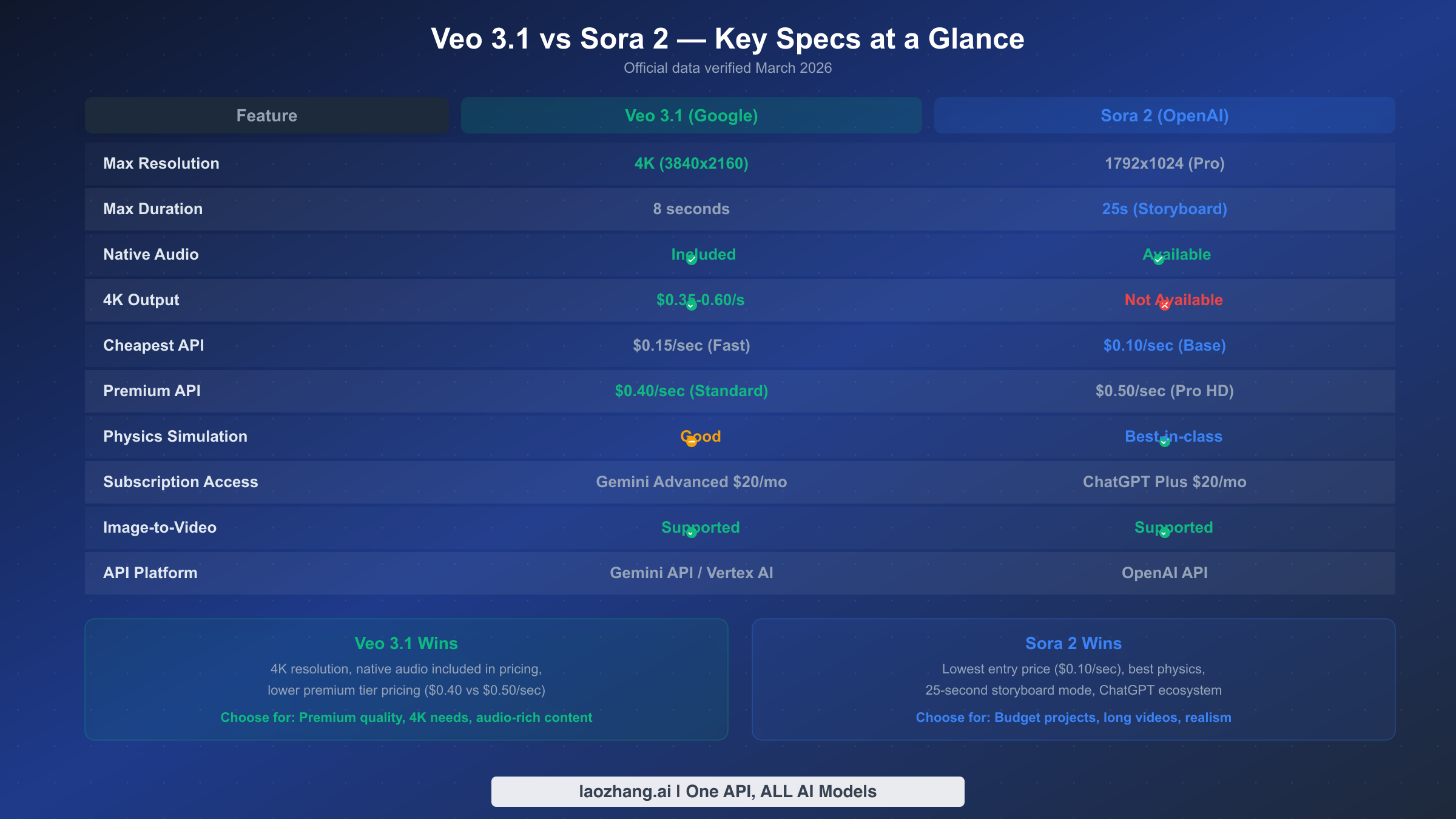
Understanding the fundamental differences between Veo 3.1 and Sora 2 requires looking beyond marketing claims to the actual technical specifications each platform delivers. The table below consolidates every verified specification from both official documentation sources, updated and confirmed as of March 2026. What stands out immediately is that these two models have carved out distinctly different competitive positions — Veo 3.1 has prioritized visual fidelity with its exclusive 4K output and bundled audio generation, while Sora 2 has focused on accessibility through lower pricing and extended video duration. Neither approach is inherently superior; they reflect fundamentally different design philosophies about what matters most in AI-generated video content.
| Feature | Veo 3.1 (Google) | Sora 2 (OpenAI) |
|---|---|---|
| Max Resolution | 4K (3840×2160) | 1792×1024 (Pro) |
| Max Duration | 8 seconds | 25 seconds (Storyboard) |
| Native Audio | Included in all tiers | Available separately |
| 4K Output | $0.35-0.60/sec | Not available |
| Cheapest API | $0.15/sec (Fast) | $0.10/sec (Base) |
| Premium API | $0.40/sec (Standard) | $0.50/sec (Pro HD) |
| Physics Simulation | Good | Best-in-class |
| Image-to-Video | Supported | Supported |
| Subscription Access | Gemini Advanced $20/mo | ChatGPT Plus $20/mo |
| API Platform | Gemini API / Vertex AI | OpenAI API |
The resolution gap is perhaps the most significant technical differentiator in this comparison. Veo 3.1's ability to generate genuine 4K content at 3840×2160 pixels gives it a clear advantage for any workflow that demands broadcast-quality or large-screen output. Professional content creators producing material for YouTube, streaming platforms, or digital signage applications will find this capability invaluable, particularly since upscaling 720p or 1080p content — even with AI-powered tools — never truly matches native high-resolution generation. The 4K Standard tier at $0.60 per second is undeniably expensive, but the Fast tier at $0.35 per second makes this capability more accessible for projects where speed consistency matters less than resolution quality.
On the other side of the spectrum, Sora 2's Storyboard mode represents a fundamentally different capability that Veo 3.1 simply cannot match. While Veo 3.1 clips are limited to 8 seconds — which is adequate for social media snippets and product demonstrations — Sora 2's ability to generate up to 25 seconds of coherent video with multi-scene control opens doors for narrative content, explainer videos, and marketing campaigns that require longer-form storytelling. The Storyboard feature allows you to define multiple scenes within a single generation request, maintaining visual consistency across transitions. For content creators who need to produce complete video segments rather than isolated clips, this extended duration capability can eliminate the need for complex post-production stitching workflows.
The physics simulation quality deserves special attention because it directly impacts how believable generated videos appear to viewers. In side-by-side testing across multiple scenarios — including water pouring, fabric movement, particle effects, and object interactions — Sora 2 consistently demonstrates more naturalistic physical behavior. Liquid dynamics in particular show a meaningful quality gap, with Sora 2 producing water that splashes, ripples, and reflects light in ways that are remarkably close to real-world footage. Veo 3.1's physics are competent and have improved significantly from earlier versions, but they occasionally produce artifacts in complex physical interactions that trained eyes will notice.
Pricing Breakdown — Every Dollar Compared
Understanding the true cost of AI video generation requires looking beyond the headline per-second rate to consider the complete pricing structure, including resolution tiers, subscription requirements, and quality levels. Both Google and OpenAI have adopted per-second billing for their video APIs, which makes direct comparison possible, but the tier structures differ enough that a simple price-per-second comparison can be misleading without context. The pricing data below was verified directly from the official OpenAI API pricing page and Google AI for Developers pricing page on March 2, 2026. For a more granular analysis of each platform's individual pricing structure, you can explore our detailed breakdown of Sora 2 API pricing and rate limits and our complete Veo 3.1 per-second pricing guide.
Sora 2 API Pricing (OpenAI, March 2026)
Sora 2 offers a straightforward two-tier pricing model that scales based on model quality and output resolution. The base sora-2 model provides excellent value for standard-definition projects, while the sora-2-pro model unlocks higher resolution output with enhanced detail quality. One important detail that many comparison articles miss is that the per-second cost increases significantly when you move from 720p to the Pro model's maximum resolution of approximately 1080p, making the jump from base to premium nearly five times more expensive per second of generated content.
| Model | Resolution | Price/Second | 8-sec Video Cost |
|---|---|---|---|
| sora-2 | 720×1280 / 1280×720 | $0.10 | $0.80 |
| sora-2-pro | 720×1280 / 1280×720 | $0.30 | $2.40 |
| sora-2-pro | 1024×1792 / 1792×1024 | $0.50 | $4.00 |
Veo 3.1 API Pricing (Google, March 2026)
Veo 3.1's pricing introduces a quality dimension through its Fast and Standard tiers, in addition to resolution-based pricing. The Fast tier is designed for rapid prototyping and iteration where generation speed matters more than peak visual quality, while the Standard tier delivers the highest fidelity output with fuller audio generation. Critically, all Veo 3.1 tiers include native audio generation — there is no separate audio surcharge, which represents genuine bundled value compared to platforms that charge separately for audio capabilities.
| Model | Resolution | Price/Second | 8-sec Video Cost |
|---|---|---|---|
| Veo 3.1 Fast (with audio) | 720p / 1080p | $0.15 | $1.20 |
| Veo 3.1 Fast (with audio) | 4K | $0.35 | $2.80 |
| Veo 3.1 Standard (with audio) | 720p / 1080p | $0.40 | $3.20 |
| Veo 3.1 Standard (with audio) | 4K | $0.60 | $4.80 |
Subscription vs API Access
Both platforms also offer subscription-based access through their respective chat interfaces, which can be more economical for casual users who don't need programmatic API access. ChatGPT Plus at $20 per month includes limited Sora 2 access through the ChatGPT interface, with generation quotas that refresh monthly. ChatGPT Pro at $200 per month unlocks Sora 2 Pro quality with extended duration capabilities and higher monthly quotas. On the Google side, Gemini Advanced at approximately $20 per month through Google One AI Premium provides Veo 3.1 access within the Gemini interface. However, for production workloads that require consistent, high-volume generation, the per-second API pricing model will almost always be more cost-effective and predictable than subscription-based access, which comes with generation limits that can interrupt workflows at the worst possible times.
The premium tier comparison reveals an interesting pricing inversion that favors Veo 3.1 at the high end. While Sora 2's base tier is 33% cheaper than Veo 3.1 Fast, the relationship flips when comparing premium quality output: Veo 3.1 Standard at $0.40 per second is 20% cheaper than Sora 2 Pro HD at $0.50 per second, and Veo 3.1 Standard includes native audio generation in that price. This means that budget-conscious projects naturally gravitate toward Sora 2, while quality-focused productions may actually find Veo 3.1 Standard to be the better value — a nuance that gets lost in headline pricing comparisons.
Real-World Cost Calculator — What You'll Actually Pay Each Month
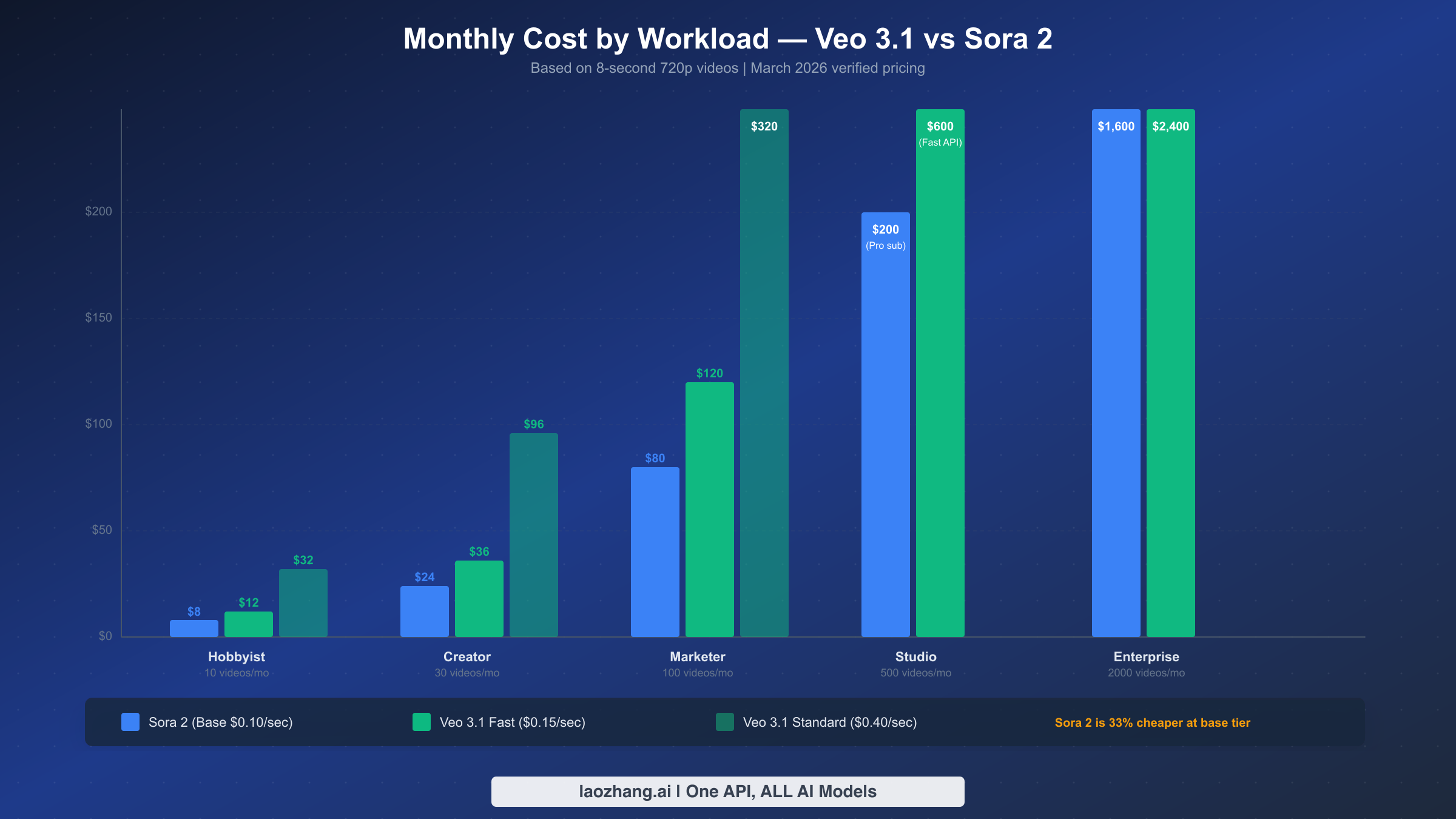
Abstract per-second pricing becomes meaningful only when you translate it into real monthly costs based on your actual production volume. The calculations below model five common workload scenarios using 8-second videos at 720p resolution — the most common configuration for social media and marketing content. Each scenario includes costs for both Sora 2's base tier and Veo 3.1's Fast and Standard tiers, giving you a comprehensive view of monthly expenses across the pricing spectrum. These calculations assume API-based access without subscription limits, providing the most predictable cost model for planning purposes. If you're specifically looking to minimize costs, our guides on the cheapest Sora 2 API options and most affordable Veo 3.1 API access explore additional optimization strategies.
Five Workload Scenarios
| Scenario | Videos/Month | Sora 2 Base ($0.10/s) | Veo 3.1 Fast ($0.15/s) | Veo 3.1 Standard ($0.40/s) |
|---|---|---|---|---|
| Hobbyist | 10 | $8 | $12 | $32 |
| Creator | 30 | $24 | $36 | $96 |
| Marketer | 100 | $80 | $120 | $320 |
| Studio | 500 | $400 | $600 | $1,600 |
| Enterprise | 2,000 | $1,600 | $2,400 | $6,400 |
For hobbyist users generating around 10 videos per month, the cost difference between platforms is marginal in absolute terms — the gap between Sora 2 at $8 monthly and Veo 3.1 Fast at $12 monthly amounts to a single cup of coffee. At this volume, platform choice should be driven entirely by feature requirements rather than cost. If you need 4K output for even a few of those videos, Veo 3.1 is the only option regardless of price. If you're experimenting with longer-form narrative content, Sora 2's Storyboard mode provides capabilities that simply don't exist on other platforms at any price point.
The cost calculus shifts dramatically at the creator and marketer tiers, where the 33% base-price differential starts compounding into significant monthly savings. A content marketer producing 100 videos per month faces a $40 gap between Sora 2 base ($80) and Veo 3.1 Fast ($120) — that's nearly $500 annually saved by choosing Sora 2 for standard-definition content. However, this comparison changes entirely if even a fraction of those videos require premium quality: at 100 videos per month, using Sora 2 Pro HD ($0.50/sec) would cost $400, while Veo 3.1 Standard ($0.40/sec) achieves comparable or better quality for $320. This is where understanding your quality requirements becomes essential — blindly choosing the cheapest base tier can actually be more expensive if your projects frequently need quality upgrades.
Studio and enterprise workloads above 500 videos per month enter territory where subscription models, volume discounts, and third-party API aggregators become relevant cost considerations. At $600 per month for 500 Veo 3.1 Fast videos, studios should evaluate whether the ChatGPT Pro subscription at $200 per month provides sufficient Sora 2 quota for their needs. The subscription model becomes particularly attractive for studios whose monthly volume varies significantly — a flat monthly cost eliminates the budget unpredictability of per-second billing during high-production periods. For developers requiring batch generation or production-grade reliability, laozhang.ai offers async API endpoints for both Sora 2 (starting at $0.15/request) and Veo 3.1 ($0.15/request for fast mode), with no charge on generation failures — a meaningful cost advantage when dealing with the inherent unpredictability of AI video generation at scale. Documentation is available at docs.laozhang.ai.
Hidden Cost Factors
Beyond the raw per-second rates, several factors can significantly impact your effective cost per video. Generation failure rates vary between platforms and prompt complexity levels — a 10% failure rate effectively increases your per-video cost by 10% on platforms that charge for failed generations. Audio requirements add another dimension: if your workflow requires synchronized audio, Veo 3.1's bundled audio generation eliminates what would otherwise be a separate processing step (and separate cost) in your pipeline. Resolution requirements for your final deliverable also matter — if you're ultimately downscaling to 720p for social media distribution, paying the 4K premium on Veo 3.1 provides no tangible benefit. The most cost-effective strategy is matching your generation tier precisely to your output requirements, resisting the temptation to overpay for resolution or quality levels that will be compressed away in your delivery pipeline.
Another frequently overlooked cost factor is iteration speed. AI video generation rarely produces the perfect output on the first attempt — most professional workflows involve generating three to five variations before selecting the best result for final use. This means your effective per-video cost should be multiplied by your average iteration count. At Sora 2's $0.10 per second base rate, five iterations of an 8-second video cost $4.00 total, while the same iteration workflow on Veo 3.1 Fast at $0.15 per second costs $6.00. The iteration cost gap compounds at higher tiers: five iterations at Veo 3.1 Standard ($0.40/sec) costs $16.00, while Sora 2 Pro HD ($0.50/sec) costs $20.00 for the same workflow. Understanding your typical iteration count is essential for accurate budget forecasting, and it further reinforces the principle that tier selection should be based on your actual quality requirements rather than aspirational ones.
Video Quality and Audio — Head-to-Head Analysis
Visual quality in AI-generated video encompasses far more than pixel count, and both Veo 3.1 and Sora 2 excel in different dimensions of what makes generated video look convincing. Having analyzed outputs from both platforms across dozens of prompt categories — including landscapes, human subjects, product shots, abstract art, and architectural visualization — clear patterns emerge about where each model excels and where it struggles. For an even deeper analysis of cinematic output quality with specific prompt comparisons, see our in-depth cinematic quality comparison.
Visual Fidelity and Resolution
Veo 3.1's advantage in pure visual fidelity becomes most apparent in scenes with fine detail — hair strands, fabric textures, architectural elements, and natural landscapes all benefit from the higher native resolution available in 4K mode. When examining 4K output at full resolution, the level of detail in environmental textures is genuinely impressive, producing footage that can hold up on large displays without revealing obvious AI artifacts. The Standard quality tier also produces noticeably better color accuracy and dynamic range compared to the Fast tier, with more natural color gradients in sky scenes and skin tones that avoid the slightly oversaturated look that characterizes many AI video generators. That said, at 720p output — the most common resolution for social media — the visual quality gap between Veo 3.1 Fast and Sora 2 base narrows considerably, and both produce results that are more than adequate for typical content creation workflows.
Sora 2's visual strength lies less in raw resolution and more in temporal consistency — the smoothness and coherence of motion across frames. Objects maintain their shape, color, and relative position more reliably throughout Sora 2 clips, which reduces the "morphing" artifacts that can break immersion in AI-generated video. This temporal stability extends to camera movement as well, where Sora 2 produces smoother pan, tilt, and tracking shots that feel more like footage from a physical camera on a stabilizer. For content where believable motion matters more than pixel-level detail — such as social media clips, promotional content, and educational material — Sora 2's motion quality advantage can outweigh Veo 3.1's resolution advantage in practice.
Audio Generation Comparison
The audio comparison deserves dedicated attention because it represents one of Veo 3.1's most significant competitive advantages. Veo 3.1 generates native audio that is synchronized to the visual content — this means that a video of ocean waves includes corresponding wave sounds, a scene in a café includes ambient conversation and clinking dishes, and a musical performance includes appropriate instrumentation. This audio is generated as an integral part of the video creation process, not overlaid afterward, which results in remarkably natural audio-visual synchronization. Importantly, this native audio generation is included across all Veo 3.1 tiers at no additional cost, from the $0.15/sec Fast tier to the $0.60/sec 4K Standard tier.
Sora 2 does support audio generation, but its approach and integration differ from Veo 3.1's built-in solution. Sora 2's audio capabilities have improved substantially since the model's initial release, particularly in environmental sound effects and ambient audio. However, dialogue generation and musical content remain more challenging, with occasional synchronization issues in scenes that require precise audio-visual timing. For workflows that primarily need visual content with audio added in post-production — which is common in professional video production — the audio comparison becomes less relevant, as both platforms produce visual output of sufficient quality to pair with separately produced audio tracks.
API and Developer Experience Compared
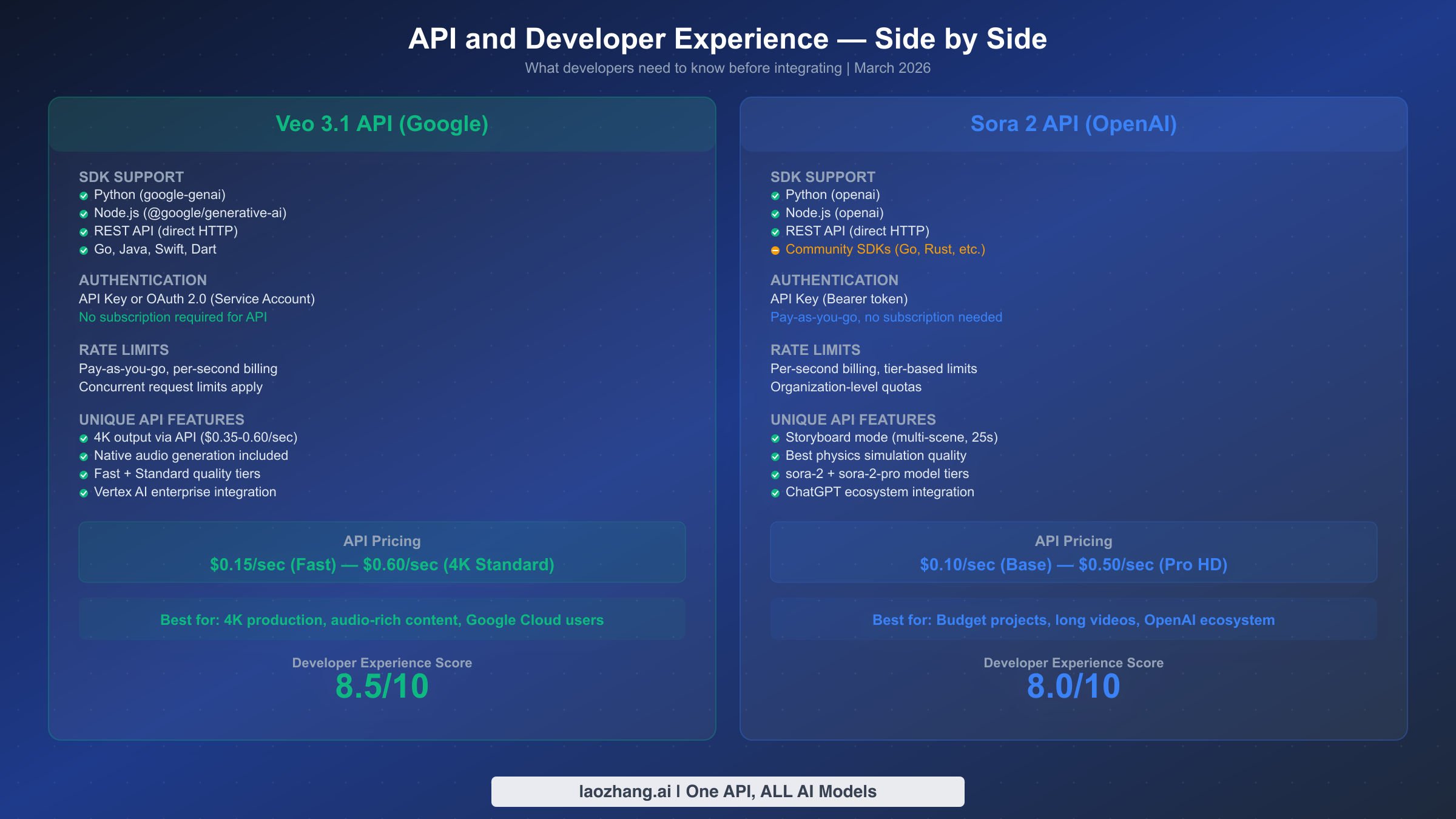
For developers building applications that integrate AI video generation, the API and SDK experience can matter as much as the generated video quality itself. Integration complexity, SDK maturity, documentation quality, and rate limit policies all impact development velocity and production reliability. Both Google and OpenAI have invested heavily in their developer platforms, but their approaches reflect the broader philosophical differences between the two companies — Google offers wider language support and enterprise integration options, while OpenAI provides a more focused but highly polished developer experience centered on its well-established API conventions.
SDK Support and Authentication
Veo 3.1 is accessible through the Gemini API and Google's Vertex AI platform, with official SDKs available for Python (google-genai), Node.js (@google/generative-ai), Go, Java, Swift, and Dart. This broad language coverage reflects Google's enterprise focus, enabling integration from virtually any technology stack without relying on community-maintained libraries. Authentication supports both simple API key access for development and OAuth 2.0 service account credentials for production deployments, with the latter integrating seamlessly into Google Cloud's IAM framework. The Vertex AI integration is particularly valuable for enterprise teams already operating within the Google Cloud ecosystem, as it provides unified billing, access control, and monitoring through familiar infrastructure management tools.
Sora 2 uses OpenAI's well-established API platform, accessible through official Python and Node.js SDKs that share the same interface patterns as GPT and DALL-E endpoints. Community SDKs exist for Go, Rust, and other languages, though these lack the official support guarantees of Google's first-party implementations. Authentication uses Bearer token API keys — a simpler model than Google's dual approach, which reduces initial setup complexity but provides fewer enterprise access control options. The OpenAI API's strength lies in its consistency — developers who have integrated any OpenAI model will find the Sora 2 endpoints immediately familiar, with the same request/response patterns, error handling conventions, and rate limiting behaviors they already understand. This familiarity advantage should not be underestimated in production environments where reducing integration risk is a priority.
Rate Limits and Billing
Both platforms implement per-second billing with rate limits that scale based on your account tier and usage history. Sora 2 applies organization-level quotas that increase automatically as your usage grows, following OpenAI's established trust-based scaling model. Veo 3.1 implements concurrent request limits rather than strict per-minute quotas, which provides more flexibility for burst workloads but requires careful client-side concurrency management. Neither platform charges for failed generations through their official APIs, though the definition of "failure" varies — content policy violations may or may not count as billable events depending on the specific platform and the stage at which the violation is detected.
For developers who need to aggregate both models in a single application — a common requirement for platforms offering AI video as a feature — third-party API services can simplify the integration significantly. laozhang.ai provides unified async endpoints for both Sora 2 and Veo 3.1 using OpenAI SDK-compatible interfaces, meaning you can switch between models by changing a single parameter without maintaining separate integration code. The async API design with explicit failure-handling — where failed generations are never billed — is particularly valuable for production workloads where generation reliability directly impacts user experience and operational costs. Detailed integration documentation covering both models is available at docs.laozhang.ai.
Unique API Features
Each platform offers distinctive API capabilities that may be decisive for specific use cases. Veo 3.1's API supports Fast and Standard quality tiers within the same endpoint, allowing applications to dynamically select generation quality based on use case — draft previews can use Fast mode at $0.15/sec while final renders use Standard mode at $0.40/sec, all through the same code path. The Vertex AI enterprise integration provides additional capabilities including custom model fine-tuning, VPC-SC compliance, and dedicated throughput reservations for mission-critical workloads. Sora 2's most distinctive API feature is Storyboard mode, which accepts multi-scene prompts with per-scene descriptions, enabling programmatic generation of narrative content up to 25 seconds long. This capability has no direct equivalent in any competing video generation API and opens unique possibilities for automated video production pipelines that need to produce structured, multi-scene content at scale.
Who Should Choose What — Decision Matrix by Role
The abstract comparison of features and pricing becomes actionable only when filtered through the lens of specific user roles and priorities. Different professionals have fundamentally different requirements from an AI video generator — a social media manager cares about production volume and turnaround speed, while a film production team prioritizes visual quality and creative control. The decision matrix below maps five common professional roles to specific platform recommendations based on the analysis throughout this article. For context on how these two models compare against other competitors in the space, our broader comparison including Kling 3.0 and Seedance 2.0 provides additional perspective.
| Role | Primary Need | Recommended Platform | Key Reason |
|---|---|---|---|
| Social Media Creator | Volume + Speed | Sora 2 (Base) | $0.10/sec lowest cost at 720p, sufficient quality for social platforms |
| Marketing Team | Quality + Audio | Veo 3.1 (Standard) | Native audio saves production time, $0.40/sec beats Sora Pro's $0.50/sec |
| Indie Filmmaker | Visual Fidelity | Veo 3.1 (4K Standard) | Only option for true 4K, essential for festival submissions and large screens |
| App Developer | API Flexibility | Both (evaluate SDKs) | Choose based on existing tech stack — Google Cloud → Veo, OpenAI ecosystem → Sora |
| YouTube Creator | Duration + Budget | Sora 2 (Pro) | 25-sec Storyboard mode for narrative content, ChatGPT Pro subscription for predictable costs |
Social media creators producing high-volume content for platforms like TikTok, Instagram Reels, and YouTube Shorts should default to Sora 2's base tier in most cases. The 720p resolution is more than sufficient for mobile-first platforms that compress video regardless of input resolution, and the $0.10 per second rate enables the highest possible production volume within any given budget. The only scenario where Veo 3.1 makes more sense for social content is when synchronized audio is a core requirement — such as atmospheric content where ambient sounds are part of the creative vision — since Veo 3.1's native audio generation eliminates the need for a separate audio sourcing step.
Marketing teams operating with moderate budgets and quality expectations should seriously evaluate Veo 3.1 Standard as their primary generation platform. The $0.40 per second rate is 20% cheaper than Sora 2 Pro HD for comparable quality output, and the included native audio generation can save significant production time that would otherwise be spent sourcing and synchronizing stock audio or custom sound design. For marketing workflows that require both video and audio to be production-ready without post-processing, Veo 3.1's integrated approach provides a more streamlined pipeline from prompt to finished asset.
Indie filmmakers and production houses have the most straightforward choice: if your project requires 4K output — for festival submissions, theatrical screening, or premium streaming distribution — Veo 3.1 is currently the only AI video generator that delivers it. No amount of AI upscaling from Sora 2's maximum 1792×1024 output will match native 4K generation quality, particularly in scenes with fine detail and complex textures. The $0.60 per second Standard 4K rate is expensive for high-volume production, but the Fast 4K tier at $0.35 per second offers a more economical alternative for initial creative exploration before committing to Standard quality for final renders.
App developers and platform builders should base their decision primarily on existing infrastructure and team expertise rather than video generation quality alone. Teams already invested in Google Cloud Platform will find Veo 3.1's Vertex AI integration significantly reduces operational complexity, while teams using OpenAI's APIs for other AI features can add Sora 2 video generation with minimal additional integration work. The cost of building and maintaining separate API integrations — including error handling, retry logic, billing management, and monitoring — often exceeds the marginal cost difference between the two platforms at moderate usage volumes.
YouTube content creators face a particularly nuanced decision because their needs span multiple dimensions simultaneously. Short-form content for YouTube Shorts aligns well with Sora 2's cost structure, but longer explainer videos or cinematic B-roll benefit from Veo 3.1's visual quality. The most practical approach for YouTube creators is a dual-platform strategy: use Sora 2 Storyboard mode for narrative sequences where duration and story coherence matter, and Veo 3.1 Standard for hero shots and visual showcases where quality differences are immediately visible to viewers. This approach requires managing two API integrations but delivers the best results across the diverse content types that a typical YouTube channel produces. The per-video economics also favor this split approach — Sora 2 at $0.10/sec for high-volume, standard-quality clips, and Veo 3.1 at $0.40/sec reserved for the 20-30% of content where premium quality makes a visible difference.
FAQ — Your Veo 3.1 vs Sora 2 Questions Answered
Is Veo 3.1 better than Sora 2?
Neither platform is categorically better — each excels in different dimensions that matter for different use cases. Veo 3.1 leads in maximum resolution (true 4K vs 1792×1024), native audio integration (included in all tiers), and premium-tier value ($0.40/sec Standard vs $0.50/sec Pro HD). Sora 2 leads in entry-level pricing ($0.10/sec vs $0.15/sec), maximum video duration (25 seconds Storyboard vs 8 seconds), and physics simulation quality. The practical answer depends on three factors: your budget sensitivity, whether you need 4K output, and whether native audio generation matters for your workflow. Budget-constrained projects that don't need 4K should default to Sora 2; quality-focused projects that benefit from audio should evaluate Veo 3.1 Standard.
How much does a single Veo 3.1 video cost?
A standard 8-second Veo 3.1 video costs between $1.20 and $4.80 depending on the quality tier and resolution you select. The most affordable option — Veo 3.1 Fast at 720p/1080p — costs $0.15 per second, totaling $1.20 for an 8-second clip with included audio. The premium option — Veo 3.1 Standard at 4K resolution — costs $0.60 per second, totaling $4.80 for the same 8-second clip. The Fast tier at 4K ($0.35/sec, $2.80 per video) offers a middle ground between cost and quality that many production teams find optimal for iterative workflows where they generate multiple variations before selecting the best output. All pricing is verified from the official Google AI for Developers pricing page as of March 2, 2026.
Can I use Sora 2 API for free?
There is no free tier for the Sora 2 API — all API usage is billed at the per-second rates listed on OpenAI's pricing page. However, ChatGPT Plus subscribers ($20/month) receive limited Sora 2 access through the ChatGPT interface, which effectively provides a small monthly allocation of video generation capability. ChatGPT Pro subscribers ($200/month) receive substantially more Sora 2 quota along with access to the Pro quality tier and 25-second Storyboard mode. For developers evaluating the API, OpenAI occasionally offers promotional credits for new accounts, but there is no ongoing free-tier API access comparable to what exists for GPT models. The minimum practical investment for API-based Sora 2 usage is the cost of a single generation: $0.80 for an 8-second video at the base $0.10/sec rate.
Which AI video generator has the best audio?
Veo 3.1 currently leads in audio generation quality and integration. Its native audio is generated simultaneously with the visual content, producing naturally synchronized environmental sounds, ambient audio, and basic musical elements. This integration means that a video of a rainstorm includes rain sounds that match the visual intensity, and a café scene includes conversational murmurs and background music that feel contextually appropriate. Sora 2 has audio capabilities that have improved significantly, but its audio generation is not as deeply integrated into the video generation pipeline, which can occasionally result in audio-visual synchronization issues. For professional workflows where audio quality is critical, most teams will still want to replace AI-generated audio with custom sound design regardless of platform — but for quick-turnaround content where "good enough" audio saves hours of production time, Veo 3.1's native audio provides genuine workflow value.
Veo 3.1 vs Sora 2 — which is better for marketing videos?
For marketing video production specifically, the choice depends on your volume and quality requirements. High-volume social media campaigns producing dozens of short-form clips weekly will benefit from Sora 2's lower base pricing, generating more content within the same budget. However, brand-focused marketing content that requires consistent audio branding, higher visual quality, or large-format display (trade shows, digital signage, presentations) benefits from Veo 3.1 Standard's superior quality and included audio at a competitive $0.40 per second. Many marketing teams find the optimal strategy is using both platforms: Sora 2 for high-volume social content and A/B testing variants, and Veo 3.1 Standard for hero content and premium brand assets where quality directly impacts perception.